

Guías para coleccionistas
Toy Dirt Bikes: Scale, Play Use and Collector Models
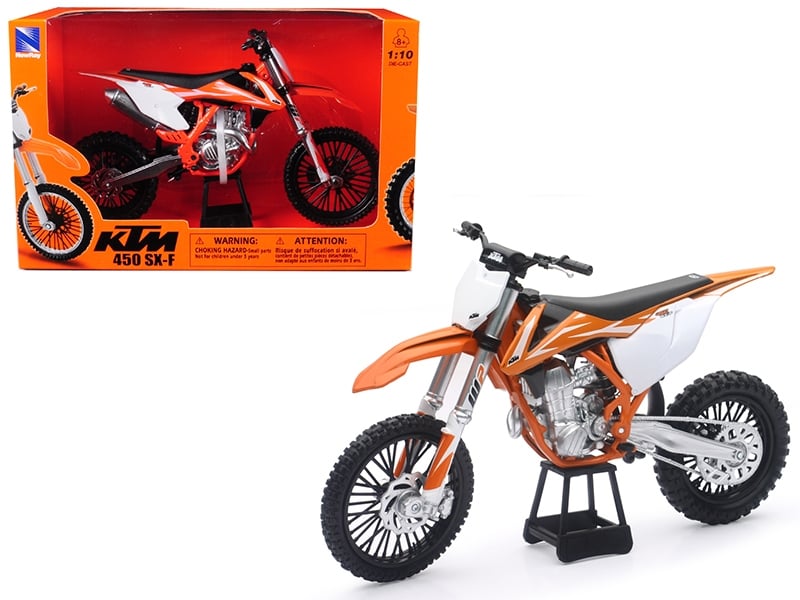
Toy dirt bikes range from small play pieces to large-scale diecast display motorcycles. The phrase does not tell you the scale, age guidance, moving parts or intended use. Start by deciding whether the bike is for active play, a desk or shelf, a motorcycle collection or a scale diorama.
Muncle Mikes currently carries examples as different as a New Ray KTM 450 SX-F in 1:10, a New Ray Honda CRF450R in 1:6 and a small loose Hot Wheels 450F dirt bike. Those are not interchangeable products.
Choose play model or collector display model
| Product type | What to expect | What to verify |
|---|---|---|
| Small loose toy bike | Compact handling and play or collection use | Age label, scale wording, wheels, rider figure and condition. |
| 1:10 diecast motorcycle | Larger display presence with visible graphics and components | Exact bike, scale, stand, moving parts and package. |
| 1:6 display motorcycle | Very large shelf footprint and more visible detail | Completed dimensions, support stand and intended handling. |
| Licensed race replica | Team, rider or manufacturer decoration | Model year, graphics, number and exact item code. |
Scale controls the space, not the quality
A 1:6 Honda CRF450R can dominate a shelf, while a 1:10 KTM 450 SX-F is smaller but still far larger than a Hot Wheels dirt bike. Measure the display area and leave room for handlebars, foot pegs and a stand.
For a diorama, match the bike with figures, vehicles and scenery in the same or visually compatible scale. A 1:6 bike beside 1:64 trucks will not create a realistic scene.
Read the age guidance and small-parts information
A detailed diecast model can have small mirrors, controls, brake parts or stand components. Follow the age label and intended-use statement on the exact product. “Toy” in a search query does not mean every result is designed for rough play or young children.
For active play, prioritize secure parts, smooth wheel movement and a design intended for handling. For display, prioritize accurate graphics, stable support and package condition.
Identify the exact motorcycle
Record the manufacturer, model, color, scale and item number. “Red Honda dirt bike” is not enough when several CRF versions and scales exist. Current MM examples include the Honda CRF450R item 49583 and KTM 450 SX-F item 57943.
For loose Hot Wheels bikes, use the casting name, color, graphics and base markings. The Hot Wheels identification guide provides a repeatable release-matching method.
Inspect wheels, steering and stands without forcing them
Move only the parts the exact product is designed to move. A handlebar can look functional while being fixed or fragile. Check whether a display stand is included and keep it with the item number.
For packaged models, inspect the handlebars, forks and exhaust through the window. For loose models, look for bent axles, missing stands, paint rub and stress around the steering head.
Shop current dirt-bike models
Search current dirt bike models, browse Honda diecast motorcycles, Yamaha motorcycle models and KTM models.
Clean and store the bike for its intended use
Dust display models with a soft brush while supporting the frame, not the handlebars or exhaust. Avoid household cleaners unless the manufacturer says they are safe for the paint, plastic and rubber. Store loose play bikes in a divided container so axles, handlebars and stands are not crushed under heavier vehicles.
Keep the package and item number for licensed replicas. Graphics and model-year details are much easier to verify when the original label remains with the bike.
Frequently asked questions
Are toy dirt bikes all the same scale?
No. Current examples range from small loose toys to 1:10 and 1:6 display models. Confirm the exact scale.
Is a large diecast dirt bike suitable for rough play?
Not automatically. Follow the product's age guidance and intended-use information; detailed models can have fragile small parts.
What should I record for a motorcycle model?
Keep the manufacturer, bike model, scale, color or livery, item number, package and condition.
Do the handlebars and suspension move?
Features vary. Move only parts identified as functional for the exact product, and never force a detailed component.

