

Guías de Coches de Slot
HO Scale Slot Cars: Size, Wheelbase and Display Guide
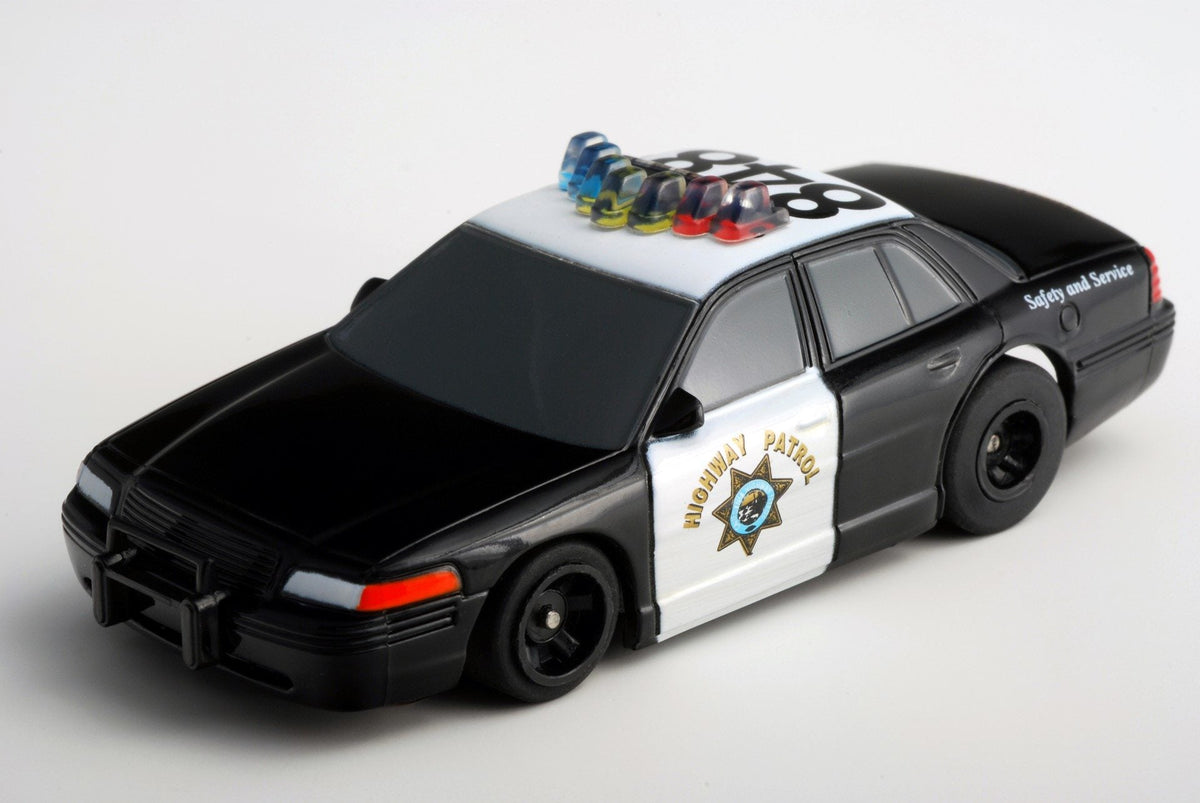
HO scale slot cars are a compact racing category, but the HO name does not guarantee that every car is a mathematically exact 1:87 replica. Slot-car bodies are shaped around working chassis, motors, pickup systems and track geometry, so actual length, width, wheelbase and proportions matter more than the label alone.
Use the category name to find the system, then use measurements to decide whether a car fits the layout, storage case or diorama. This article focuses on physical scale and footprint. Track, controller and electrical compatibility belong to the companion HO slot-car setup guide.
Treat HO as a category before treating it as a ratio
Model railroading normally uses HO to mean 1:87.1, but slot-car manufacturers have historically used HO for a compact class that can vary in body proportion. A car may be shortened, widened or raised to clear the chassis and remain durable at racing speed.
That does not make the model unusable. It means the buyer should ask a better question: what are the actual body dimensions and wheelbase, and do they fit the intended scene or track clearance?
| Measurement | What it tells you | Why the HO label is insufficient |
|---|---|---|
| Overall length | Storage and straight-line footprint | Different vehicle bodies and chassis vary |
| Body width | Lane, guardrail and scenery clearance | Racing bodies can be wider than scale math |
| Wheelbase | Chassis/body relationship | Short and long chassis can share one system |
| Body height | Bridge and tunnel clearance | Rooflines and mounts vary |
| Chassis overhang | Clearance at nose and tail | The body does not show every working part |
Use wheelbase to understand the chassis family
The AFX Highway Patrol #848 Ford Crown Victoria 21034 uses a Mega G+ short-wheelbase chassis listed at 1.5 inches. The wheelbase is a chassis identity field, not a claim that the body is a precise scale replica of every dimension of the full-size Crown Victoria.
The AFX 1970 Chevrolet Camaro SS350 22002 uses the Mega G+ long-wheelbase platform listed at 1.7 inches. Comparing 1.5 and 1.7 inches shows why two cars in the same HO system can have different footprints and replacement-part needs.
Estimate display scale from the actual vehicle
To estimate an effective length scale, divide the real vehicle’s length by the model body’s measured length using the same units. Treat the result as an approximation because slot-car bodies can alter width, height or wheelbase independently.
A single ratio cannot prove complete dimensional fidelity. A car might look convincing beside HO scenery while its width is enlarged for track stability. Photograph it beside a ruler and record the actual dimensions for future layout planning.
- Measure the model: length, width, height and axle-to-axle wheelbase.
- Find a reliable full-size dimension: use the correct vehicle generation.
- Calculate cautiously: treat length scale as an estimate, not a universal ratio.
- Test the scene: compare road width, figures, buildings and nearby vehicles.
- Record the result: keep measured dimensions with the manufacturer item number.
Plan road, bridge and scenery clearance
A display road must leave room for mirrors, body roll and the visual shoulder around the car. On an operating layout, guardrails, bridge supports and scenery should clear the widest and tallest cars that will run—not just the first car used during construction.
- Road width: allow visual margin beyond the body.
- Curves: account for front and rear swing.
- Bridges: test the tallest roof and any roof equipment.
- Barriers: leave space for body width and guide behavior.
- Storage: support the chassis without crushing pickup parts.
Keep the body and rolling chassis as separate identities
A replacement such as the AFX Mega G+ short 1.5-inch rolling chassis 21029 is not a complete car. A body can fit one wheelbase and not another, even within the same brand. Catalog body, chassis family and wheelbase as separate fields.
This separation also prevents a scale mistake. The body represents a vehicle; the chassis provides the working footprint. Both influence how the car appears and operates.
Use the right article for the right question
| Question | Use this scale guide | Use the HO setup guide |
|---|---|---|
| Will it look right beside scenery? | Yes | Secondary |
| What is the actual wheelbase? | Yes | Also relevant |
| Will it run on my track? | Secondary | Yes |
| Which controller or power system? | No | Yes |
| How much bridge clearance is needed? | Yes | Yes for operating clearance |
Browse AFX HO slot cars and compare the exact body, chassis family, wheelbase and manufacturer item number before choosing a car for a layout or display.
Frequently asked questions
Are HO slot cars exactly 1:87?
Not automatically. HO is often a compact slot-car category. Measure the specific body and compare it with the real vehicle or scene.
Why can two HO cars have different wheelbases?
Different vehicle bodies and chassis platforms need different axle spacing. Short and long wheelbases can belong to the same operating system.
Can I use HO railroad buildings with HO slot cars?
You can, but test the visual fit. Road width, door height, figures and parked vehicles may reveal proportional differences.
Does wheelbase prove the body scale?
No. It identifies axle spacing and chassis fit. Overall length, width and height must be checked separately.

