

Guías de Trenes en Miniatura
Model Railroad Easements: Smoother Curves and Better Transitions
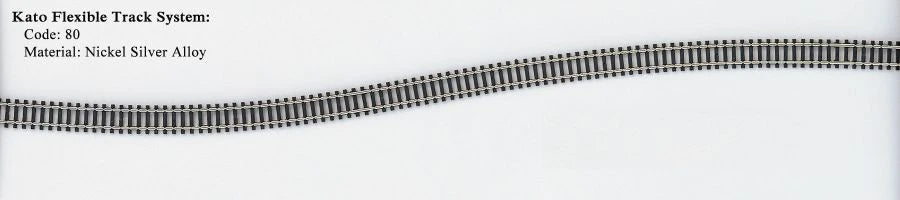
An easement is a transition curve whose radius changes gradually. Instead of moving instantly from straight track to the final circular radius, the track begins with a gentle bend and tightens progressively. The train appears to steer into the curve instead of snapping sideways.
The transition uses space. Plan it before cutting roadbed or fixing track, because forcing an easement into the same boundary as a minimum-radius curve can reduce clearance elsewhere.
What the transition changes
NMRA’s curve data sheet distinguishes tangent track, constant-radius circular curves and easements with changing curvature. Its beginner track guide notes that easements look more realistic and can reduce misalignment between body-mounted couplers on longer cars.
That benefit is most visible with passenger cars, long freight cars and locomotives with wide overhang. Short equipment may tolerate an abrupt curve, but the track still looks smoother when curvature builds gradually.
Lay out the whole route before fastening
Mark the straight centerline and the desired circular curve. The easement connects them over a chosen length. Flexible track is useful because it can form changing radii rather than locking the route into one sectional geometry.
Use the longest equipment and the track centers that will actually operate on the layout to check side clearance. Overhang occurs on the outside of a curve and inward swing occurs between the trucks, so scenery and parallel tracks need clearance on both sides.
- Keep the minimum radius requirement intact.
- Make both ends of an S-curve gradual.
- Check couplers with the longest cars.
- File cut rail ends and align joints.
- Test under power before ballasting.
Test the transition as part of the system
Roll cars through slowly by hand, then run a complete train in both directions. Watch coupler angles, truck rotation and the joint where the easement meets the circular curve. A smooth centerline can still fail if rail joints kink.
Do not hide a rough transition with ballast. Correct alignment, electrical continuity and clearance first. Once glued and scenicked, a small kink becomes much harder to reach.
Sectional curves and easements
| Choice | Best when | Watch for |
|---|---|---|
| Abrupt sectional curve | Compact plans with fixed geometry and short equipment. | Immediate change in curvature. |
| Flex-track easement | Longer cars and a more flowing main line. | Needs planning space and careful alignment. |
| Compound curve transition | Routes joining two different radii. | Avoid a sudden tighter section at the joint. |
Plan the next step
Draw the centerline, pin flex track temporarily and run the longest complete train through both directions. Fasten the route only after couplers and clearances behave consistently.
Keep exploring this topic
Questions builders and collectors ask
Does an easement increase the final curve radius?
It changes how the track reaches that radius. The tightest circular portion still needs to meet the equipment requirement.
Can sectional track make an easement?
A sequence of broader-to-tighter sections can approximate one, but flex track allows a continuous transition.
Are easements only cosmetic?
No. They can reduce abrupt car and coupler misalignment, especially with long equipment.
Should every curve have one?
Use them where space and operating goals justify them. A cramped yard or industrial spur may have different priorities.
Return to Model Train Guides for more Muncle Mikes guides.

