

Guías de Trenes en Miniatura
O Gauge Track: Geometry, Curve Size and System Compatibility
O gauge track must be chosen as a system. Rail spacing alone does not prove that two track families connect, share the same electrical arrangement or create curves suitable for the trains you want to run.
This page owns broad O-gauge track planning. It stays separate from Lionel FasTrack, Lionel train-track and O scale track pages.
Identify the exact track family
Record manufacturer, product line, rail construction, connector design, roadbed, center-rail arrangement and item number. Traditional tubular track, integrated-roadbed track and specialty systems can all be O gauge while requiring different joiners or transition solutions.
Plan curves by diameter and clearance
Use the manufacturer’s curve designation and actual outside footprint. Add room for car-body overhang, long locomotives, scenery and edge protection. A curve that physically connects may still be too tight for the equipment.
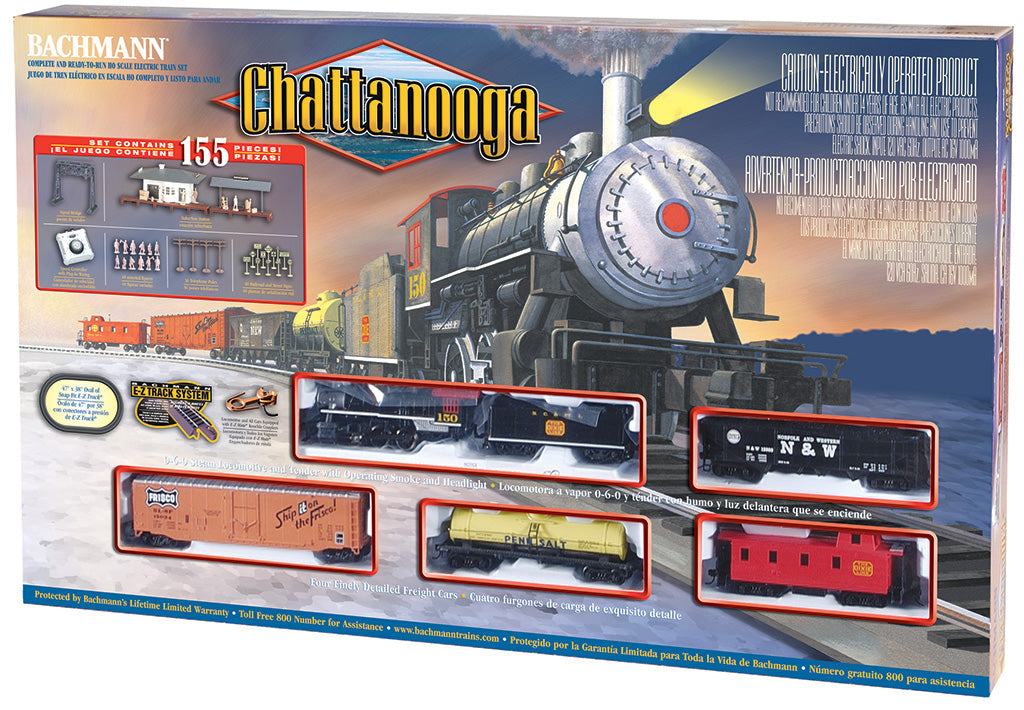
A complete train-set example such as the Bachmann Chattanooga set is a different scale, but it illustrates a universal lesson: track, power and rolling stock must be evaluated together rather than from one shared word such as “train.”
Verify electrical compatibility
Confirm AC or another power arrangement, center-rail continuity, lock-ons, insulated sections, switch wiring and controller capacity. Do not connect power components across systems until their electrical requirements are documented.
| Factor | Verify | Plan |
|---|---|---|
| Track family | Maker, line, connector and roadbed | Use one documented system or tested transitions. |
| Geometry | Curve diameter, switch length and spacing | Draw the full footprint before buying. |
| Equipment | Minimum curve and car overhang | Test the longest locomotive and car. |
| Power | Electrical arrangement and connection points | Match controller and wiring to the system. |
Test before permanent scenery
Assemble the complete plan on a level surface. Run slowly through every curve and switch in both directions. Correct gaps, uneven joints, voltage drop and clearance problems before attaching track or scenery.
Common mistakes to avoid
- Assuming every O gauge track line snaps together.
- Confusing curve radius and diameter.
- Buying switches without measuring their full length and diverging route.
- Ignoring center-rail insulation and accessory wiring.
Frequently asked questions
Is O gauge track the same as O scale track?
Gauge describes rail spacing; scale describes model proportions. The terms overlap in practice but are not identical.
Can different O gauge brands be combined?
Sometimes, with documented transition methods and compatible electrical operation. Do not assume direct connection.
What curve should I choose?
Use the widest curve the space allows while meeting the minimum recommendation of the longest equipment.
Should track be fastened permanently?
Only after the full layout has operated reliably and access for maintenance is protected.
Final checklist
Confirm track family, connectors, curve footprint, switch geometry, equipment minimums, electrical system and test results. O gauge track performs best when every piece belongs to a documented plan.

