

Guías de Trenes en Miniatura
O Gauge Train Sets: How to Choose a Starter System
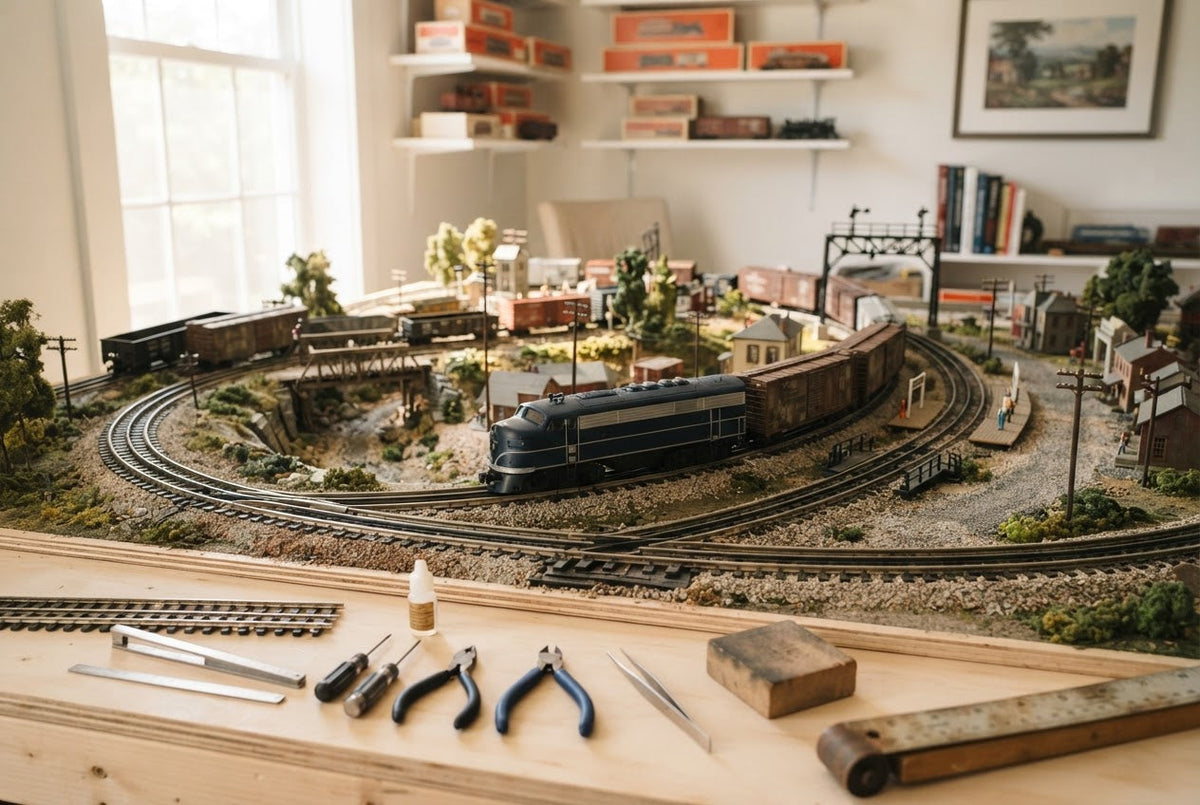
O gauge train sets remain one of the fastest ways to put a substantial electric train into motion. The locomotives have presence, the cars are easy to handle, and the three-rail system is friendly to temporary loops as well as permanent layouts. A boxed set can look complete, but the important question is whether its track, power, control system, curve size, and train length fit the room where it will operate.
A good starter set should be judged as the foundation of a railroad, not as a sealed bundle of parts. The train may be the exciting part, but track geometry and power determine whether it becomes a layout or returns to the box. This guide separates “O gauge” from “O scale,” explains what a useful set should contain, and shows how to choose one with a realistic expansion path.
What should be included in O gauge train sets
A complete set commonly includes a locomotive, compatible cars, a loop of track, a power supply, a controller or remote, and the small parts needed for initial operation. Some add smoke fluid, figures, signs, or themed accessories. Read the component list closely. “Train set” may describe a train without track and power in some listings, while “ready-to-run” generally signals a more complete package.
Count the track pieces and identify the curve size. An oval that fits the box may still be too large for the intended table once side clearance and access are included. Conversely, a compact loop may limit future locomotives. A set such as the Lionel Star Trek train set can be a complete themed starting point, but its value is strongest when the buyer understands how its track and control system can grow.
O gauge train sets are not all the same size
O gauge describes the track gauge, not the exact body scale of every train. Traditional O gauge equipment may be shortened to run on tighter curves. O scale equipment is generally closer to 1:48 proportions and often needs broader curves. Both can use three-rail O gauge track, but visual proportions, coupler swing, car overhang, and minimum radius can differ significantly.
Use the longest car and locomotive in the set to evaluate the room. Place the proposed curve on a floor plan and add clearance beyond the outer rail for body overhang. Include space for fingers to rerail cars and for people to walk around the layout. A set that technically fits edge to edge is usually frustrating to operate.
Choose the curve before the locomotive
The stated minimum curve is a limit, not necessarily the most attractive operating radius. Broader curves make long cars look better, reduce coupler stress, and provide more choices for future purchases. If the set includes a tight oval but the room supports a larger one, an early track upgrade can be more useful than buying another train.
Switches create operational interest, but they also introduce geometry and wiring decisions. A matched pair such as the left-hand O-36 FasTrack switch and right-hand O-36 FasTrack switch can form a passing siding. Verify that every piece belongs to the same track family and that the siding is long enough for the train you intend to park there.
Power and control determine the operating experience
A conventional set changes speed through track voltage. It is simple and satisfying for one train. Remote or command-oriented sets may offer fixed-voltage track, speed steps, sound, lighting, and easier direction changes. The included control method should be evaluated for range, batteries, pairing, and future compatibility—not just for the number of buttons.
Add up the electrical demands before expanding with lighted cars, accessories, or multiple locomotives. The included power supply is sized for the starter configuration, not necessarily for a room full of accessories. Separate accessory power or a larger supply may be appropriate later. Good wiring with feeders placed around a larger loop prevents the far side of the railroad from slowing because of voltage drop.
Plan the first expansion before buying the set
The smartest first expansion is usually operational: a passing siding, a spur, a bridge, or an industry where cars can be switched. A Lionel girder bridge adds a visual destination, but it should be placed on level, well-supported approaches. Buildings and scenery come after the route runs reliably.
Rolling stock should follow the locomotive’s era, pulling ability, couplers, and scale approach. One or two compatible cars create a more convincing train than a random group bought only because they were available. Keep the original set components together in your records even when the layout grows; that preserves the set’s identity and makes troubleshooting easier.
Who should choose O gauge
O gauge is well suited to people who value physical presence, easy handling, sound, smoke, operating accessories, and a strong visual connection to classic American toy trains. It requires more room than smaller scales, especially when scale-size equipment and broad curves are involved. The trade is worthwhile when the train itself is the center of the scene.
A family layout can favor durability and simple control. A collector layout may prioritize road names and production eras. A scale-oriented operator may accept fewer trains in exchange for accurate proportions. The same track gauge can serve all three, but the set should be selected for the intended style rather than for the biggest box.
O gauge set buying checklist
- Confirm that locomotive, cars, track, power supply, and controller are included.
- Identify the track family and curve designation.
- Measure the full footprint with body overhang and operating access.
- Check whether the train is traditional size or scale size.
- Match conventional, remote, or command features to the way you want to operate.
- Verify minimum curve for every future locomotive you are already considering.
- Choose an expansion—siding, spur, or broader oval—before adding a second train.
Frequently asked questions
What is the difference between O gauge and O scale?
O gauge refers to the spacing between the rails. O scale usually refers to models built near 1:48 proportion in the United States. Traditional O gauge trains can be shorter or compressed while using the same track gauge.
How much space does an O gauge set need?
It depends on the curve included. Use the track system’s outside dimensions, then add clearance for car overhang and access. A floor plan should include the table or floor boundary, not just the centerline of the track.
Can I mix O gauge brands?
Sometimes, but check wheel standards, couplers, minimum curves, control electronics, and track power. Shared gauge does not guarantee that every feature or proportion will match.
What should I add first to a starter set?
A broader loop or passing siding usually adds more operating value than another locomotive. Reliable track, adequate power, and a place to meet or switch cars make the existing train more interesting.
Choose O gauge train sets for the railroad after the first lap
The best O gauge train sets provide a dependable first train and a clear route forward. Check the complete contents, curve designation, equipment size, power, and control method before comparing themes or paint schemes.
A set becomes a railroad when the track fits the room, the power remains steady, and the next expansion has a purpose. Begin with a system you can operate comfortably, then let scenery, rolling stock, and accessories grow around reliable movement.

