
Hot Wheels Gassers
Hot Wheels Gasser Wheels: Drag Slicks, Sizes & Fitment
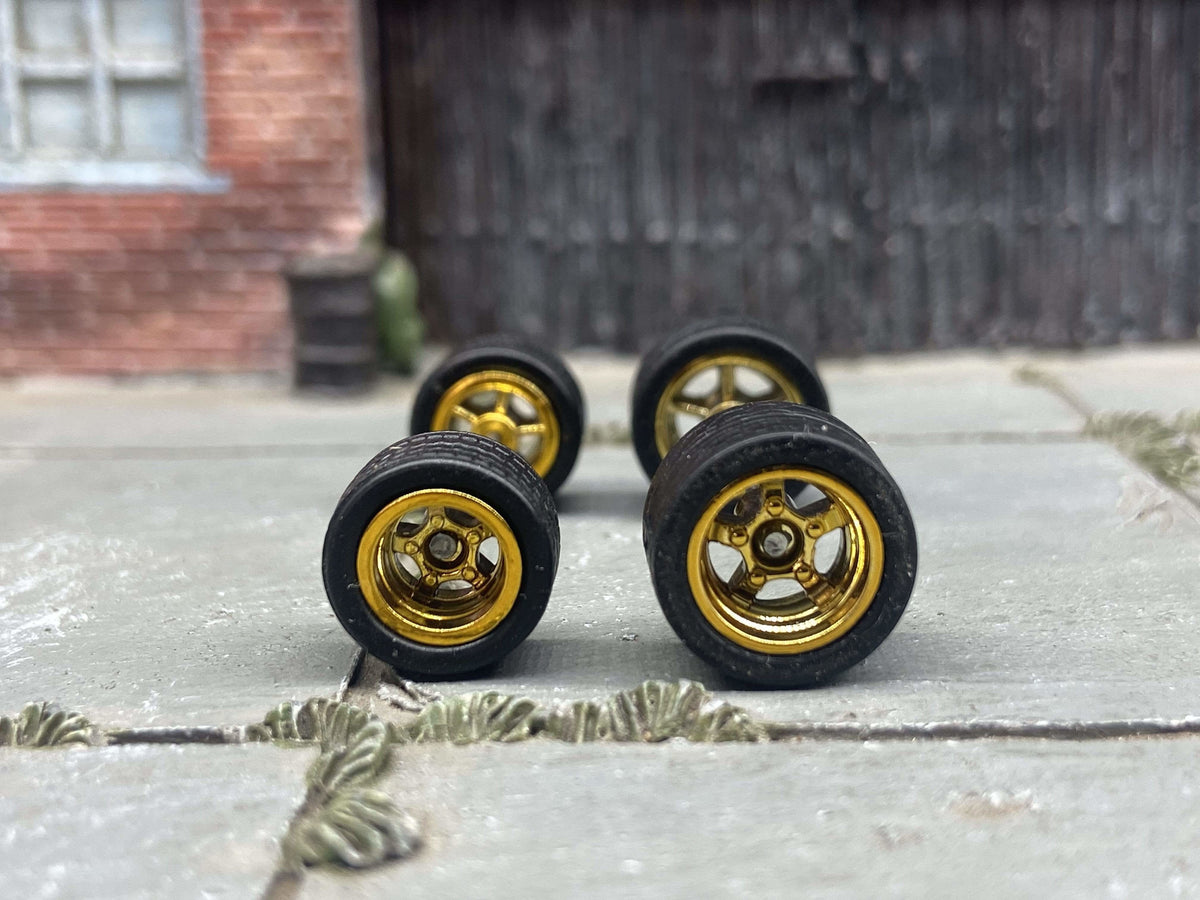
Hot Wheels gasser wheels & drag slicks
Build the stance. Buy the right parts.
For a drag-era display build, start with narrower-looking front tires, a stronger rear-tire profile, and a wheel design that suits your reference car. The best Hot Wheels gasser wheels are the ones that fit your casting and deliver the look you want—not automatically the widest slicks.
Compare staggered wheel sets, rear-tire replacements, and a ’55 Chevy donor below. Then check tire diameter, width, axle fit, and body clearance before ordering.
Building from scratch? Shop Build Your Own Hot Wheels kits. Custom upgrade wheels and tires are a separate purchase unless a listing explicitly includes them.

Product contents were verified against Muncle Mikes catalog records. Setup suggestions are not a claim that every combination has been physically test-fitted.
Three gasser wheel setups to consider
Choose the build’s purpose first. These are styling directions, not a universal specification or a promise of racing performance. A replica should follow the particular car you are recreating.
| Your build goal | Wheel and tire approach | What to check |
|---|---|---|
| Classic drag-inspired display | A visually narrow front setup with rear slicks or cheater-slick styling. Match the wheel face to your reference. | Front profile, rear fender room, and whether the drag-slick listing contains tires alone or wheels as well. |
| A coordinated custom finish | Matching five-spoke wheel faces in a staggered size combination, with the larger pair at the rear where the donor allows. | Compare the five-spoke wheels and tires by size and finish. A matched design is not proof of matched fit. |
| A rolling or track-tested project | A setup selected for straight axles, free rotation, and reliable clearance before cosmetic extras. | Test on your actual course. A rubber-tire swap is not a guarantee of a faster car. |
There is no single mandatory wheel design. For a documented Hot Wheels example, Mattel’s Triassic-Five ’55 Chevy Bel Air Gasser pairs slotted front wheels with rear drag wheels and cheater-slick tires. That is a reference for one release, not a rule for every gasser.
Shop wheel sets, rear slicks, and a gasser DIY kit
These three listings solve different parts of a build. They are sold separately, not as a ready-made compatibility bundle. Open the product pages for current prices, availability, photos, and included components.
Four wheels + rubber tires
Gold five-spoke staggered set
The listing includes two 10 mm wheels with rubber tires and two 12 mm wheels with rubber tires. Start here when you want a coordinated wheel design with different front and rear sizes.
Before ordering: check axle compatibility and tire width. The listing does not specify an axle length, and the size labels are not a universal gasser fitment guarantee.
View the 10 / 12 mm set
Two rear tires only
13 mm Firestone cheater slicks
Two rubber rear tires with Firestone sidewall lettering. This is a tire-only listing: wheels and axles are not included. Consider it when you already have a suitable wheel setup.
Before ordering: check the wheel’s tire seat and the assembled outside diameter. The listing warns that additional clearance may be needed.
View the tire-only pair
DIY project
’55 Chevy Gasser DIY kit
A stripped, ready-to-paint donor for your own finish and final assembly. Its listing identifies 10 mm / 12 mm wheel sizing, giving you a starting point for comparing replacement parts.
Before ordering: confirm the original components shown. Custom upgrade wheels, tires, and upgrade axles are separate purchases—not an included rubber-tire conversion.
View the ’55 Chevy kitNeed another wheel face or color? Compare all Hot Wheels and Matchbox wheels and tires. Prefer the completed car? Shop finished custom Hot Wheels gassers instead of buying separate build parts.
Hot Wheels gasser wheel sizes: what 10 mm, 12 mm, and 13 mm tell you
Millimeter labels are useful for narrowing your choices, but they do not describe every fit dimension. A wheel-and-tire assembly and a replacement tire are different products. Confirm what a seller measures rather than assuming a nominal wheel size equals the outside diameter of every tire fitted to it.
Our featured ’55 Chevy Gasser donor lists a 10 mm / 12 mm wheel combination. The gold set uses those same listed size labels. That makes it a sensible comparison, not a verified drop-in pairing: tire width, hub shape, and axle spacing still matter. A different gasser casting needs its own measurements.
| Check this measurement | What to compare | Why it matters |
|---|---|---|
| Assembled tire outside diameter | Measure across the complete tire, through its center; compare front and rear separately. | Affects wheel-opening clearance and axle height above the ground. |
| Tire width | Measure sidewall to sidewall, not only the visible tread. | A tire may clear the top of the arch while rubbing the inner body or chassis. |
| Hub and tire seat | Check where the tire sits on the wheel and how the wheel sits on the axle. | A tire-only purchase must seat securely and evenly on the intended wheel. |
| Axle diameter and usable length | Compare the replacement axle with the hub bore and the donor’s mounting arrangement. | The car needs adequate side clearance without excessive wheel movement or binding. |
| Body and base clearance | Test with the body seated on its base, including any fender or chassis contact points. | A wheel that spins with the body removed may bind after assembly. |
Can you use 13 mm rear slicks?
Possibly, but measure the assembled tire and check the wheel opening first. The featured 13 mm cheater-slick listing describes flexible replacement tires and notes compatibility with some 10 mm and 12 mm aftermarket wheels. It also warns about clearance; that is not a promise that every 13 mm tire and wheel combination fits every ’55 Chevy gasser.
A sizing example: changing a measured tire outside diameter from 12 mm to 13 mm adds 0.5 mm to its radius. With the axle mount unchanged, the tire reaches 0.5 mm farther toward the top of the wheel opening. This is geometry, not a measurement of the featured products.
Measure before modifying. Compare a smaller or narrower setup before cutting the body to make a large tire fit. Choose the appearance you want, but do not mistake a clearance problem for a reason to buy the biggest available rear tire.
Skinny fronts, deep-dish wheels, and the nose-high stance
Narrow front tires and small-diameter front tires are not the same thing. Width changes the front-on silhouette; diameter changes how high the axle sits above the ground. A tire can be narrow without being extremely small.
Smaller front tires do not create a raised nose by themselves. With the mounting geometry unchanged, reducing front tire diameter tends to lower the front. The raised look depends on the body, base, and axle-mount geometry as well as the tire sizes. Check the car from the side with all four wheels touching a flat surface.
Deep-dish styling describes the recessed appearance of the wheel face. It can give a display build a stronger rear-wheel look, but a deep-looking rim does not automatically mean more tire clearance. Check the hub location and actual width, not just the photograph’s sense of depth.
For period-inspired styling, use a photograph of the specific car and era as your reference. For a freestyle custom, choose the finish you enjoy. Chrome, gold, dark centers, and bright sidewall lettering are design choices—not universal measures of accuracy or build quality.
Rubber tires vs. plastic wheels
Rubber tires are worth considering when a realistic tire profile and display finish are your priorities. Keep an original plastic-wheel setup when factory originality matters, or compare setups through repeatable testing when track performance matters. Material alone does not establish a car’s speed, authenticity, or resale value.
Real Riders is Mattel’s wheel-range name, not a generic label for every aftermarket rubber tire. Mattel’s Real Riders Wheels Pack Set 4 lists several distinct wheel types, including small drag wheels and larger cheater slicks. An aftermarket wheel swap does not turn a mainline into a factory premium or a Super Treasure Hunt.
A six-point test-fit checklist before final assembly
- Record the starting setup. Photograph the donor and measure the original front and rear tires. Keep the factory parts identified if originality matters to you.
- Check the package contents. Confirm wheel count, tire count, and any axle or mounting hardware. Two rear tires are not a four-wheel conversion kit.
- Seat tires evenly. Check that each replacement tire sits squarely on its wheel and does not bulge, twist, or slip off its seat.
- Check the axles. Look for straight alignment and enough side clearance for free rotation. Do not force an incompatible hub onto an axle.
- Test with the body in place. Roll the car gently on a flat surface. Check both sides and all four contact points; identify rubbing before closing the base.
- Finish only after the fit works. Use the assembly method specified for your donor or kit. Keep adhesive away from moving wheels and axles.
Wheel swaps involve small parts. Cutting or drilling requires suitable eye protection, a secured workpiece, and adult handling. Follow the selected kit, tool, and adhesive instructions; this guide does not prescribe one drill size or axle length for every casting.
Buy the parts—or choose a finished custom gasser
For a DIY build: choose the donor first, then compare the complete wheel-and-tire dimensions, and finally check the required axles or hardware. Budget for the items actually listed. Buying a rear-tire pair does not supply the front wheels, and a DIY kit is not automatically a complete custom-parts bundle.
For a finished car: inspect the actual listing photos for even tire seating, straight wheel alignment, a balanced stance, and the specified finish. Ask about rolling behavior if it matters to you; a dramatic display stance should not be advertised as tested racing performance without evidence.
Not sure which route suits you? Send Muncle Mikes the casting name and your measurements before ordering a fit-sensitive part.
Hot Wheels gasser wheels: frequently asked questions
What are the best wheels for a ’55 Chevy Bel Air Gasser?
Start with the donor’s existing size and the look you want. Our featured ’55 Chevy DIY listing identifies 10 mm / 12 mm wheel sizing, so a staggered set is worth comparing. Confirm tire width and axle fit before treating any set as a direct replacement.
Do all Hot Wheels gassers use 10 mm front and 12 mm rear wheels?
No universal size is established by this guide. Measure your exact casting and release. A size noted for the featured ’55 Chevy kit is not a specification for every Corvette, Nova wagon, Willys, or other gasser project.
Does a rear drag-slick listing include wheels and axles?
Not necessarily. The featured Firestone 13 mm listing contains two rear rubber tires only. The gold staggered listing includes four wheels with rubber tires. Check each package’s stated contents rather than relying on the words “wheel kit” in a tag or category.
Do I need skinny front wheels for a gasser?
A visually narrow front setup is one styling option, especially when it matches your reference car. It is not a requirement for every custom. Separate tire width from diameter, and check the stance with the body assembled.
Will rubber tires make my Hot Wheels gasser faster?
Do not assume so. Test the actual wheel-and-axle setup on the intended track. This guide recommends rubber tires for appropriate display goals, not as a speed upgrade guaranteed to outperform plastic wheels.
Why do my new wheels rub after I close the base?
Check tire diameter and width, axle alignment, hub position, and whether the seated body changes the available clearance. Diagnose the contact point before changing the axle length or removing material from the car.
Are aftermarket rubber tires the same as Real Riders?
No. Real Riders identifies Mattel’s wheel range. Generic aftermarket wheels or replacement tires should not be presented as genuine Real Riders without verified identification.
Where can I buy a gasser that is already customized?
Browse Muncle Mikes custom Hot Wheels gassers for finished listings. For your own project, choose a DIY Hot Wheels DIY kit and compare the separately listed upgrade parts.
Find the right wheels for your next gasser.
Choose the wheel design, check the measurements, and compare the exact contents before checkout. Build your own combination or pick a finished car whose stance is already the way you want it.
About this guide: product photos, listed sizes, and package contents come from the linked Muncle Mikes listings. Mattel references identify specific factory wheel configurations; they do not certify aftermarket fitment. We have not represented these separate products as a physically tested bundle. Muncle Mikes is an independent customizer and reseller, not affiliated with or endorsed by Mattel.

