

Guías de cohetes modelo
Estes Model Rockets: Kits, Motors and a Safe First Launch
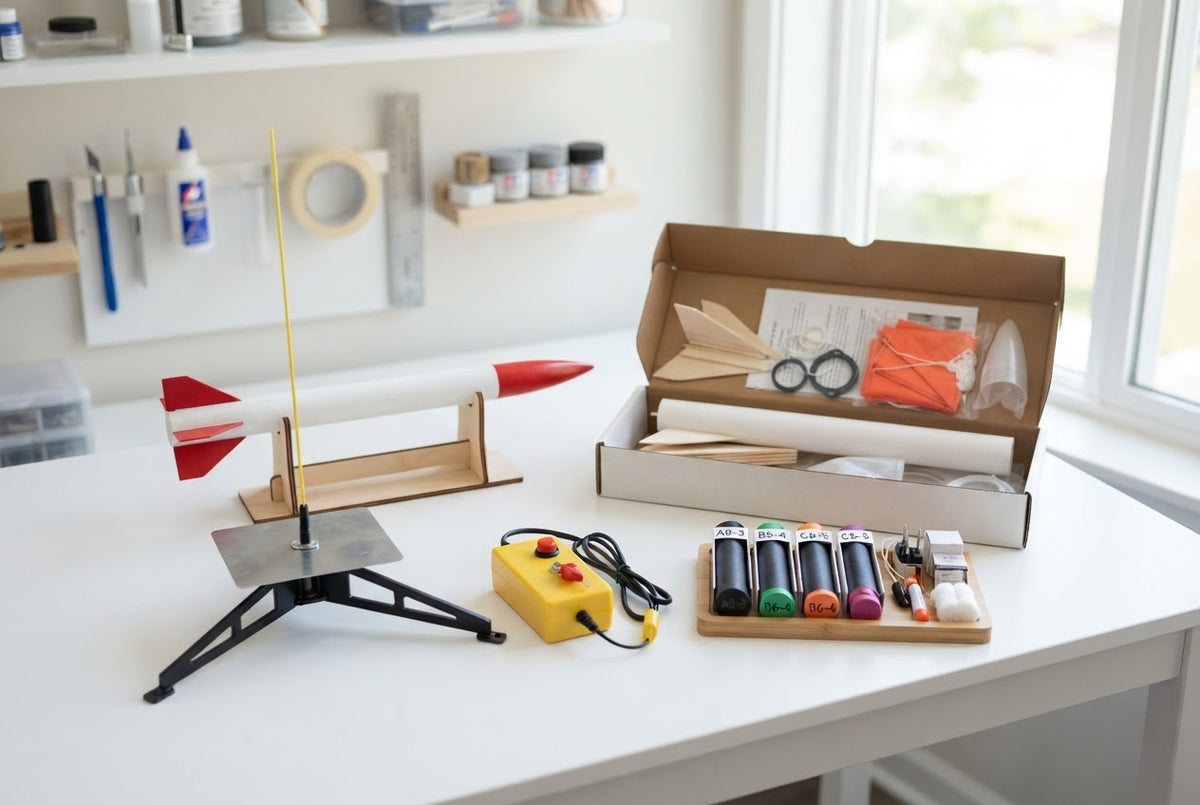
Estes model rockets make rocketry approachable because the kit, motor, recovery system, launch pad, and controller are designed as parts of a complete hobby system. A rocket can be simple enough for a first build or detailed enough to reward careful finishing, but every flight depends on more than the model. Motor choice, launch-site size, weather, recovery preparation, electrical distance, and strict safety procedures all matter.
This guide explains how to choose a first Estes kit, understand launch sets and motor codes, prepare recovery, select field equipment, and build a repeatable preflight routine. Always use the current instructions supplied with the rocket, motor, controller, and launch equipment. Follow the National Association of Rocketry Model Rocket Safety Code, manufacturer guidance, and all applicable local rules. Minors need responsible adult supervision.
Choose Estes model rockets by skill and flight goal
A first rocket should have clear instructions, stable fin alignment, a recovery system that is easy to pack, and a motor range suited to a field you can legally use. A simple kit such as the Estes Alpha teaches the basic structure: body tube, motor mount, fins, nose cone, shock cord, and recovery device. A stylized design such as the Estes Der Red Max adds finishing personality without changing the need for careful construction.
Skill-level language should be treated as a planning aid. A rocket with through-the-wall fins, complex wraps, multiple body tubes, or a detailed paint scheme may take longer than the number of parts suggests. Choose the project for the builder’s patience, not only for advertised altitude. A rocket that is built straight and recovered repeatedly teaches more than a high-performance model rushed to the pad.
A launch set versus a rocket kit
A rocket kit generally provides the parts needed to build the model but may not include a launch pad, electrical controller, motors, starters, or recovery wadding. A launch set combines a rocket with core ground equipment. The Estes Tandem-X launch set is designed to establish a broader first-launch system, but the exact package contents still need to be read.
Before checkout, make a complete-flight list: assembled rocket, approved motor, starter, recovery wadding or manufacturer-specified protection, launch pad, correct rod or rail, electrical controller, fresh controller power, field tools, and a legal launch site. Missing one small consumable can cancel a launch day.
Understand model rocket motor codes without guessing
A motor code communicates performance and timing information, but selection must come from the rocket manufacturer’s approved motor list for that exact model. The letter identifies a total-impulse class, the first number relates to average thrust, and the number after the dash identifies the delay before the ejection event for a typical single-use motor code. Those elements are not permission to substitute any motor that fits physically.
A product such as the Estes C6-3 motor pack should be used only with rockets and flight conditions for which that motor is recommended. Do not alter, reload, combine, or experiment with certified single-use motors. Keep motors in their original packaging, away from heat and flame, and follow storage, handling, transport, and age requirements.
Build straight for stable flight
Fin alignment matters. A fin that is canted can make the rocket spin excessively or introduce drag; a weak joint can fail under acceleration. Mark lines accurately, use the adhesive specified for the materials, and allow each joint to cure. Fillets add strength when the instructions call for them. Keep the launch-lug or rail-guide path straight and free of glue.
Balance and mass should remain within the kit design. Do not add heavy decorations, substitute major components, or change fin shape without understanding stability. Paint in light coats and keep the motor mount, shock-cord attachment, recovery area, and launch-guide surfaces functional. A beautiful finish cannot compensate for a blocked tube or weak recovery mount.
Prepare recovery as carefully as propulsion
The ejection event must deploy a parachute or streamer without burning it, tangling it, or leaving it packed too tightly. Use the protective method specified in the instructions, inspect the shock cord, untangle lines, and fold or roll the recovery device as directed. Humidity, cold, and long storage can change how easily a parachute opens.
Perform a gentle ground check of recovery packing without igniting anything. The nose cone should separate with the intended resistance, and the recovery device should slide freely. Replace damaged elastic, scorched material, torn shroud lines, or brittle components before flight. Recovery is not an afterthought; it is what makes a rocket reusable.
Set up the launch site and electrical system
Use a launch site large enough for the rocket and motor, with dry grass, power lines, buildings, roads, aircraft activity, people, and fire restrictions considered. Do not launch in high wind, into clouds, near aircraft, or when local conditions make fire risk unacceptable. Obtain permission for the site and follow any notification or permit requirements.
The launch rod or rail must match the rocket and be stable. A replacement such as the Estes two-piece launch rod is selected by exact equipment requirements, not simply because it is available. Use an electrical launch controller with the safety key removed until the range and rocket are ready. Keep everyone at the required distance and conduct a loud countdown.
Use a written preflight and postflight routine
A checklist removes memory from the safety process. Confirm rocket condition, approved motor, motor retention, starter installation, recovery protection, nose fit, launch-guide movement, controller continuity, range clearance, wind, and countdown positions. If anything is uncertain, stop and correct it. There is no penalty for postponing a flight.
After recovery, remove the spent motor only when safe, inspect the airframe and recovery system, and record the motor, weather, flight behavior, and damage. An Estes altimeter can add measured flight data when used according to its instructions, but observation notes are valuable even without electronics.
Estes launch-day checklist
- Use only manufacturer-recommended certified motors for the exact rocket.
- Inspect fins, body, motor mount, shock cord, nose cone, and recovery device.
- Pack recovery protection and parachute or streamer exactly as instructed.
- Use the correct stable launch pad, rod or rail, and electrical controller.
- Confirm legal site permission, field size, wind, visibility, and fire conditions.
- Keep the safety key out until the range is clear and conduct a loud countdown.
- Inspect and log the rocket after every flight before launching again.
Frequently asked questions
Do Estes model rocket kits include motors?
Some packages may bundle flight supplies, but many rocket kits do not include motors, starters, recovery wadding, pad, or controller. Read the exact contents list and assemble a complete-flight checklist.
Can I use a larger motor if it fits in the tube?
No. Use only motors recommended by the rocket manufacturer for the exact model and configuration. Physical fit does not establish stable or safe performance.
Where can model rockets be launched?
Use a legal site with owner permission, adequate field dimensions, safe weather, and compliance with local fire, airspace, park, and age rules. Follow the NAR Model Rocket Safety Code and manufacturer instructions.
Why did a parachute fail to open?
Common causes include tight or incorrect packing, tangled lines, inadequate heat protection, damaged recovery components, cold or damp material, restricted nose separation, or an unsuitable delay. Inspect every part and follow the kit instructions before another flight.
Fly Estes model rockets with a complete system
Successful Estes model rockets flights begin long before the countdown. The kit must be built straight, the approved motor must match the model, the recovery system must be prepared correctly, and the field and weather must support a safe launch.
Use written checklists, certified motors, proper electrical launch equipment, and conservative judgment. A postponed launch is always better than forcing a flight. Careful preparation is what turns one rocket into many successful recoveries and years of rocketry.

