

Guías de cohetes modelo
Estes Rockets Guide: Choose a Kit, Launch Set and Motor
Estes rockets cover much more than one beginner kit. The line includes simple snap-together or quick-build projects, traditional skill-building kits, complete launch sets, classroom packs, motors, recovery supplies, and larger advanced models. Choosing well means matching the kit’s construction demands, launch equipment, motor range, field size, and recovery method to the flyer.
This guide is brand-specific. It helps you move from the Estes product number to a complete, compatible flight plan without guessing. Browse the public Estes Rockets collection, then use the exact listing and instructions for the model you choose. For the full hobby process, including launch-day safety, see the model rocketry guide.
Choose between a kit and a launch set
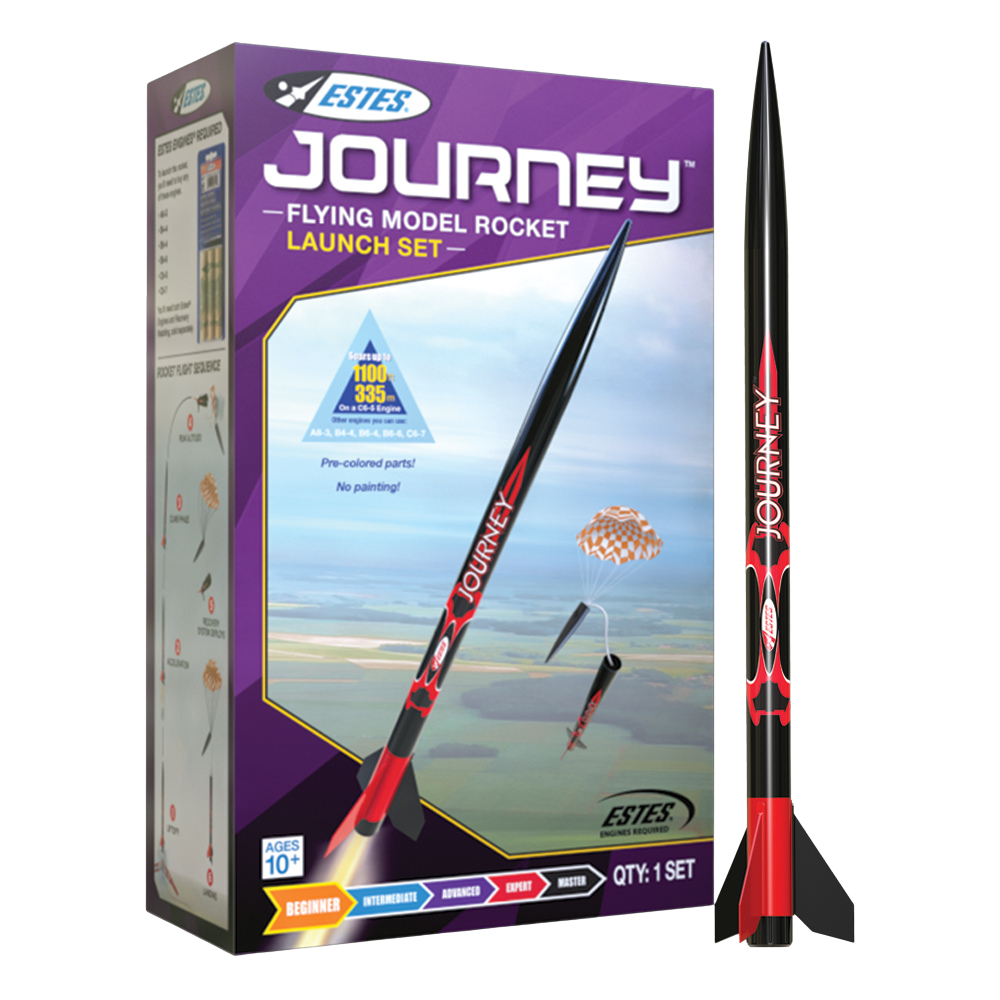
A rocket kit is primarily the rocket project. A launch set normally combines a rocket with some or all of the ground equipment needed to launch, such as a controller and launch pad. The exact contents vary, and motors are not automatically included. Read the package list carefully. The Estes Journey Launch Set #1441 is an example of a product that should be evaluated as a complete launch-system package rather than as a rocket alone.
A launch set can simplify the first purchase when the flyer does not already own compatible ground equipment. A separate kit makes sense when a pad and controller are already available or when the builder wants a specific design. Muncle Mikes groups complete options in Complete Model Rocket Launch Sets and standalone projects in Individual Model Rocket Kits.
Read the skill level as a construction promise
Skill guidance tells you what the build is likely to require: part preparation, alignment, adhesive, sanding, finishing, decals, and patience. A beginner should not choose only by advertised altitude or body shape. A rocket that can be assembled accurately and repaired confidently is more likely to fly repeatedly.
Quick-build projects reduce construction time, while traditional kits teach fin alignment, tube preparation, fillets, sealing, painting, and recovery installation. The Estes Banshee #1303 and the Estes Red Flare #1954 represent different subjects that must be compared through their own instructions, motor recommendations, and recovery details rather than through appearance alone.
Match the motor to the exact rocket
Use only the motor types recommended in the current instructions for the exact kit. Motor codes describe performance and delay characteristics; they are not a simple small-to-large ladder that can be improvised. A motor that physically fits may still be wrong for the model, field, weather, or recovery system.
Keep motors in their original packaging until use, follow storage directions, and never alter a motor. The National Association of Rocketry’s Model Rocket Safety Code calls for certified, commercially made motors and prohibits tampering. Muncle Mikes organizes compatible categories such as Estes model rocket engines and motors, but the rocket instructions remain the final compatibility reference.
Plan the field before choosing performance
A rocket that can fly high needs enough open area to recover safely. Wind can carry a parachute or streamer far beyond the pad. Nearby trees, power lines, dry vegetation, buildings, roads, crowds, and aircraft activity can turn a normal flight into a poor launch decision. Select the field and check conditions before selecting the motor.
The NAR safety code specifies open outdoor launch sites, safe weather, wind limits, minimum distances, and recovery practices. Local fire restrictions, landowner rules, park rules, and state or municipal laws can add requirements. The FAA also publishes amateur rocket information. Check current local conditions and regulations for the actual launch site; do not treat a product listing as legal clearance.
Understand recovery
Most Estes model rockets recover by parachute, streamer, or another designed method. The recovery device must be packed correctly and protected from ejection heat with the method specified in the instructions. A tightly packed parachute may not deploy; an overly loose or tangled line can snag. Practice folding and packing before launch day.
Match recovery to conditions. A large parachute may provide a gentle descent but drift farther in wind. A streamer may descend faster and stay closer, but it must be appropriate for the rocket. Never substitute a recovery method casually. Inspect shock cord, attachment points, canopy, shroud lines, and wadding or protector before every flight.
Use the launch equipment as a safety system
A proper launch system keeps people away from the rocket and provides intentional electrical ignition. It should include a stable pad, a guide rod or rail suited to the rocket, a blast deflector, and a controller with a safety interlock. Place the pad on stable ground, point the guide within the permitted safe range, and keep the launch area clear.
If ignition fails, keep the safety key out and wait the required time before approaching. The NAR code specifies a 60-second wait after a misfire. Never lean over a rocket on the pad, and never allow spectators to crowd the launch area.
Build an Estes path that grows with the flyer
- Start with a kit or launch set suited to the builder’s actual skill.
- Use the exact instructions to identify recommended motors and supplies.
- Fly on a large, legal, low-risk field in suitable weather.
- Inspect and repack recovery gear after every flight.
- Record the motor, weather, flight result, and any repair.
- Advance to more complex construction or larger motors only after consistent success.
For groups, Classroom & Group Model Rocket Packs can simplify repeated builds, but adult supervision, field control, and motor handling still require a clear plan. For individual progression, the public beginner, intermediate, and advanced collections provide useful navigation, not permission to skip the exact instructions.
Frequently asked questions
Do Estes rocket kits include motors?
Not always. Confirm the exact package contents. Many kits require motors, starters or igniters, recovery protection, and launch equipment to be purchased separately.
Can I use a larger Estes motor for more altitude?
Only if that exact motor is listed or approved for the exact rocket in the current instructions and is appropriate for the field and conditions. Never choose by physical fit alone.
What should I save after the build?
Keep the instructions, package label, product number, recommended motor table, and a record of each flight. Those materials help with repair, repeat flights, and compatible supply purchases.
Muncle Mikes tip: A successful rocket is one that is built straight, launched within the rules, recovered safely, and flown again—not simply the one with the biggest altitude number.

