

Guías de Trenes en Miniatura
Bachmann HO 52-Foot Center-Beam Flatcar with Lumber Load - Canadian National #604215: Scale, Layout & Compatibility Guide
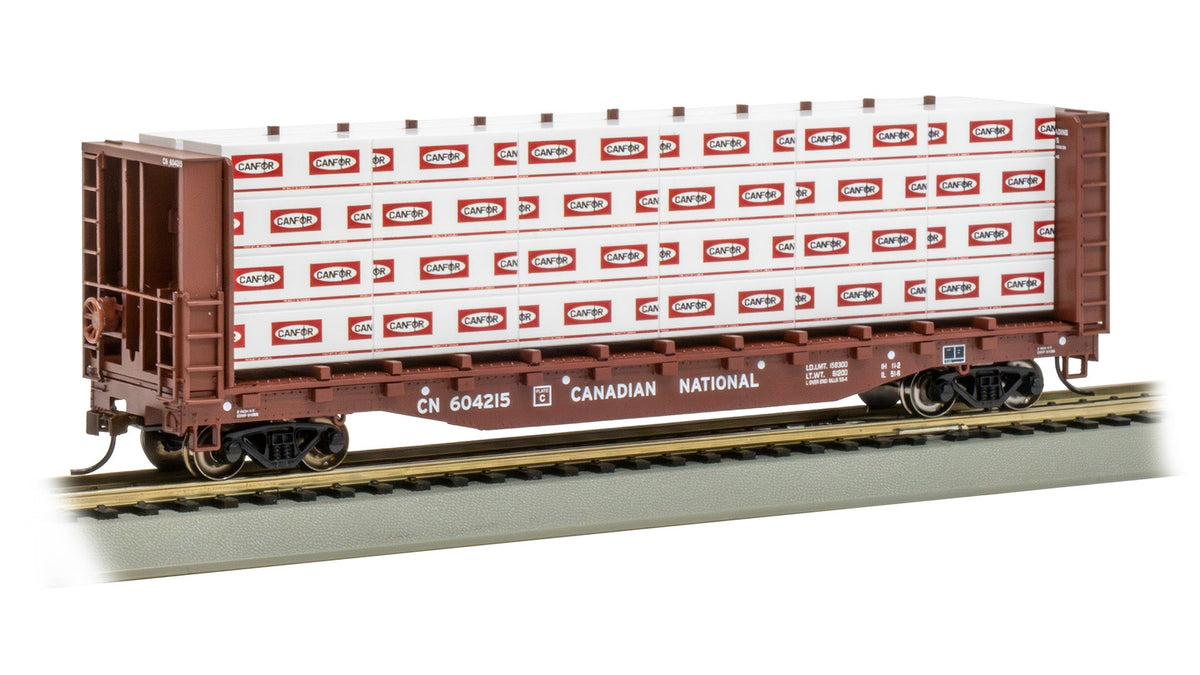
Bachmann HO 52-Foot Center-Beam Flatcar with Lumber Load - Canadian National #604215 can be considered in two parts: what it represents and how it fits the layout. Keeping those questions separate makes a mismatch easier to spot before regular service or permanent installation.
A closer look
Bachmann's HO scale 52' Center-Beam Flatcar with Lumber Load - Canadian National #604215 adds this railroad and equipment variant to a model train collection or layout. The wrapped lumber load lifts out for an empty-car display. The brake wheel is a separately fitted detail. E-Z Mate Mark II couplers provide magnetic uncoupling. Metal wheels have blackened finishes and RP25 contours.
The stated scale is HO scale. That scale should match the surrounding model, layout, or collection.
The manufacturer item number is 12926, while the Muncle Mikes item number is BAC12926. Those references help distinguish closely named products.
Start with scale, gauge, and product type
A locomotive, freight car, turnout, structure, decoder, and scenery accessory can all belong to the same railroad category while raising different compatibility questions. The stated scale and product type determine what should be checked next.
Match the item to the layout
Rolling stock and locomotives need suitable curves, clearances, wheel standards, and couplers. Track components need the correct gauge, rail code, geometry, and electrical plan. Structures and scenery need an appropriate footprint, height, era, and access for installation.
Test before permanent installation or regular service
Run rolling stock slowly through the tightest curve and most complicated turnout. Bench-test electrical items before connecting them to the full layout. Place structures with a paper footprint or temporary fastener before cutting scenery or gluing them down.
Keep maintenance practical
Inspect wheels, trucks, couplers, pickups, wires, and delicate details when the item arrives. Store the manufacturer and item number with the layout roster so matching parts and future maintenance do not depend on memory.
How it fits into a layout plan
Test the item at the most demanding point in its intended setup: a tight curve, turnout, platform edge, tunnel, grade, footprint, or electrical connection. A short controlled test is more useful than assuming everything in the same nominal scale will behave alike.
Track geometry matters as much as scale
Rail code, turnout direction, frog design, curve geometry, and connection style have to suit the adjoining track. Lay the component over the track plan before cutting roadbed or feeder wires, and check clearance for the longest equipment that will use the route.
Test the route before scenery closes it in
Roll several cars through the trackwork slowly in both directions. Watch wheel flanges, coupler swing, and the path of long cars. Electrical gaps, feeders, and switch-machine access are much easier to correct before ballast and scenery are added.
Study the exact product photographs


Use one final reversible check
Before the item is permanently altered, place it in the intended project, display or operating setup without adhesive or destructive work. Confirm access, clearance, visual scale and the ability to remove or maintain it later. When electrical or powered use applies, begin with the lowest-risk controlled test allowed by the instructions.
Write down any unresolved point rather than improvising an answer. A short pause for the correct dimension, material or interface is usually less expensive than repairing a product that was forced into the wrong role.
A careful first inspection
Begin with the exact reference BAC12926 and the current photographs for Bachmann HO 52-Foot Center-Beam Flatcar with Lumber Load - Canadian National #604215. Confirm the package or item, selected variant and visible components before discarding labels or separating small parts. Inspect high-risk areas such as thin trim, mirrors, fins, axles, couplers, clear pieces and electrical contacts when those features apply.
If the item will be modified, make one dated photograph of the starting condition. That image protects the product record and gives the builder a useful reference for reassembly, wheel alignment, paint placement or later troubleshooting.
Model railroad questions to settle
Does matching scale guarantee operating compatibility?
No. Track geometry, rail code, couplers, wheel standards, minimum radius, voltage and control systems can still differ.
What is the safest first test?
Use a clean, controlled section of track and begin slowly. Test the tightest curve, turnout, clearance point or electrical connection before regular service.
What belongs in the roster?
Record manufacturer, item number, road name or number, scale, coupler or connector standard and any maintenance or decoder changes.
Can instructions for a similar item be substituted?
Only after the exact manufacturer item and revision match. Similar bodies can contain different electronics, mechanisms or dimensions.
For related projects, browse Bachmann Model Trains & Railroad Models · Bachmann Model Trains.
Use one final reversible check
Before the item is permanently altered, place it in the intended project, display or operating setup without adhesive or destructive work. Confirm access, clearance, visual scale and the ability to remove or maintain it later. When electrical or powered use applies, begin with the lowest-risk controlled test allowed by the instructions.
Write down any unresolved point rather than improvising an answer. A short pause for the correct dimension, material or interface is usually less expensive than repairing a product that was forced into the wrong role.

