

Guías de Trenes en Miniatura
Bachmann 18519 HO Union Pacific #47754 Stock Car Guide
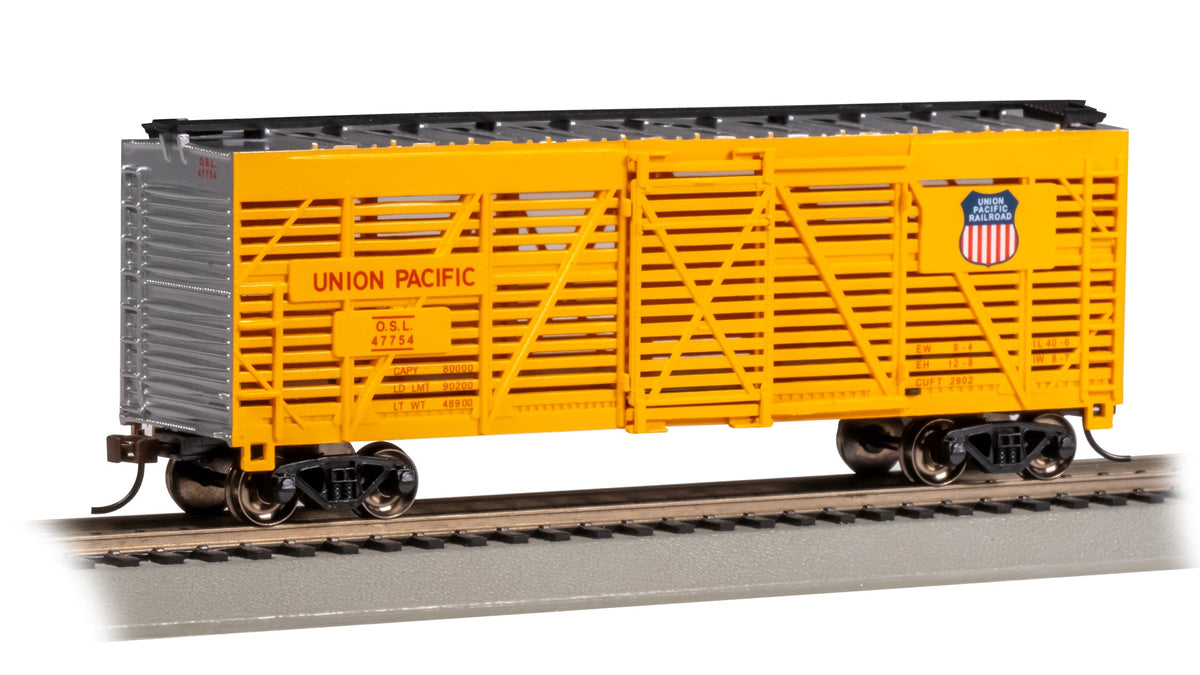
Bachmann 18519 is an HO-scale 40-foot stock car decorated for Union Pacific #47754. The yellow Union Pacific scheme and see-through wooden-plank sides make it easy to distinguish from solid-sided freight cars and other livestock-car releases. This guide focuses on the exact UP model, Bachmann’s listed features, and the checks that help it operate reliably on an HO layout.
Quick identity check
- Manufacturer: Bachmann
- Item number: 18519
- Store SKU: BAC18519
- UPC: 022899185194
- Scale: HO, 1:87
- Car type: 40-foot stock car
- Railroad and road number: Union Pacific #47754
- Model dimensions: 6 in. long × 1.5 in. wide × 2 in. high
Use the item number, UPC, and road number together when checking a product page or package. Union Pacific lettering appears on many types of rolling stock; the #47754 marking and ventilated plank-sided stock-car body identify this specific release more precisely than the railroad name alone.
Why the sides are see-through
Bachmann describes stock cars as freight equipment used to transport livestock to market. Traditional cars resemble boxcars but have louvered sides that allow ventilation. The model’s see-through wooden-plank sides carry that visual distinction into HO scale. This product description explains the type of car but does not mean livestock figures or cargo are included with item 18519.
The manufacturer lists detailed painted bodies with precision graphics, see-through plank sides, opening sliding doors, a detailed underframe, separately applied roofwalk and brake wheel, added weight, magnetically operated E-Z Mate Mark II couplers, detailed trucks with see-through sideframes, and blackened metal wheels with RP25 contours. The model dimensions are 6 × 1.5 × 2 inches; the retail package is 7.25 × 1.75 × 3.4 inches. Use the car measurements for layout planning and the larger package measurements for storage.
Layout clearance and operation
The listed height of 2 inches gives you a starting point for tunnel and bridge clearance checks. Measure from the railhead to the lowest obstruction and leave operating margin for track irregularities. Pay attention to the roofwalk and brake wheel: they are separately applied details and should not be pressed when lifting the car. On curves, the ends of the car swing outward, so check side clearance near platforms, signals, bridge supports, and neighboring cars.
Bachmann does not list a minimum curve radius on its product page. Test the actual model through the tightest curve, turnout, and grade transition where it will run, moving at low speed. Check that the plank sides and doors do not catch nearby scenery. The open-sided look can draw attention in a scene, but it does not change the basic wheel and coupler checks required for any freight car.
First-run checklist
- Match the item: Bachmann 18519, BAC18519, UPC 022899185194, UP #47754.
- Inspect the decoration: compare the yellow scheme and number with the current product images.
- Try the doors gently: confirm the sliding doors move without force.
- Check wheels and trucks: verify all wheels are seated and roll freely on HO track.
- Test couplers: check E-Z Mate Mark II operation with your locomotives and cars.
- Check overhead and side clearance: use the 2-inch height as a reference and leave margin.
These are practical, layout-specific checks; they do not guarantee compatibility with every radius, track brand, or coupler setup.
Placing UP #47754 in a consist
The road number is a useful roster key when building a Union Pacific freight train. Keep the model’s item number and road number together so that it does not get confused with other yellow UP freight cars. If you model a specific year, check the prototype history of the individual car and markings separately. Bachmann’s product page verifies the model’s identity and listed features but is not a complete historical record for UP #47754.
For display, the ventilated plank sides create a different visual texture from a solid boxcar. You can pair it with other livestock cars or use it as a contrast within a mixed freight consist. Add any figures or scene details separately and do not assume they are part of the package unless the current listing confirms them.
Buying and condition review
Before purchase, make sure the listing is HO item 18519 with Union Pacific #47754. Review the images for the yellow scheme, number, side construction, and doors. Use the live product page for current price and availability, which can change. When buying used, request clear photos of both sides, the underframe, couplers, trucks, and packaging. Ask if the doors work and whether the separately applied roofwalk or brake wheel has been damaged.
See the official Bachmann 18519 product page for manufacturer details and our Bachmann Model Trains and Model Trains collections for related equipment.
Frequently asked questions
What is the road number?
Union Pacific #47754.
What scale is it?
HO, 1:87.
Does the model include livestock?
The manufacturer features reviewed do not list livestock figures or cargo as included. Confirm package contents on the live product page.
Do the doors open?
Yes. Bachmann lists opening, sliding doors as a feature.
Does Bachmann list a minimum curve radius?
No minimum radius appears in the product details reviewed. Test the model on your layout’s tightest trackwork.
Bottom line: Bachmann 18519 is the HO Union Pacific #47754 40-foot stock car, with ventilated sides, sliding doors, and a listed 6 × 1.5 × 2-inch size. Match the exact identifiers, protect the applied roof details, and test its doors, trucks, and couplers on your railroad.
View Bachmann HO Union Pacific #47754 Stock Car (18519)
Product details checked against Bachmann’s manufacturer listing and the live store record on October 18, 2026. Current price and availability remain on the product page.

