

Guías de Trenes en Miniatura
Bachmann 18204 Rio Grande #67422: HO Hi-Cube Boxcar Guide
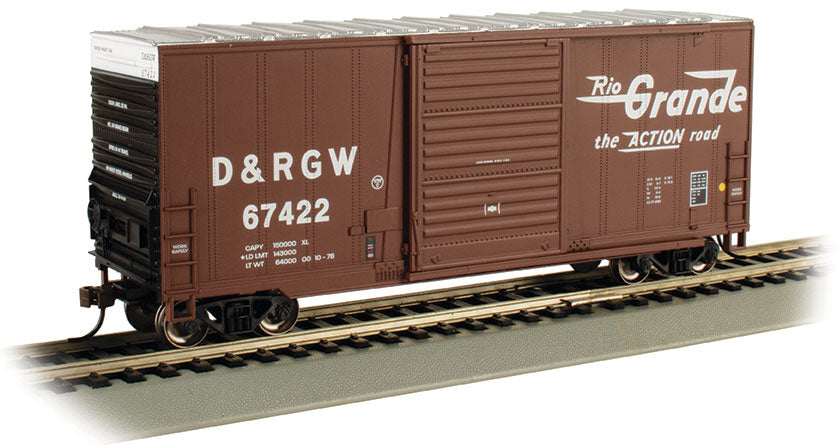
Bachmann 18204 Denver & Rio Grande Western #67422 is an HO-scale 40-foot steel Hi-Cube boxcar with a sliding door and boxcar-red paint scheme with white lettering and the Flying Grande logo. Its identifiers are Bachmann item 18204, SKU BAC18204, and UPC 022899182049. The model measures 6.4 inches long, 1.6 inches wide, and 2.4 inches high. This guide shows how to match the D&RGW release, understand the Hi-Cube distinction, and check the car’s fit and operation on an HO layout.
Match the Rio Grande #67422 release
Use the full railroad name and road number—Denver & Rio Grande Western #67422—with Bachmann item 18204 and UPC 022899182049. The retailer SKU is BAC18204. The product record identifies this release as a 40-foot steel Hi-Cube boxcar with a sliding door, in boxcar red with white lettering and a Flying Grande logo. Confirm those details against the exact product image; “Rio Grande” alone may not separate it from a different car type or decoration.
The 6.4-inch length is the size of the model, not the full-size car. Bachmann lists it at 6.4 inches long by 1.6 inches wide by 2.4 inches high; the retail package is 7.25 by 1.75 by 3.4 inches. Use model measurements to plan a shelf or trackside clearance and package measurements for storage with the box retained.
What “Hi-Cube” adds to the scene
Hi-Cube box cars have a taller body than standard-height box cars. Bachmann’s official Hi-Cube product description explains that the design provides more interior capacity and was used for larger freight. This makes the car’s taller profile a visible point of difference when you place it beside ordinary box cars. Compare the roofline and door proportions in a mixed freight train to show the change in car design.
The model’s road name, number, and product type identify the Bachmann release; they do not by themselves prove the real car’s build date, specific freight, route, or precise operating years. If your layout depicts an exact D&RGW year or prototype assignment, consult dated railroad photographs or equipment registers. For a broad scene, use the car as a rostered Rio Grande Hi-Cube boxcar without assigning a historical cargo the documentation does not establish.
Plan space for the model’s height and length
At HO 1:87 scale, item 18204 belongs with HO track, structures, and rolling stock. Its 2.4-inch model height is the measurement to consider around tunnels, loading platforms, overhead bridges, and low roof details. Check side clearance too: the listed width is 1.6 inches. On a shelf or in a display case, compare those dimensions with neighboring models and any lighting or support brackets.
The body is 6.4 inches long, so it may fit shorter sidings than a longer 50-foot model, but couplers and the locomotive used in a switching move still need room. Measure the useful siding from turnout clearance to bumper. If you want the engine to enter the spur with the car, include its length and the clearance needed to uncouple.
Wheels, trucks, and couplers
The product record lists blackened machined-metal wheels with RP25 contours, magnetically operated body-mounted E-Z Mate couplers, non-magnetic axles with needle-point bearings, Celcon trucks, and added weight. These are useful details for layout planning and inspection. They do not guarantee operation on every curve, turnout, or mixed-brand layout, so test the actual car with your equipment.
Start on a clean, level track section and check that the wheels roll freely and the trucks pivot. Then run the car through the tightest curve and most restrictive turnout in your route. Confirm coupler height with a gauge if it must mix with other manufacturers, and test magnetic uncoupling using your layout’s specific magnet placement. Slow tests with a short consist make it easier to spot a clearance or coupling issue.
Inspection and roster notes
- Paint and lettering: Verify the red-brown body, white lettering, Flying Grande logo, and #67422.
- Sliding door: Check the door configuration against the exact product photos.
- Roofline: Use the 2.4-inch height when checking bridges, tunnels, and loading structures.
- Wheels and trucks: Confirm free rolling, correct seating, and unobstructed truck movement.
- Body-mounted couplers: Check height, swing, and magnetic operation on your layout.
- Item record: Keep 18204, BAC18204, UPC 022899182049, and road number 67422 together in your roster.
When the model arrives, record the condition you actually observe and save a photo of the car and package. That creates a reliable reference for future maintenance or replacement without confusing a later observation with a factory specification.
Questions about Bachmann 18204
Is this car an HO Hi-Cube model?
Yes. Its product record identifies an HO 1:87, 40-foot steel Hi-Cube boxcar with a sliding door.
How high is the model?
The listed model height is 2.4 inches. Check that against bridges, tunnel portals, and nearby scenery.
Does the model establish an exact Rio Grande service date?
No. Use dated railroad records for a specific prototype history or operating year.
Will it fit every HO layout?
Confirm your layout’s scale, track clearances, curve behavior, coupler height, and magnetic uncoupling setup.
Quick checklist
- Match D&RGW #67422, Bachmann item 18204, and UPC 022899182049.
- Confirm HO 1:87 suits your layout.
- Check model dimensions of 6.4 × 1.6 × 2.4 inches against track and structures.
- Test wheels, trucks, body-mounted couplers, and curves.
- Use primary references for precise prototype-era claims.
See the Bachmann 18204 Rio Grande Hi-Cube boxcar listing for current details and availability. Browse HO scale model trains and Bachmann models to compare freight cars. Product identity and dimensions were checked against the active product record on October 18, 2026; the broader Hi-Cube context follows Bachmann’s official Hi-Cube boxcar descriptions. Price and inventory are omitted because they change.

