

Guías de cohetes modelo
Model Rockets Buying Guide: Kits, Launch Sets, Motors and Recovery
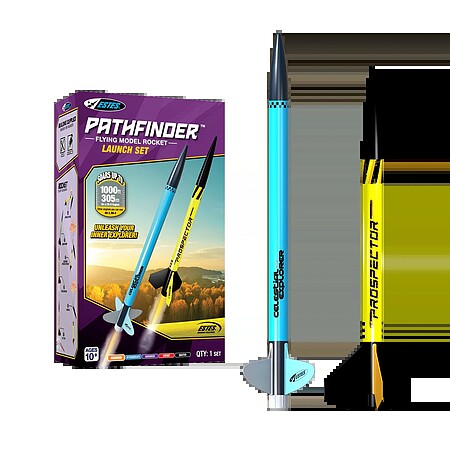
Model rockets are easiest to buy when you separate four decisions: the rocket kit, the launch equipment, the approved motor, and the recovery plan. A package may solve one, two, or three of those needs, but rarely should a buyer assume it solves all four. The exact kit instructions connect the pieces and should remain with the rocket for its entire flying life.
This buying guide is about physical product selection. For the full operating process and safety framework, read the model rocketry guide and the current NAR Model Rocket Safety Code. For Estes-specific choices, use the Estes rockets guide.
Choose the right product type
Rocket kit
A kit provides the parts needed to build the rocket as described, but it may not include adhesive, finishing supplies, motors, starters, recovery protection, pad, or controller. Traditional kits offer more construction experience; quick-build kits reduce preparation. Compare the instruction sheet and contents, not just the package photograph.
Launch set
A launch set is designed to give a new flyer more of the ground system. It may include a rocket, pad, and controller, but the exact package must be checked. The Estes Pathfinder Launch Set #3238 is an example of a product that should be evaluated by its stated contents, recommended motors, and field needs. Browse other complete packages in Model Rocket Launch Sets.
Bulk or classroom pack
Bulk packs can support clubs, classes, and group builds. They require planning for tools, adhesives, finishing, motors, range control, adult supervision, and storage across many participants. A lower per-rocket packaging count does not eliminate the need for exact instructions and individual quality checks.
Match construction difficulty to the builder
A first rocket should teach success. Look for clearly formed parts, manageable fin alignment, an understandable recovery system, and instructions the builder can follow. Adults helping young builders should plan enough time for adhesive curing and paint rather than rushing to launch.
Intermediate and advanced kits may use more parts, complex fin shapes, larger body tubes, transitions, scale details, or finishing steps. Muncle Mikes separates beginner, intermediate, and advanced model rocket kits for navigation, but the exact manufacturer guidance is the authority.
Use dimensions and weight to plan the field
A tall or heavy rocket is not necessarily more difficult, but it may need different motors, guide equipment, and field conditions. A small rocket may fly very high and become harder to track. Read length, diameter, weight, recovery type, and expected performance together.
Bright color and a visible recovery device can help tracking. The Estes Red Flare #1954, for example, should still be selected from its instructions and approved motor range rather than from color or name. Consider how the model will be seen against the actual sky and terrain.
Buy motors from the instruction table
The motor recommendation table connects the rocket to approved performance. It accounts for the design, mass, stability, delay, and recovery sequence. Do not simply choose the largest letter or the longest delay. A delay that is wrong for the flight can deploy recovery too early or too late.
Motor availability should be checked before committing to a kit, especially if local access or shipping restrictions matter. Muncle Mikes organizes Estes model rocket engines and engine flight packs, but every purchase must be cross-checked against the exact rocket instructions.
Confirm the launch equipment
- Pad: stable, compatible with the required launch rod or rail, and equipped with a blast deflector.
- Guide: correct diameter or rail format, straight, clean, and long enough for the model.
- Controller: electrical, with the required safety interlock, lead length, and power source.
- Starters or igniters: compatible with the approved motors and used exactly as directed.
- Recovery protection: flame-resistant wadding or the specified protector.
- Field tools: tape, spare starters, cleaning supplies, checklist, and a safe motor storage method.
Do not make a home-built launch controller or substitute a battery system unless you have the technical knowledge, legal authority, and an accepted design appropriate to the event. For a first flyer, a recognized launch set and manufacturer instructions reduce avoidable uncertainty.
Recovery determines how much field you need
Parachutes can provide gentle descent but drift. Streamers can stay closer but descend faster. Large, light rockets can drift substantially even in modest wind. Choose the motor and launch day based on the available field, not the altitude claim on the package.
Inspect the recovery components before purchase if the kit is open or used. Shock cord, canopy, shroud lines, swivels, attachment tabs, and nose cone must be present or correctly replaceable. Used rockets should not be flown until construction, stability, motor mount, and recovery have been evaluated by someone competent.
New, built or used
An unbuilt kit gives the builder control over alignment, adhesive, finishing, and inspection. A professionally or carefully built rocket may save time, but quality must be verified. A used rocket can hide heat damage, weak paper tubes, old elastic, cracked fins, or a modified motor mount.
Ask for clear photos of the fin joints, motor mount, recovery anchor, launch guide, body-tube ends, and internal condition where visible. Avoid any rocket with an unknown or altered propulsion system.
A complete purchase checklist
- Exact kit name and product number.
- Current instructions and complete parts.
- Skill level suited to the builder.
- Approved motor choices available for the intended field.
- Correct pad, guide, controller, and electrical power.
- Starters, recovery protection, and repair supplies.
- Legal launch site, permission, current fire conditions, and suitable weather.
- Storage for the rocket, motors, and launch equipment.
Frequently asked questions
Are model rockets reusable?
Many are designed for repeated flights when recovered safely and inspected after each launch. Motors are single-use unless the product belongs to a separately specified reloadable system. Follow the exact instructions.
What is the difference between a rocket kit and launch set?
A kit centers on building the rocket. A launch set adds some ground equipment. Contents vary, so read the listing rather than relying on the category name.
Should a beginner buy the highest-flying model?
No. Visibility, field size, recovery, construction success, and repeatability matter more. A lower flight that returns safely is a better first experience.
Muncle Mikes tip: Buy the entire flight system on paper before ordering. Missing one controller, guide, motor, or recovery supply can stop launch day.

