

Diecast Model Guides
1:18 Scale Cars: Dimensions, Fit and Shelf Planning
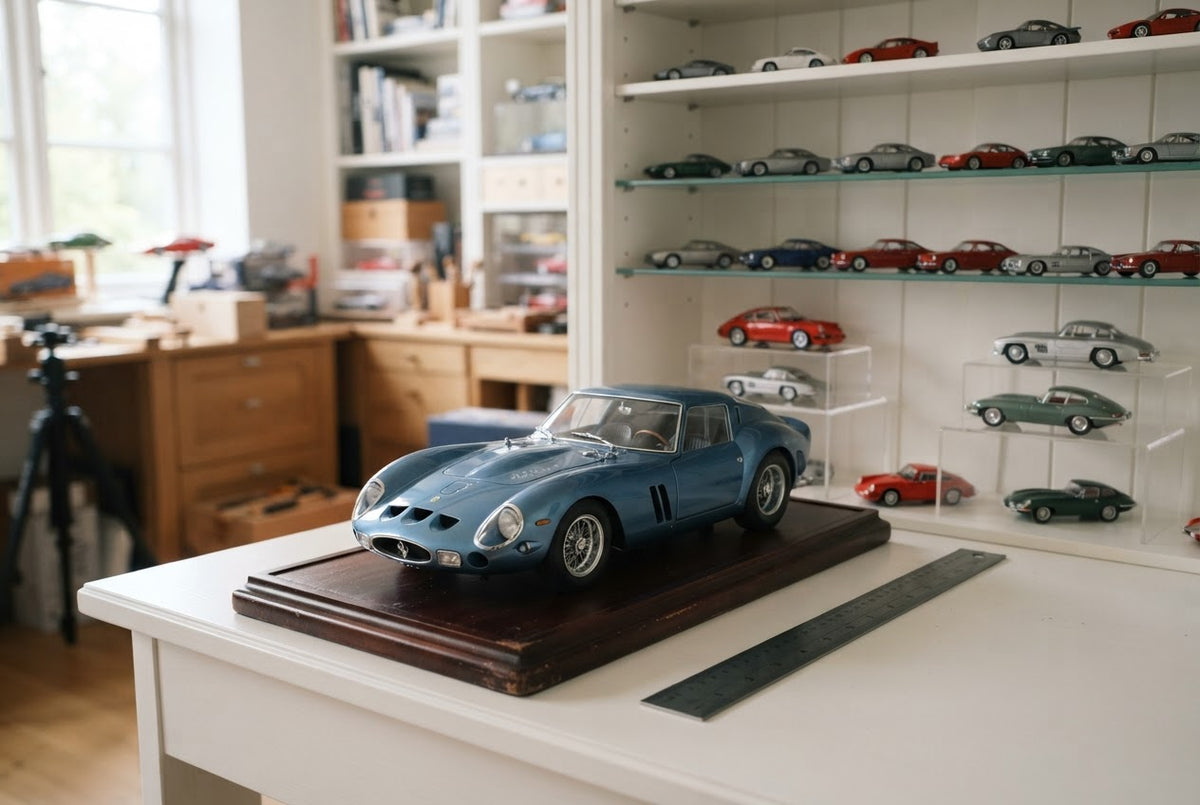
1:18 scale cars are eighteen times smaller than the full-size vehicles they represent, but that simple ratio becomes useful only when it is translated into shelf depth, case width, door clearance, and collection capacity. A compact sports car and a long luxury sedan share the same scale while occupying very different amounts of space. Bases, mirrors, wings, open doors, and packaging add more.
This guide is about dimensions and fit. It explains how to estimate model size from real-car measurements, how much clearance to add, why “1:18” does not guarantee identical proportions between manufacturers, and how to plan cabinets before the collection outgrows them. For feature and finish evaluation, see the companion 1:18 model cars buying guide.
How large are 1:18 scale cars?
Divide the full-size vehicle dimension by eighteen using the same units. A real car about 180 inches long scales to about 10 inches. A 198-inch vehicle scales to about 11 inches. Width and height scale the same way. These are planning estimates; the finished model may differ because published vehicle dimensions can exclude mirrors, and manufacturers may simplify or interpret certain proportions.
Wheelbase is another useful check. Dividing the prototype wheelbase by eighteen gives an expected model wheelbase. If the body looks unusually stretched or compressed, wheelbase and overall length can help identify whether the difference comes from the real vehicle or the model.
Plan cabinet width, depth, and height
Do not size the shelf to the body alone. Add side clearance for mirrors and fingers. Add front and rear clearance so bumpers and spoilers do not touch the case. Add height for antennas, roof accessories, open hoods, or display stands. A model angled on a shelf uses more width and depth than one parked straight.
A wagon such as the 1:18 BMW M5 Touring may need different spacing from an open-wheel race car. Measure the actual base when the model is sold mounted. Bases can be longer and wider than the vehicle and may determine the cabinet footprint.
Why 1:18 models from different makers can look different
Scale labels describe intent, but tooling choices, reference data, tire dimensions, ride height, and production tolerances affect appearance. Some models prioritize opening mechanisms; others prioritize a sealed silhouette. A hinge can require thicker pillars or different interior packaging. Resin models may capture sharp exterior forms while omitting openings.
Compare the same prototype, not unrelated vehicles. A low supercar should appear much shorter than an SUV even in identical scale. When accuracy matters, use prototype length, width, height, and wheelbase rather than expecting every 1:18 box to occupy the same volume.
Open features change the required space
An opening door can nearly double the width needed for photography or full display. A hood may require significant vertical clearance, and a trunk lid can extend beyond the rear. Gullwing, scissor, butterfly, and upward-opening doors create especially tall display poses.
If the cabinet is shallow, plan to display panels closed and confirm they sit flush. If open-engine presentation is important, measure the model with the hood raised before buying a case. The visual drama of an open model is lost when the case forces every feature closed.
Calculate collection capacity realistically
Take usable shelf width and divide by the planned model pitch—the car’s width plus breathing room. Then check depth and door opening. A 36-inch shelf might theoretically hold several models, but tight packing makes dusting and removal risky. Leave enough space to lift one car without moving an entire row.
Mixing orientations can increase capacity, but it can also create visual clutter. A consistent straight presentation is easier to catalog. If more cars are planned, standardize a shelf module or case size and reserve expansion space instead of filling the first cabinet completely.
Shipping, storage, and handling dimensions
The retail box can be much larger than the model because of foam, formed plastic, display base, and outer carton. Keep a separate storage area for packaging. Do not assume a cabinet that fits the car will fit the box.
Large models are heavy enough to damage delicate parts if they shift. Support the chassis or base with both hands. A model such as the 1:18 Bburago Red Bull RB21 has exposed aerodynamic pieces that require different handling from a closed-body road car. Scale planning includes the safe route from box to shelf.
1:18 scale space-planning checklist
- Divide prototype length, width, height, and wheelbase by eighteen for a first estimate.
- Add mirror, spoiler, antenna, base, and finger clearance.
- Measure open doors, hood, or trunk if they will be displayed.
- Use actual product or base dimensions whenever available.
- Plan shelf pitch with breathing room, not edge-to-edge capacity.
- Reserve storage for boxes and protective packaging.
- Check the lifting path and support the model from the chassis or base.
Measure the case, base, and opening envelope
The car’s nose-to-tail length is only the first measurement. Many 1:18 models sit on a base wider than the tires, and an acrylic cover adds wall thickness and lifting clearance. Opening doors can nearly double the required width, while a raised hood or rear hatch changes shelf pitch. Mirrors and antennas may extend beyond the body and need a safety margin.
Make a paper rectangle using the largest width and depth of the complete display, then place it on the intended shelf. Add a second outline for doors or panels if they will be shown open. This simple test catches conflicts with cabinet doors, shelf supports, lighting bars, and neighboring models before a large car is ordered.
Frequently asked questions
How long is a typical 1:18 model car?
Many passenger-car models are roughly ten to twelve inches long, but compact cars, race cars, trucks, and limousines vary. Divide the real vehicle length by eighteen for a better estimate.
Is every 1:18 model exactly one-eighteenth scale?
Manufacturers aim for the stated scale, but reference choices, tooling, tires, opening mechanisms, and tolerances can produce differences. Compare prototype dimensions when precision matters.
How deep should a display shelf be?
It should exceed the model or base depth and leave clearance at the front and rear. Angled display and open doors require more depth. Measure the actual intended pose.
Can 1:18 and 1:24 cars share a display?
They can share a cabinet, but the scale difference will be visually obvious. Grouping each scale on its own shelf usually creates a more coherent presentation.
Measure 1:18 scale cars before building the collection
The ratio behind 1:18 scale cars is simple, but good display planning includes the prototype’s real size, the model’s base, mirrors, open panels, handling clearance, and packaging.
Calculate first, then verify the actual product dimensions. A cabinet with deliberate spacing protects the cars and makes each one easier to see. In a large scale, empty space is part of the display rather than wasted capacity.

