

Model Rocket Guides
Model Rocketry Guide: Building, Launching and Recovering Safely
Model rocketry is a complete flight hobby: design and construction, motor selection, launch equipment, weather judgment, range safety, recovery, inspection, and recordkeeping. The rocket on the workbench is only one part of the system. A careful flyer plans the field and recovery before installing a motor, and treats every launch as an operation that must be safe enough to repeat.
This guide explains the hobby from first build through post-flight inspection. It is not a substitute for a kit’s instructions, the current NAR Model Rocket Safety Code, local law, landowner permission, fire restrictions, or launch-organizer rules. Use those sources for the real launch. Muncle Mikes provides public pathways for individual model rocket kits, launch sets, and engines and flight packs.
The model rocketry system
A typical flight system includes the airframe, fins, nose cone, recovery components, motor mount, approved motor, starter or igniter, launch pad, guide rod or rail, electrical controller, blast deflector, and a suitable outdoor range. The motor produces thrust; the delay allows the rocket to coast; the ejection event deploys the recovery system. Each component must match the rocket and instructions.
Do not improvise motors, alter propellant, or substitute launch wiring. The NAR code calls for lightweight non-metallic structural parts in the model rocket, certified commercially made motors, and an electrical launch system with a safety interlock. These requirements are foundational, not optional “advanced” practices.
Build straight and light
Alignment matters. Crooked fins, a tilted motor mount, a loose launch lug, or an obstructed guide can create unstable or unpredictable flight. Dry-fit parts, mark reference lines, use an alignment method, and let adhesive cure fully. Keep glue fillets neat rather than heavy; unnecessary weight can shift performance and stress recovery.
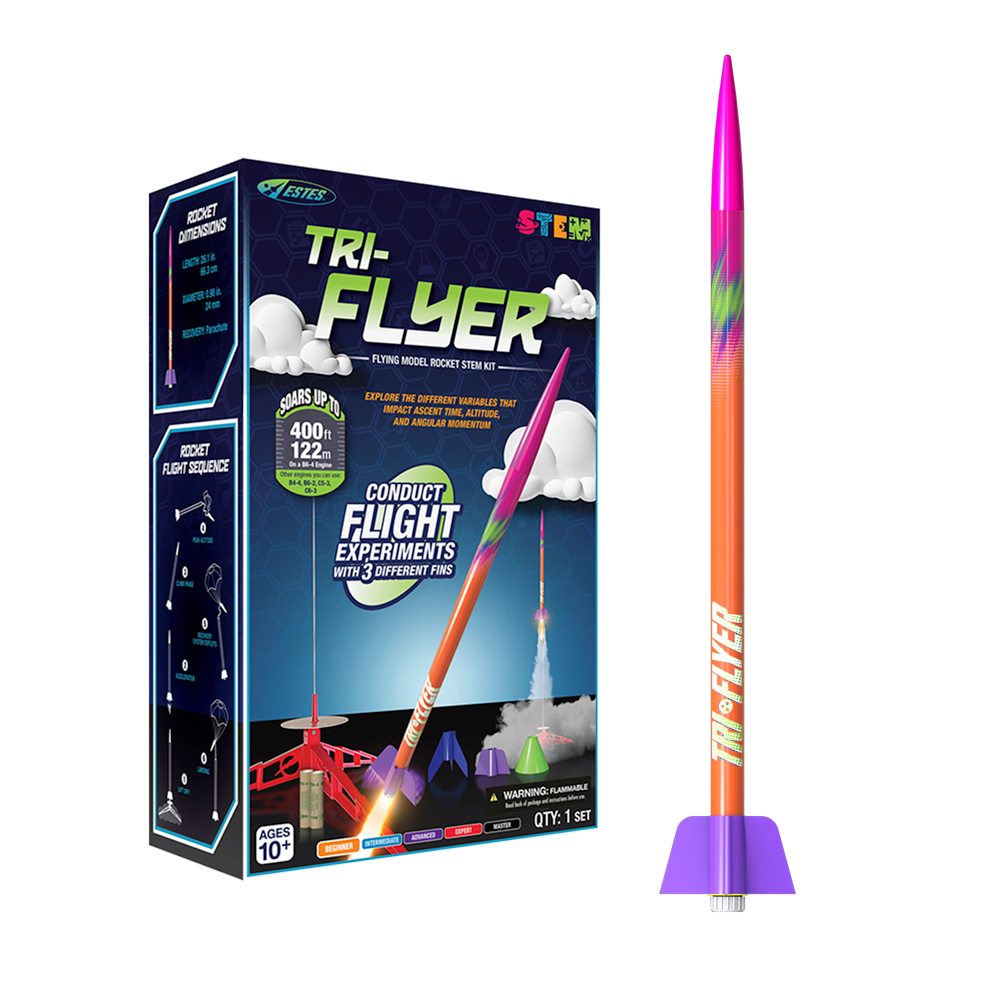
The Estes Tri-Flyer STEM Kit #0647 is one example of a project that can connect construction with repeated observation. Whatever the kit, follow the manufacturer’s sequence. Sand and paint only as the materials allow, keep paint out of couplers and moving joints, and verify that the motor retainer and recovery system remain functional after finishing.
Build, observe and inspect: Estes Tri-Flyer 0647

The Tri-Flyer offers a practical way to compare the permitted fin configurations while keeping careful flight notes. Start with its exact instructions and record the chosen setup before each flight. Change only what the manufacturer permits, and compare observations under suitable conditions.
Check the Tri-Flyer kit and required launch supplies, or browse model rockets and launch equipment to match an existing setup.
Understand motors without guessing
Model rocket motor designations communicate total impulse class, average thrust, and delay, but correct selection still comes from the exact rocket instructions. The same rocket may have several approved choices for different field sizes and conditions. More impulse can mean more altitude, speed, drift, and recovery distance; it does not automatically mean a better flight.
Store motors as directed, keep them dry and protected, transport them responsibly, and use only intact products. Use certified commercial motors exactly as supplied and instructed. Do not cut, drill, combine, alter or attempt to repair a motor.
Choose a legal, safe launch site
The launch field should be open, outdoor, and free from dry vegetation, power lines, tall trees, buildings, road traffic, and other hazards. The size must suit the motor and expected altitude. The NAR code includes minimum site dimensions and minimum personnel distances. It also limits launch in high wind and unsafe weather.
Check landowner permission, local ordinances, fire-season restrictions, and any park or school rules. FAA treatment depends on the rocket class and operation; review the FAA’s current amateur rocket guidance and the NAR’s laws and regulations resources. When conditions are questionable, postpone.
Set up a controlled range
- Define the launch point, spectator line, preparation area, and recovery direction.
- Install the pad on stable ground with a working blast deflector.
- Angle the guide only within the limits allowed by the safety code and conditions.
- Connect the starter only when the rocket is on the pad and the range is controlled.
- Keep the safety interlock or key out until the range safety sequence calls for it.
- Give an audible countdown and confirm the sky and recovery area are clear.
- After a misfire, remove power and wait the required 60 seconds before approaching.
One person should clearly control the launch system. Group launches benefit from a designated range safety officer or experienced leader. Spectators should know where to stand and when the range is closed.
Pack recovery for the weather
Parachutes, streamers, and other recovery systems must deploy freely. Use the specified flame-resistant wadding or protector so hot ejection gases do not damage the recovery material. Untangle lines, inspect attachment points, and test that the nose cone or payload section separates with the intended resistance.
Wind affects recovery more than many new flyers expect. A broad parachute can drift far; a streamer may reduce drift but descend faster. Use only recovery options allowed by the design and instructions. Never launch toward buildings, roads, spectators, trees, or power lines in the hope that the wind will change.
Observe the whole flight
Assign a spotter to watch apogee, deployment, descent, and landing. Note whether the rocket weathercocked into the wind, spun, arced, deployed early or late, descended too fast, or drifted beyond the expected area. A phone video can help, but do not let filming distract from range safety or sky watch.
Do not attempt recovery from power lines, tall trees, rooftops, steep terrain, water, or other dangerous places. The rocket is replaceable. The NAR safety code explicitly warns against hazardous recovery attempts.
Inspect before flying again
- Airframe for dents, heat damage, loose seams, and soft tube ends.
- Fins for cracks, looseness, warping, and alignment.
- Motor mount and retainer for charring, looseness, or deformation.
- Shock cord and attachment points for burns, cuts, and stretching.
- Parachute or streamer for melted areas, torn material, and tangled lines.
- Nose cone and couplers for free but secure movement.
- Launch lug or rail buttons for alignment and firm attachment.
Log the date, rocket, motor, weather, approximate field, deployment behavior, landing condition, and repairs. A simple flight card turns repeated launches into useful evidence. It also prevents repeating a motor-and-weather combination that produced excessive drift.
What to compare after a flight
| Observation | Check before another flight | Next decision |
|---|---|---|
| Long drift with normal deployment | Wind, permitted motor and available recovery area. | Choose suitable conditions and an approved setup; postpone when the field is insufficient. |
| Damaged or tangled recovery material | Heat protection, lines, attachments and packing instructions. | Repair or replace correctly before another launch. |
| Loose fin or damaged tube | Structural integrity and alignment. | Keep the rocket out of service until the damage is properly resolved. |
Progress through skill, not altitude
Beginners should first achieve straight construction, reliable ignition, stable boost, correct deployment, safe recovery, and accurate post-flight inspection. Then progress to more complex finishing, clustered design only where permitted and instructed, larger models, or advanced certification pathways. The model rockets buying guide helps choose the physical equipment, while the Estes rockets guide focuses on that brand’s purchase path.
Frequently asked questions
Is model rocketry safe?
It can be conducted safely when flyers use approved equipment, follow the safety code and instructions, choose a suitable legal field, control the range, and postpone in unsafe conditions. No launch is risk-free.
Can I launch alone?
Local rules and event policies vary, but a spotter or experienced helper improves sky watch, range control, and recovery. Young flyers require responsible adult supervision.
What is the best first goal?
A straight flight with correct deployment, safe recovery, and a rocket ready to fly again. Altitude is secondary to repeatable success.
Muncle Mikes tip: The launch decision belongs to the conditions in front of you. A finished rocket does not create an obligation to fly that day.
Return to model rockets with your equipment list, or continue through the Learning Center.

