

Model Train Guides
Bachmann Stallion 24025: First Setup and Layout Planning
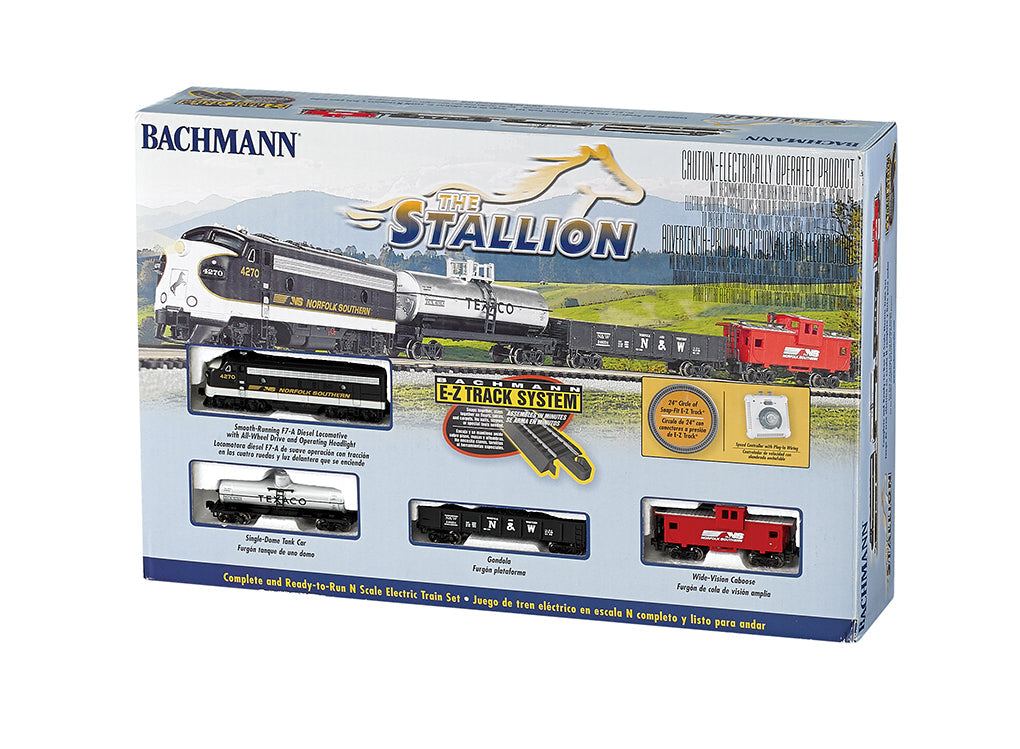
Start a Bachmann Stallion 24025 setup by choosing the operating surface and assembling the included circle. Leave scenery and additional track for a later session. That gives you a simple first railway to learn from, with room to discover whether you enjoy watching a freight train circulate, arranging a scene, or planning a more involved layout.
The set is an N scale, 1:160 model of a Norfolk Southern freight train. Its F7-A diesel has a working headlight and comes with a gondola, tank car and caboose. You can check the exact set and current ordering options on the Bachmann 24025 product page.
Plan a working area around the 24-inch circle
Bachmann specifies a 24-inch circle of E-Z Track. Treat that figure as the starting point for your layout plan. Your hands, the controller and the connecting wire also need space. A board cut exactly to the quoted track dimensions leaves little room to reach a derailed car or keep equipment back from the edge.
Before choosing a permanent base, lay out a paper square representing the circle and decide where you will sit or stand. Can you comfortably reach the far side? Can the controller rest securely where its cable will not pull on the track? Will the surface remain available, or must the railroad be packed away after each session? These questions determine whether a table, removable board or dedicated layout space is the more practical choice.
The manufacturer's 24025 specification lists eleven curved sections and one curved terminal rerailer. The terminal section completes the twelve-section circle; it is not an extra piece to add after closing the loop.
Give the first assembly its own session
Choose a firm, level, dry surface and keep the track accessible. Arrange the sections loosely before joining them, with the terminal rerailer facing a convenient place for the controller. Resist attaching scenery immediately. An open layout makes it easier to inspect connections and move a section without damaging a building or landscape.
The small metal joiners matter as much as the plastic roadbed connection. Each rail must enter its joiner correctly, with the rail tops level across the joint. Bachmann's illustrated E-Z Track assembly instructions show this connection and include English and Spanish directions. Follow the instructions supplied with your particular set for the power connections.
A useful habit is to inspect one completed joint before making the next. If a section looks uneven, correct it with the power disconnected before putting the train on it. Finishing the circle slowly is easier than searching all twelve joints after scenery has hidden them.
Use the first runs to understand the train
For your own setup notes, separate the first locomotive check from the first complete-train check. A locomotive-only run makes it easier to see where the engine hesitates; adding the cars afterward helps you distinguish a track issue from a wheel that was not seated correctly. Keep the speed modest enough to watch the wheels as they pass each joint.
If the train stops, switch off and unplug the power before inspecting wheels, track and leads. Bachmann's manual identifies misplaced wheels, loose connections and incorrectly joined track among the checks to make. Do not keep increasing the control setting to force a stalled train through a problem.
Write down the location of a repeated hesitation using a simple landmark, such as “the joint beside the controller.” A precise observation is more useful than “it runs badly.” When you adjust one thing at a time, you can tell whether that change solved the problem.
Know what the controls and cars let you do
This set uses conventional DC control. Plan around the supplied power pack and speed controller; check separately if a future project calls for DCC or onboard sound. Bachmann specifies a US-style 110-volt power supply, so anyone using another country's electrical system should establish the correct power arrangement before connecting it.
The three cars give a first freight train visibly different shapes. The gondola includes a removable coal load, the tank car has a single dome, and the caboose finishes the consist. That variety can guide a scene: sketch where a loading area might sit, how a road might approach it, and which side of the train you want viewers to see. These are layout ideas, not extra buildings or accessories included in the box.
Choose an expansion by the job you want it to do
A useful first expansion begins with a sentence: “I want a longer run,” “I want a place to leave a freight car,” or “I want a small scenic railroad I can put away.” Each goal leads to a different track plan. Buying assorted track first can leave you with pieces that do not form the shape you intended.
For a straightforward extension, begin with N scale Bachmann E-Z Track and verify the geometry of the proposed plan. The E-Z Track name also appears on other scales, so the scale marking still matters. Check the minimum curve requirements of any additional locomotive or car before assuming it belongs on the original circle.
Draw the new arrangement before ordering. Include the controller location, room to reach track joints, and access to any turnout. A siding introduces another useful decision: where will a car wait while the locomotive moves elsewhere? Solving that on paper helps the added track support an activity instead of merely occupying more table space.
Make the set easy to enjoy again
For a gift, check the intended user's available space and comfort with small models. Bachmann recommends this set for ages fourteen and up. A clear surface and time for a first setup session can be more useful than a pile of unverified accessories.
If the railroad will be temporary, keep the molded packaging and instruction booklet together. Decide where the disconnected track, controller and cars will go before the first pack-up. A repeatable storage arrangement makes the next session easier to start and reduces the chance that a small component is left behind.
Explore model trains and railroad supplies when you know the next task, or return to Muncle Mikes Product Guides for more practical buying and hobby guidance.

