

Model Train Guides
HO Scale Trains: Track, Power, Rolling Stock and Layout Planning
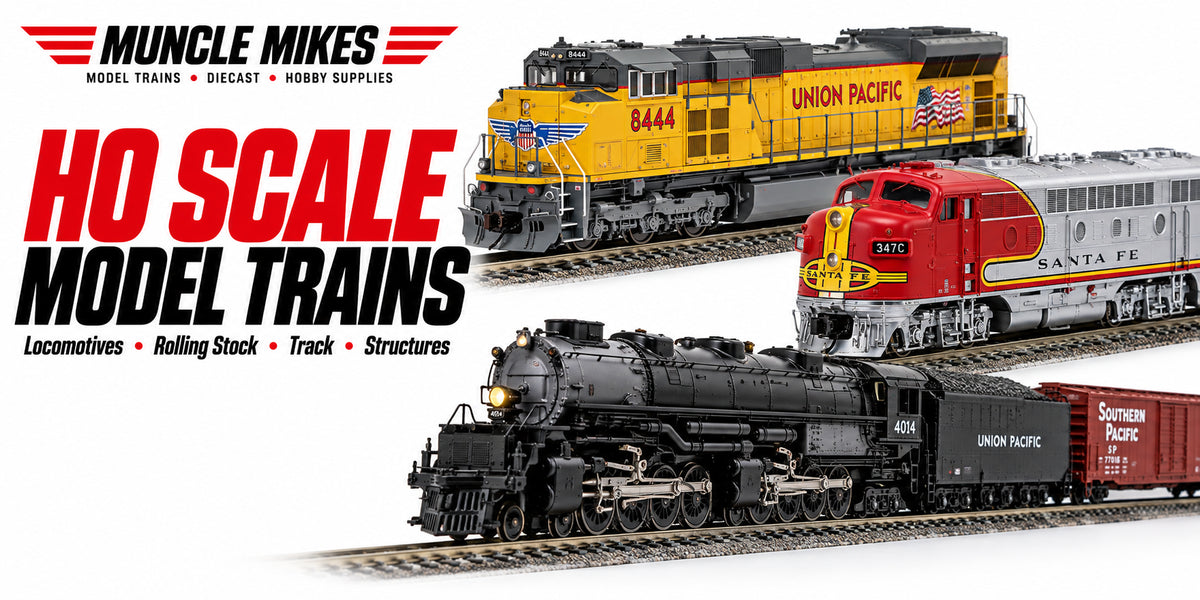
HO scale trains are a system, not just a locomotive size. A reliable first layout needs track with a known geometry, a compatible power and control method, locomotives that can handle the curves, rolling stock with workable couplers and enough room to reach the entire railroad.
Browse HO scale trains at Muncle Mikes for locomotives, cars, track and sets. The separate HO train-set guide focuses on complete starter packages; use this guide to connect those purchases into a workable layout.
Know what HO tells you—and what it does not
HO scale is 1:87.1, with nominal 16.5 mm track gauge for standard-gauge subjects. That helps match the broad size family, but it does not guarantee electrical compatibility, coupler compatibility, curve clearance or digital features. A British OO model can also use 16.5 mm track while representing a different scale proportion.
Record the manufacturer, model, item number, control format, minimum curve and coupler type for every locomotive or car you plan to combine. “HO locomotive” is not enough information for a purchase or a compatibility question.
Choose the operation before designing the track
| Goal | Track priority | Rolling-stock priority |
|---|---|---|
| Continuous running | A complete loop with curves suitable for the longest equipment. | A locomotive and train length that fit the loop and available power. |
| Switching industries | Turnouts, sidings and straight space for coupling and uncoupling. | Cars that have destinations and fit the usable siding length. |
| Passenger station scene | Long platforms, broad curves and clearance beside structures. | Passenger cars whose length and couplers suit the planned curves. |
| Temporary floor or table layout | Durable sectional track, accessible joints and an easy storage plan. | Equipment that can be packed safely between sessions. |
A layout that tries to do everything immediately often sacrifices reach and reliability. Define one first activity, draw it, and keep enough open space to rerail cars and clean track.
Match the curves to the longest equipment
A locomotive can physically enter a tight curve and still pull long cars poorly or look strained. Check the manufacturer’s minimum radius for every locomotive and car, then use the largest requirement as the minimum for the train. Turnouts and S-curves also affect operation.
Measure the complete track centerline and leave clearance outside the rails for vehicle overhang, scenery and your hands. A stated oval dimension does not include all working space around it. The model train buying guide helps compare scale, curves, power and room dimensions before the first purchase.
Separate track power from train control
Conventional direct-current control varies track voltage to control speed and reverses polarity to change direction on a block of track. DCC sends digital commands to equipped locomotives while the track remains powered. A locomotive described as DCC ready is not necessarily equipped with a decoder; DCC fitted or DCC equipped states that the decoder is installed.
Sound is another separate feature. A decoder socket does not guarantee a sound decoder or speaker. Read the exact locomotive description and identify the command system before purchasing a controller, decoder or power supply.
Do not connect an unfamiliar power pack because the plug fits. Confirm input voltage, output, track system and wiring from the instructions. Disconnect power before altering wiring or placing equipment on the track.
Use a complete set when it solves the first-system problem
A complete HO train set can combine a locomotive, cars, track and a control system selected to work together. Muncle Mikes carries examples such as the Bachmann Thoroughbred 00691 and Santa Fe Flyer 00647. Confirm each exact listing and its included track footprint before ordering.
A complete set is not automatically the best long-term system, but it can reduce the number of unknowns for the first session. If you already own track and control equipment, a separate locomotive or car may be more appropriate—after compatibility checks.
One complete starting point: Santa Fe Flyer 00647

This Bachmann HO set combines an FT locomotive, three freight cars, a 36-inch E-Z Track circle, a power pack and speed controller. It provides a defined first system; it does not establish that every additional HO track or locomotive will be compatible.
The illustrated train is the specific 00647 example. Allow a border beyond the track footprint and confirm the supplied US-style 110-volt power arrangement is appropriate for your location. For the current offer and exact contents, check the Santa Fe Flyer listing.
Build a roster that has a job
Choose cars for the operating scene rather than buying every attractive release. A boxcar can serve a warehouse, a hopper can serve a bulk industry and a caboose can support a historical freight scene. Your full collection does not need to fit on the layout at once.
The first train-roster guide explains how to give each locomotive and car a purpose. Keep one inventory record for the catalog model and another for each physical copy, including road number, couplers, condition and any decoder address.
Plan maintenance and access before scenery
Track needs cleaning, rail joints need inspection and rolling stock needs to be rerailed. Do not build a tunnel or scenery wall over the least accessible curve before operating the bare track. Test every route in both directions with the longest train.
Provide storage for locomotives and cars that protects couplers, handrails and details. The model-train storage guide helps keep equipment identified and ready for the next session.
HO system checklist
- Define the first operating activity.
- Measure the room, table and reach from each side.
- Choose track family and minimum curve radius.
- Select conventional DC or DCC based on the equipment and goals.
- Confirm locomotives, couplers, cars and power requirements.
- Run the complete track plan before adding scenery.
- Keep manuals, item numbers and maintenance notes together.
Use the model train department to compare scales, or stay within HO scale when building a coherent first system. The exact product page remains the source for current contents, price and availability.
Questions about HO trains
Will every HO locomotive run on every HO layout?
No. Check power/control format, curves, track condition, wheel standards and any decoder requirements.
Do I need DCC to start?
No. Conventional DC can run a first train. Choose DCC when its independent control and functions match your plan.
Can I mix HO and OO equipment?
Some models share 16.5 mm track, but scale proportion, couplers, electrical requirements and clearances still need individual checks.
Return to the model-train buying hub when planning another scale or a different operating space.

