

Model Train Guides
Model Railway Trains: Read the Listing Before You Buy
When comparing model railway trains, read the description in three parts: the exact model, the equipment needed to run it and the contents of the purchase. A familiar locomotive name or an impressive box photograph cannot answer all three.
This is especially useful when moving between British and American products. Scale names, railway names and phrases such as “train pack” may be familiar while referring to quite different purchases. A few careful distinctions will tell you whether you are looking at an addition to a layout or the beginning of one.
Separate the item number from the number on the train
The manufacturer's item number identifies a catalog product. The number painted on the locomotive identifies the full-size engine it represents. A shop may also use its own SKU. Keep these labels distinct when comparing versions: the same locomotive class can appear with different decorations, running numbers or electronics.
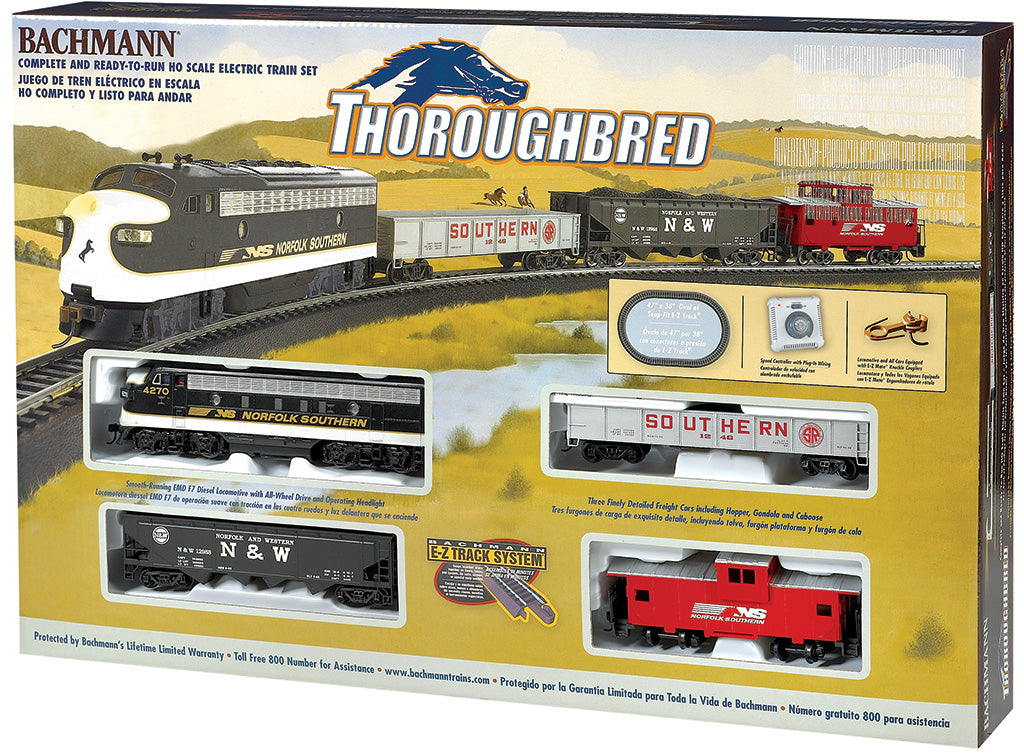
For example, 00691 identifies Bachmann's NS Thoroughbred train set. It is not the locomotive's painted running number. Searching or asking about that item number is a direct way to distinguish the set from other Norfolk Southern models.
Photographs help you recognize the decoration and shape, but the description should settle the purchased version. If an image shows scenery, extra cars or an alternate decoration, use the stated contents and selected item to establish what is included.
Read scale and gauge separately
Scale describes how much smaller the model is than its real counterpart. Gauge measures the distance between the running rails. Two models can use the same track gauge while representing different scales.
| Common description | Scale | Track gauge |
|---|---|---|
| HO | Approximately 1:87 | 16.5 mm |
| British OO | Approximately 1:76 | 16.5 mm |
| American or continental European N | Commonly 1:160 | 9 mm |
| British N | Commonly 1:148 | 9 mm |
These are common standard-gauge conventions; narrow-gauge models introduce other combinations. “British outline” describes the prototype's appearance and origin, not a guarantee of electrical compatibility. HO and OO sharing 16.5 mm track does not make every locomotive, coupler, controller or platform arrangement interchangeable.
Also read the model's minimum curve and your track system's actual dimensions. A label such as “second radius” belongs to a particular track range; it is not a universal measurement across every brand.
Does the price cover a locomotive, a pack or a set?
Product names suggest a format, but the contents list decides what you receive. Use this comparison to find the next question rather than treating the labels as universal promises.
| Listing format | What to establish | What may still be needed |
|---|---|---|
| Locomotive | Whether it is powered and which control version is supplied | Compatible track, power, controls and vehicles to haul |
| Train pack | Which vehicles are included and which are powered | Track and operating equipment unless explicitly included |
| Starter train set | The exact locomotive, cars, track plan and operating equipment | Space for the layout and any separately listed extras |
A dummy or unpowered unit can be an intentional part of a train. It should not be confused with a second powered locomotive. Likewise, a box's total piece count can include scenery and track sections; it does not tell you how many powered vehicles you are buying.
Decode the control wording
In Hornby's terminology, DCC Ready means the locomotive has provision for fitting a decoder, with a socket described for that model; DCC Fitted means a decoder is already installed. “Ready” does not mean it will respond to DCC commands without that additional equipment.
Read sound claims separately. A decoder installation socket does not by itself establish that a sound decoder and speaker are included. If you plan an upgrade, check the required socket, available space and model instructions before choosing the decoder.
For imported sets, check the supplied power unit's input rating and suitability where you will use it. A plug adapter changes the physical connection; it does not establish that the supply accepts your local voltage. Settle that question before including the supplied power unit in your buying comparison.
Apply the questions to one actual set
The 47 × 38-inch measurement describes this set's supplied oval. It is neither the locomotive's length nor a guaranteed finished table size. Allow a margin around the track, and check the product description for the power supply and other contents. Do not infer a digital upgrade simply from the word “train set.”
Questions that often change the purchase
Are OO and HO the same because both use 16.5 mm track?
No. Their scale proportions differ. Sharing a nominal track gauge also leaves electrical requirements, couplers, curves and clearances to check.
Does DCC Ready include a decoder?
In the Hornby terminology described here, no: the locomotive is prepared for a decoder to be fitted. Look for an explicit installed-decoder description and the functions supplied on the exact item.
What should I ask when two listings look identical?
Ask for the manufacturer's item number, the installed control equipment and the included contents. Those answers are more useful than comparing the locomotive name or box size alone.
Start your comparison in the model train sets collection. If one detail remains unclear, ask about the exact item before ordering. For help deciding which equipment serves your layout, read how to plan a first roster, or return to the model train buying guide.

