

Model Train Guides
N Gauge Train Sets: Scale, Track and Compatibility Checks
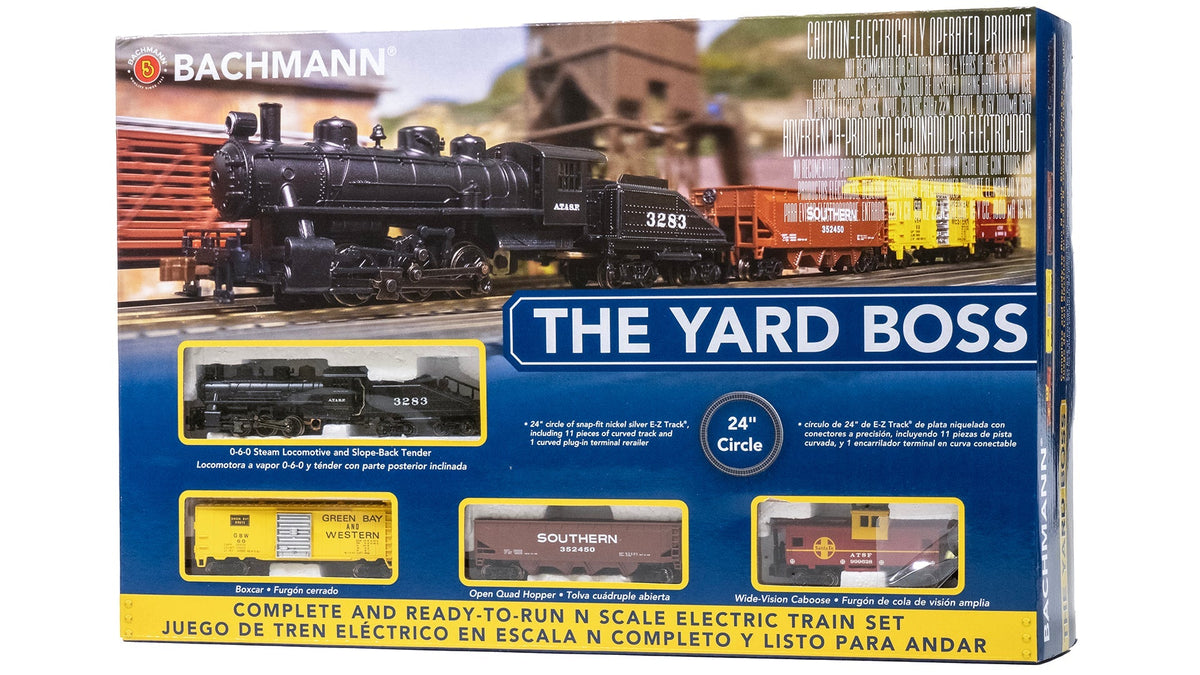
N gauge train sets are compact, but the label alone does not guarantee that every track piece, controller or locomotive will work together. In shopping language, “N gauge” and “N scale” are often used for the same general hobby category. Technically, gauge describes the distance between the rails while scale describes the model’s proportion. The safe buying method is to check both the stated scale and the exact track system.
A complete starter set should be judged as an operating package: locomotive, cars, track, terminal connection, controller or power pack, instructions and the space needed for the supplied layout.
Read the entire set description
The Bachmann Yard Boss shown here is an N-scale steam freight set. Its listed contents include a locomotive and tender, freight cars, a caboose, a 24-inch E-Z Track circle, a plug-in terminal rerailer, a power pack, speed controller and instructions. That is more useful than the word “starter” because it tells you what is needed for a first run.
When comparing another box, use the same checklist. A locomotive-and-car pack without track or a power source is not the same purchase even when its photograph looks like a train set.
Track family matters more than appearance
Sectional track systems can differ in rail profile, joiners, integrated roadbed, geometry and electrical connections. Two N-gauge pieces that look similar in a photograph might not connect directly. Record the manufacturer and track family supplied with the set before ordering curves, straights or turnouts.
Do not substitute another scale’s track because the brand name matches. A manufacturer may sell several sizes under a shared product-family name. Match the exact scale and part number.
Use the supplied curve as a starting limit
The curve included with a starter set tells you what the supplied train is intended to negotiate. It does not prove that every future locomotive or long passenger car will be comfortable on that curve. Before adding equipment, check its minimum-curve guidance and allow room for body overhang.
A track circle also needs clearance around the rails. Leave space for the power connection, controller, rerailing and a protective margin from the edge of the table. A surface exactly as wide as the nominal circle is not a practical operating space.
Check the power and control system
Conventional DC and digital command control are different operating approaches. “DCC ready” can indicate preparation for a decoder; it does not automatically mean a decoder and command station are included. Read the exact wording for the locomotive and the set.
Check the power supply’s label and intended electrical system before use. A physical plug adapter alone does not establish voltage compatibility. Follow the manufacturer’s instructions rather than improvising a supply.
N gauge versus N scale in product searches
| Term | What it describes | What to verify |
|---|---|---|
| N gauge | The rail-spacing category used by the model | Track family, rail profile, joiners and geometry |
| N scale | The proportion of the model to the full-size subject | Manufacturer’s stated ratio and regional convention |
| Starter set | A packaged beginning system | Exact train, track, power, controls and instructions supplied |
| Expansion pack | Additional track or accessories | Compatibility with the set’s exact system and intended plan |
Plan one useful expansion
A passing siding, a short industrial spur and a larger continuous loop each require different parts. Draw the finished plan and count the exact track sections before buying. Confirm whether a turnout needs a manual lever, separate controller or additional wiring.
Run the original set reliably before fastening track or adding scenery. That separates a layout problem from a locomotive or rolling-stock problem and gives you a stable baseline for later changes.
N gauge train-set checklist
- Exact set number and stated scale
- Locomotive and cars included
- Track family, layout shape and dimensions
- Terminal section, controller and power supply
- DC, DCC-ready or DCC-equipped wording
- Minimum curve for future locomotives and long cars
- Availability of matching straights, curves and turnouts
For a direct comparison of complete beginner boxes, continue with N Scale Train Sets for Beginners. For roster planning after the first set, read Model Railroad Trains: Plan Your First Roster.

