

Slot Car Guides
HO Slot Cars: Track Compatibility, Chassis and Setup
HO slot cars work as a system. The body attracts attention, but track family, chassis platform, wheelbase, guide, pickup shoes, controller, power supply and replacement parts determine whether the car can run and be maintained.
The HO label does not create universal compatibility. Match the exact manufacturer system before buying a car, track section or part. This article focuses on operation; the companion HO scale guide focuses on physical size and display proportions.
Identify the operating system first
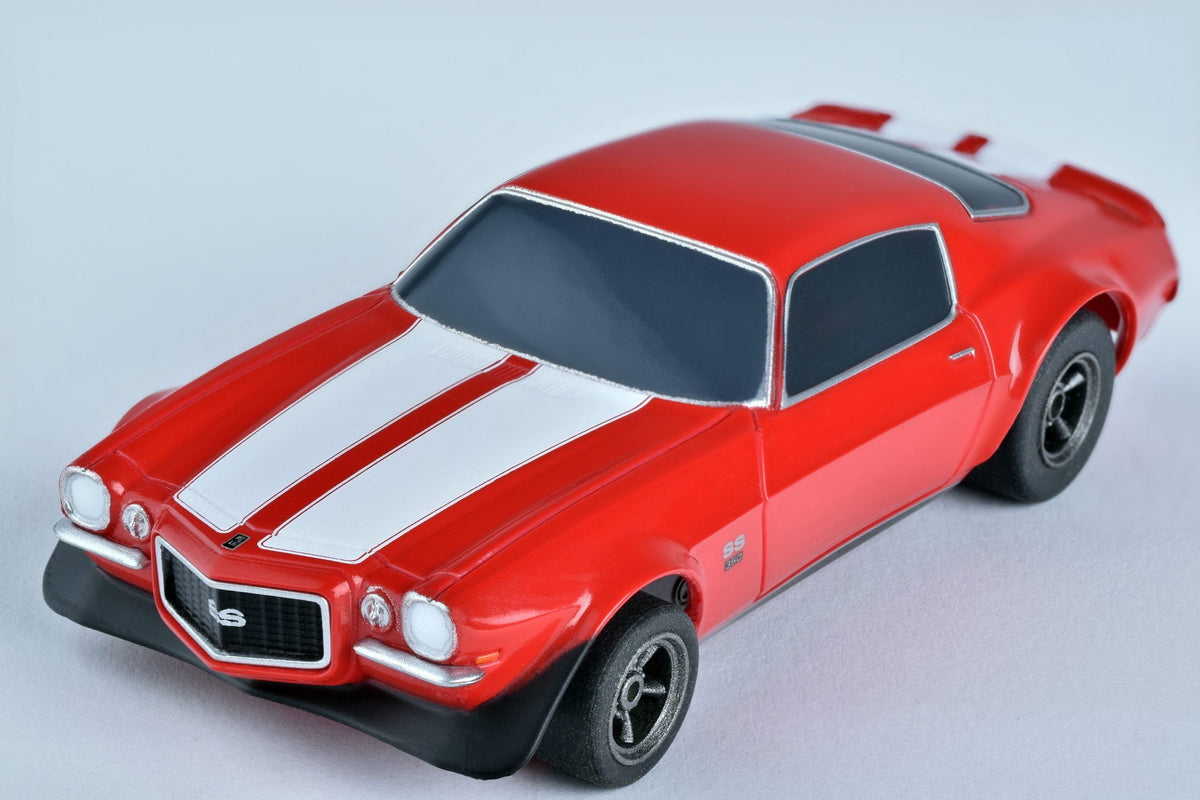
The AFX 1970 Chevrolet Camaro SS350 22002 is an individual AFX HO car on the Mega G+ long-wheelbase chassis. Its compatibility statement is tied to AFX HO, the Mega G+ platform and the listed 1.7-inch wheelbase—not to every product sold as HO.
| System field | What to verify | Failure prevented |
|---|---|---|
| Track family | Brand and generation | Poor mechanical or electrical contact |
| Chassis family | Mega G+ or exact alternative | Wrong parts and body fit |
| Wheelbase | Short or long platform | Misaligned body and axles |
| Guide and pickups | Exact style and wear parts | Intermittent current or de-slotting |
| Power and controller | Specified voltage, current and connector | Unsafe or poor operation |
Match the chassis and wheelbase
A body is not the chassis. The chassis contains the motor, gearing, pickups, guide system and running gear. Two cars from the same track family can use different wheelbases and therefore different replacement chassis or bodies.
Compare the long 1.7-inch Camaro with the AFX Highway Patrol #848 Ford Crown Victoria 21034, which uses the short 1.5-inch Mega G+ platform. Keep the exact part number with the car record.
A product such as the AFX Mega G+ short rolling chassis 21029 is a replacement platform, not a complete vehicle. Confirm body fit before ordering it as a repair.
Inspect the guide and pickup path
Current reaches the motor through the track rails and the car’s pickup system. Dirty rails, worn or misaligned pickup shoes, lint, oxidized contact surfaces or a damaged guide can cause hesitation that looks like a motor problem.
- Disconnect power: inspect the car only with the system off.
- Check the guide: look for damage, binding and free movement.
- Inspect pickups: compare both sides for wear and alignment.
- Clean conservatively: use methods approved for the track and car.
- Test one change: isolate the cause before replacing multiple parts.
Match controller and power supply to the track
Controller resistance or electronics, power-supply output and lane wiring influence speed and response. More voltage is not a cure for dirty track or worn pickups. Use the system manufacturer’s specified equipment and inspect connectors, cords and terminals before operation.
If a used set lacks its original power components, identify the exact set or terminal track before replacing them. A visual plug match is not enough.
Plan track expansion as a system
The AFX 21045 Track Pack adds 26 running feet and 40 pieces to a compatible AFX HO layout. It is an expansion pack, not a complete race set: cars, controllers and power equipment are still required.
Small connection parts matter too. The AFX 1013 track clips are listed for post-1980 AFX track. Confirm the track generation before using clips or expansion pieces.
| Expansion choice | Confirm | Common mistake |
|---|---|---|
| Track pack | Family, piece list and required power equipment | Treating expansion track as a complete set |
| Track clips | Track generation and quantity | Using clips on an unrelated family |
| Replacement chassis | Platform and wheelbase | Buying by body name alone |
| Car | System, chassis and part number | Assuming all HO cars are cross-compatible |
Design the layout for the cars that will run
Test the longest, widest and tallest cars on the tightest curves, crossings, guardrails and bridges. Front and rear overhang can swing beyond the rail centerline. A car that clears a straight can strike scenery on a curve.
- Curves: test body swing and guide movement.
- Lane changes or crossings: verify the system supports them.
- Grades: watch traction and transitions.
- Guardrails: leave body clearance.
- Power distribution: follow the maker’s guidance for larger layouts.
Use a repeatable first-run routine
Start with a clean, correctly assembled layout and one known-good car. Run at moderate speed, listen for gear noise and watch for repeated hesitation at the same track joint. If the issue follows the car, inspect the car; if it stays at one location, inspect that track connection.
Browse AFX HO cars, AFX HO track and slot-car parts by exact system and manufacturer item number.
Frequently asked questions
Will any HO slot car run on AFX track?
Do not assume it will. Verify the car’s stated system, guide and pickup compatibility.
Why does an HO car hesitate even when the motor runs?
Dirty rails, poor track joints, worn pickups, guide binding, gearing or wiring can interrupt operation. Diagnose one variable at a time.
Can I replace a short chassis with a long chassis?
Only when the body and manufacturer instructions support that fit. Wheelbase and mounting points must match.
Is an expansion track pack a complete race set?
No. Expansion packs normally require an existing compatible system with cars, controllers and power equipment.

