

1975 Hot Wheels
Street Eater Hot Wheels: Flying Colors Motorcycle Guide
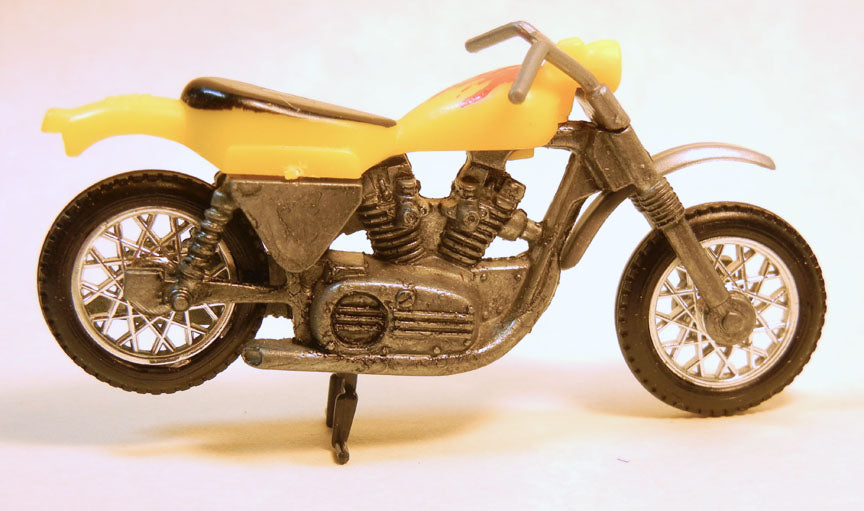
Street Eater is a motorcycle, not another wedge-shaped Hot Wheels car. The yellow tank and rear body sit above an exposed metal engine and frame, with narrow handlebars and a long front fork. Those small projecting parts are where a distant listing photo can let you down.
Street Eater reference photograph: On Line Redline Guide.
The 1975 Flying Colors motorcycle
The 1975 Flying Colors Street Eater, toy number 7669, was issued with yellow body parts, red-and-orange flame graphics on the fuel tank, gray handlebars, a metal frame and engine, motorcycle-style spoked wheels and an unpainted Hong Kong base. It was one of two motorcycles in the regular Flying Colors line that year. These details are identification clues, not proof that every loose example has its original parts.
The yellow is therefore not a reason to describe every metal surface as missing paint. Compare the actual materials and shapes with the photograph before assigning a condition fault.
Start at the handlebar ends
Ask for a head-on view as well as both sides. Check that both grips are present, then follow the fork, front fender and wheel rim. A clean tank can draw attention away from a broken end or a bent assembly.
Look beneath the rear body and around the seat. The thin yellow edges need to be visible, not hidden behind the wheel. Record cracks and glue separately from discoloration.
The reference also shows a stand beneath the engine. Request a clear underside view to establish what is present on the actual bike. Do not bend a small part to make it stand like the photographed example.
1975 Street Eater: what to check in the photographs
| Feature | Seller photograph to request | What to look for |
|---|---|---|
| Yellow tank and flames | Both sides in even light | Red-and-orange tank graphics, remaining yellow parts and any cracks or touch-up paint. |
| Handlebars and fork | Front and upper three-quarter views | Two complete handlebar ends, straight front assembly and no visible glued repairs. |
| Engine, stand and rear body | Low side and underside views | Metal structure, stand condition and any broken or missing small projections. |
| Wheels and base | Close-ups of both wheel faces and readable underside | Spoked motorcycle-wheel design, axle condition and base markings consistent with the example being identified. |
Use the photos to document the particular motorcycle; the illustrated reference cannot establish the condition or originality of a different seller’s bike. If a card is included, check it separately and compare its printed identification with the actual vehicle.
A card date needs its own evidence
The documented 1975 motorcycle does not establish distinct 1976 and 1977 editions. A later purchase date and a verified release variation are different pieces of information.
When a card is included, inspect the whole blister and how it meets the card. A loose motorcycle placed beside an old card is not an unopened example. For loose vehicles, check the actual parts and repairs before comparing condition labels or prices.
Give a motorcycle its own inspection sequence
Begin with the whole bike on a supported surface, then capture both handlebar ends, the fork and the underside. A motorcycle does not need a car’s windshield-and-interior checklist. Record the yellow body edges and stand as their own parts, and distinguish unpainted metal from missing finish by the documented construction.
Measure its height and width at the handlebars before choosing a compartment. A case suitable for some 1:64 cars does not automatically hold a motorcycle upright or protect its grips. Use a stable display position without bending the stand, and keep any original card separate from a loose-bike description. Compare the actual supplied components with MotoCross rather than relying only on their shared motorcycle form.

Street Eater collector questions
Was Street Eater a car or a motorcycle?
Street Eater is a motorcycle casting, first issued in the 1975 Flying Colors series as toy number 7669. Its spoked wheels and exposed metal structure call for a different condition inspection from a four-wheel Hot Wheels car.
Does a bare-metal engine mean the finish has worn away?
No. The documented original has unpainted metal frame and engine components. Look for damage or repairs rather than assuming every silver metal area has lost paint.
How can I check whether the handlebars are original and complete?
Ask for clear head-on and overhead photos that show both ends, then compare the front fork, tank and mounting points. Look for missing grips, bends, cracks or glue. A single side photograph often hides the opposite grip.
Will a regular diecast display case fit Street Eater?
Not necessarily. Check its internal height and width against the motorcycle’s handlebars, stand and front fork. The linked clear case is an accessory option, not a guaranteed fit for every Street Eater or an included vehicle.

