

Collector Guides
DC vs DCC Model Trains: A Beginner Buying Guide
Picture the railroad you want to run. If the plan is one train circling a small layout, conventional DC can do that job with straightforward controls. If you want a freight locomotive switching a siding while another train keeps moving, DCC gives each decoder-equipped locomotive its own instructions. Start with that operating plan, then check the equipment needed to carry it out.
What changes when you turn the throttle?
On conventional DC, changing track voltage changes motor speed; reversing polarity changes direction. Locomotives sharing the same powered section respond to that section's supply. Independent DC operation usually means dividing the railroad into electrical blocks and assigning controllers to them.
DCC sends commands through the rails to decoders in the locomotives. Each decoder responds to its selected address, so compatible locomotives can share powered track while moving at different speeds and in different directions. NCE's explanation of DCC describes this difference between controlling track power and sending instructions to a locomotive.
On narrow screens, scroll the table sideways to compare both systems.
| Buying question | Conventional DC | DCC |
|---|---|---|
| What am I selecting? | A powered track section and its controller. | A decoder address on the command system. |
| What does a locomotive need? | Documented support for the DC supply being used. | An installed, compatible DCC decoder. |
| How do two trains move independently? | Separate electrical control of their track sections. | Separate locomotive addresses, within the system's power and control limits. |
| Is sound included? | Only when the exact model supports sound on DC. | Only when sound hardware is installed and the supported functions are available. |
Read the locomotive label before buying the controller
DCC-ready does not mean a decoder is installed. A socket or other provision for fitting one still leaves a decoder purchase and installation to resolve. The interface, available space, motor current and any sound installation must suit that exact locomotive. Our guide to DCC-ready, DCC-equipped and sound-equipped labels explains those distinctions.
A DCC decoder also does not automatically promise operation on DC. Confirm the manufacturer's supported modes and any settings required. Likewise, NMRA-compatible locomotive control does not make every brand's throttle, booster or connection cable interchangeable. Check the command system's expansion documentation before buying those components.
Keep an unverified DC-only locomotive off DCC-powered rails. Some systems offer a specific analog-running mode, but this is not universal: NCE does not support that mode and warns about motor overheating. A controller offering it is not a blanket guarantee that every analog locomotive is suitable.
Two HO sets show what comes in the box
These are complete-set examples of the two approaches. They differ in locomotive, cars and track footprint as well as control equipment, so a price comparison alone would miss much of what you are buying.
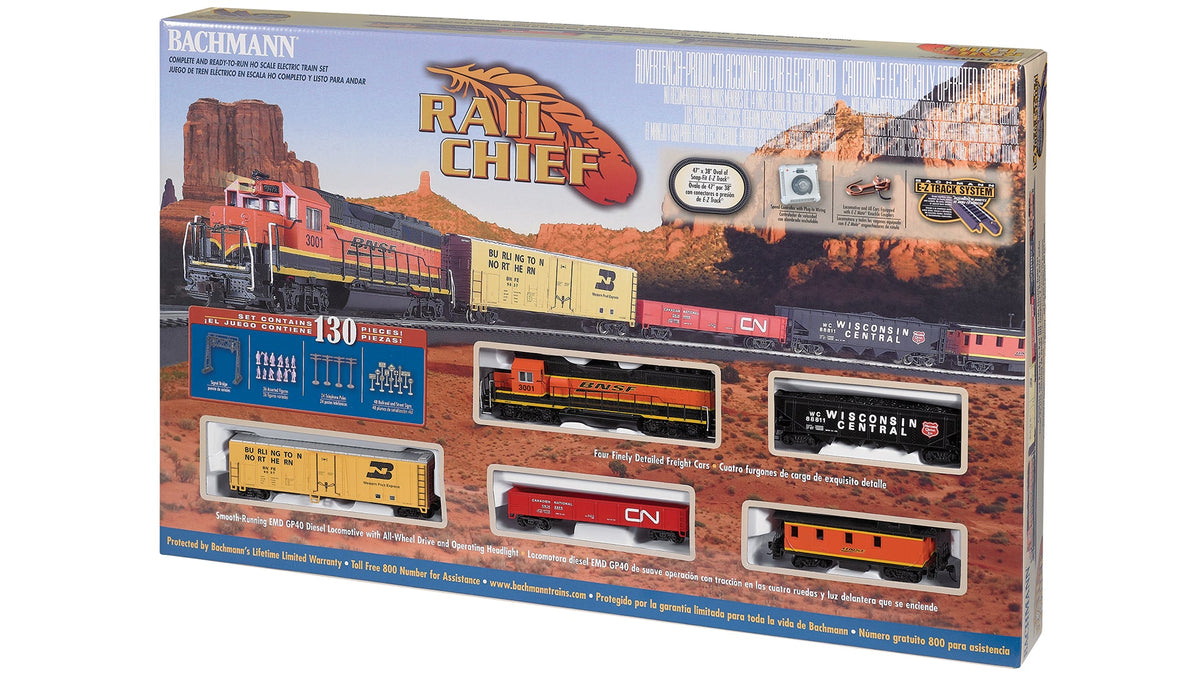
A DC starting point: Bachmann Rail Chief 00706
The Bachmann HO BNSF Rail Chief set pairs a GP40 diesel with freight cars, a caboose, a power pack and speed controller. Bachmann identifies 00706 as Standard DC and specifies a 47 × 38-inch E-Z Track oval. That makes it a concrete example for someone starting with one conventional train. This set specification does not establish a decoder socket or a particular conversion path for its locomotive.
Allow room beyond the track outline for reaching the train and keeping it away from an edge. The Rail Chief setup guide gives this set its own planning context.
A DCC sound starting point: Bachmann Echo Valley 00825
The Bachmann HO Southern Echo Valley set includes a DCC sound-equipped 2-6-0 steam locomotive and tender, freight cars and a caboose. Bachmann's current 00825 specification lists an E-Z Command Plus controller, wall-pack supply and a 56 × 38-inch nickel silver E-Z Track oval. Digital control and sound are supplied features of this exact set.

Read the controller manual as carefully as the locomotive description. The E-Z Command Plus instructions use programmable locomotive addresses 1–9 and explain that other locomotives must be removed from electrically connected track before address programming. Those are features and procedures of this controller, not rules for every DCC system. See the Echo Valley setup guide for this set.
Plan the wiring and the second purchase
DCC still needs dependable electrical pickup, clean rails and sound connections. Feeders, short-circuit protection and reversing sections remain layout-planning questions. When changing a layout's control system, follow the controller's wiring instructions: the E-Z Command Plus manual specifically requires removing the conventional DC power-pack connections before connecting its output.
Turnout operation is another separate check. Moving the points manually or digitally does not by itself establish electrical compatibility with DC or DCC. Read the exact turnout's supported layout power and wiring requirements before adding it to either railroad.
- Count the complete purchase: controller or command station, required power supply, track connections and any decoder installation. A separate throttle is not necessarily a complete system.
- Plan realistic expansion: check supported addresses, functions, throttles and available current. Buying a second locomotive does not prove the supplied system can power every future train and accessory together.
- Check the physical railroad: scale, gauge, curve requirements and couplers still matter under either control method. Both sets above are HO, but electronics do not make every HO locomotive fit every curve.
- Check the outlet requirements: these listings specify US-style 110V supplies. Confirm the supplied equipment suits your location before ordering.
For an existing fleet, make a list of each locomotive's supported control modes before replacing the power system. For a new railroad, choose the set or controller that supports the way you want to operate now, with an expansion path you understand. Browse the model trains collection once those requirements are clear.
Compare a DC set with a DCC sound set
Check the exact contents, control equipment and space requirements on each product page before choosing your starting point.

