

Collector Guides
DCC Ready vs DCC Equipped vs Sound: What Train Listings Really Mean
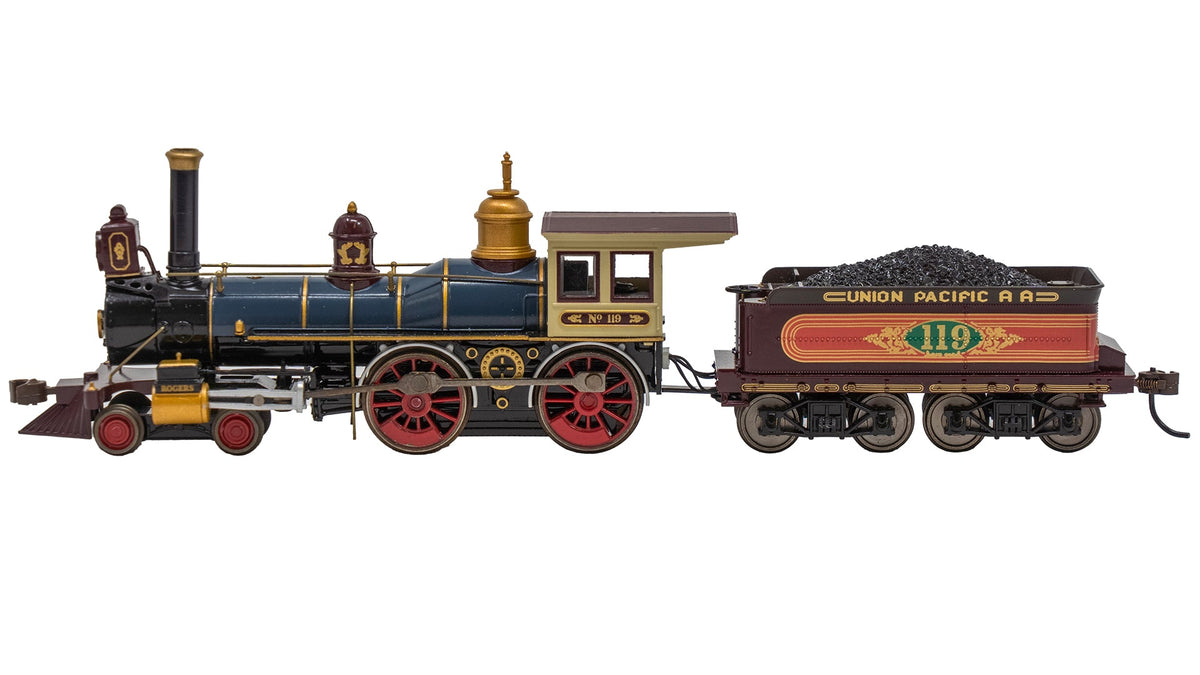
Model-train listings use “DCC-ready,” “DCC-equipped” and “DCC sound” to describe different things. The first usually tells you the locomotive is prepared for a decoder; the second says a decoder is already installed; sound is a separate feature to check. Read the exact item details before buying so you know what will work on your layout and what may still need to be added.
DCC-ready: check what is installed and what is not
A DCC-ready locomotive is not necessarily equipped to run under digital control as sold. The manufacturer may provide a decoder socket, a replacement circuit board or another installation provision, while the decoder itself is sold separately. The interface depends on the locomotive and production run, so “DCC-ready” alone does not identify which decoder fits.
For example, Bachmann’s HO Union Pacific #119, item 51002, is listed with an NMRA 21-pin decoder socket and an analog-DC setup as supplied; the decoder is separate. The product page also recommends curves of at least 15 inches for that locomotive. That is a concrete specification for this model, not a decoder or curve rule for every locomotive.
Before ordering an upgrade, find the exact item number and manufacturer instructions. Confirm the socket or board type, whether installation is plug-in or wired, and whether there is room for a speaker if you want sound.
DCC-equipped: a decoder is already aboard
“DCC-equipped” means a decoder is installed, but it does not tell you every function that decoder supports. It may handle motor and lighting control without sound. Look for an explicit sound description and the listed functions rather than treating “equipped” as shorthand for a sound model.
Bachmann’s HO Boston & Maine GP40 #340, item 60313, is an example listed as DCC-equipped. Its current product description specifies digital control but does not list a sound system. If sound is important, ask whether the exact item includes a sound decoder and speaker; do not infer either from the DCC-equipped label.

DCC sound: confirm the decoder and speaker features
A sound-equipped model adds audio functions to its installed DCC setup. Which sounds and lighting functions are available varies by model. Bachmann’s HO Nickel Plate Road 765 Berkshire, item 52401, is listed with Sound Value DCC and steam chuff, whistle, bell, air-pump, steam-release and blower sounds. Its listing recommends curves of 22 inches or greater, so a sound feature does not replace the usual check for minimum radius.

“Sound-ready” can describe a different configuration: a locomotive may have a speaker or space for one but still require a sound module. Treat that wording as a prompt to inspect the included-parts list, not as proof that sound is already installed.
Check the decoder interface and operating mode
Decoder plugs are not universal. Bachmann’s 51002 listing names a 21-pin socket, while other locomotives may use another connector, a board replacement or wired installation. Match the decoder to the exact locomotive and manufacturer instructions. For a sound conversion, verify speaker size, mounting space and any required enclosure as well.
Running behavior can also depend on the installed decoder. The #51002 listing says it runs on analog DC as supplied; do not assume that every DCC-equipped locomotive behaves the same on DC. Check the manual for the particular model and your command station before connecting it.
A quick buying check
- Record the locomotive’s exact manufacturer part number and scale.
- Separate what is installed from what the listing says is included: decoder, speaker, sound functions and any upgrade parts.
- Confirm the decoder interface and the manufacturer’s instructions for your exact model.
- Check the locomotive’s minimum curve radius and supported operating modes against your layout.
Use the DC vs. DCC beginner guide for the control-system basics. Browse model trains or Bachmann locomotives and train sets after you know which decoder and sound features you need.

