

Comparisons
Hot Wheels Tracks for Speed vs. Stunts: Raceways, Loops & Fair Tests
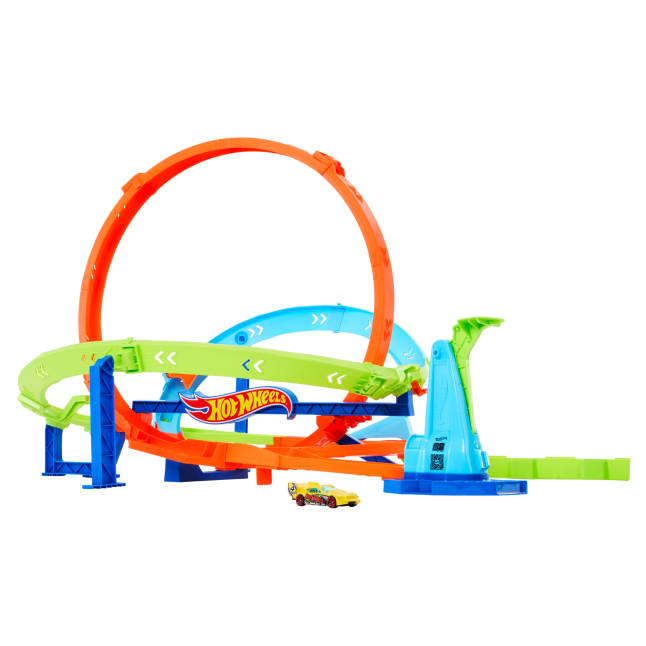
Raceway, loop and fair-test planning based on identified Mattel sets
A raceway answers which car finishes first under a chosen setup. A stunt layout asks whether a car can complete a particular challenge. Those goals overlap, but they are not the same test. Choose the activity before choosing the track.
A product described as fast is not necessarily the best instrument for measuring speed, and a dramatic loop does not make every car compatible with the set. This guide compares documented features rather than reporting laboratory tests.
Choose the result you want to observe
| Goal | Useful setup feature | What it does not establish |
|---|---|---|
| Compare two finishes | Consistent starting mechanism and visible finish result | The exact speed of either car |
| Complete a loop | Matched vehicle, supported loop and instructed launcher | A brand-wide ranking of the cars |
| Land in a scoring area | Defined target and clear landing space | Safe or successful results from a higher improvised launch |
| Build a repeatable test | Fixed layout and repeated runs with recorded conditions | A universal result for other tracks or examples |
A raceway reference: Roll Out Raceway GYX11
Mattel's Roll Out Raceway GYX11 opens into five lanes with a common start and a finish indicator. It includes one car and is described for ages four and older. It also closes into a storage container.
This is a useful format to investigate when side-by-side competition is the attraction. Count the extra suitable cars needed for the intended number of players. The finish indicator identifies a race outcome; it does not provide a measured velocity.
A stunt reference: Loop Cyclone Challenge HTK16
Mattel describes Loop Cyclone Challenge HTK16 with returning-loop and jump-and-score modes, a slam launcher, one car and fold-up storage. It is labeled for ages four and up.
The header is a manufacturer reference image for this set, not a current store offer. Compare the operating room for the mode you will actually use, including the instructed landing area. Folded storage size is a different measurement from the space occupied during a jump.
Make an ordinary home race more consistent
Use the same layout, start position and release method. Check that each car rolls without obvious rubbing and that track joins are fully seated. Alternate lanes and repeat the comparison so a lane problem is less likely to be mistaken for a car advantage.
Record a stall or wall strike separately from a completed finish. A single dramatic run is not enough to establish that one casting is always faster. Report the result for the cars and setup actually used.
When a timing system is involved, record the measured distance and timing method. Do not present an advertising “scale speed” as the actual speed across the room.
Treat stunt completion as its own test
Begin with the included or specified vehicle and follow the assembly instructions. Test the instructed configuration before adding more track, changing a launch or substituting another car.
Note where a failed run stops: before the loop, against a sidewall, at a joint or beyond the target. That observation is more useful than immediately blaming the car's weight or buying a stronger launcher.
Do not increase height, alter powered equipment or remove supports to force a successful stunt. Keep the operating area clear and follow the exact product's safety guidance.
Check car fit and track connections separately
A road car, Monster Truck and aftermarket custom can have very different clearances. A wheel that looks similar can still rub the body or fit a launcher differently. Start with the set's supported vehicles rather than assuming every Hot Wheels works everywhere.
Connector generations also matter. See the modular-track and Mario Kart comparison for a specific adapter example and the distinction between fitting track pieces and fitting vehicles.
Buy for the activity, then plan storage
Choose a clear race format for repeated comparisons or a supported stunt activity for challenge play. Measure assembled, operating and stored space before ordering. For more help, use the small-room planning guide.
Browse individual vehicle listings for additional cars after checking age guidance and fit. Finished customs are a separate hobby choice, not a promise of tested track compatibility.
Record results without overstating them
A useful home test log identifies the car, lane, layout, release method and number of runs. Alternate lanes when possible, record incomplete runs separately and describe only the setup used. A finish indicator can identify the winner of a run; it is not a speedometer.
For stunts, record the failure point—launcher, joint, loop, sidewall or landing area—before changing the setup. Retest the instructed configuration with the supplied or specified vehicle first. Do not remove supports or add height to force a result.
Mattel’s current support records back the two reference examples: GYX11 is a five-lane Roll Out Raceway with a common start, finish indicator, storage function and one car; HTK16 is a Loop Cyclone Challenge with returning-loop and jump-and-score modes, fold-up storage and one car. Both are labeled for ages four and up.
Use cars and track products that match the activity

Track-associated car
Power Pistons
Use the actual car and track to test rolling performance instead of assuming one casting is universally fastest.

Cars + track activity
Adventure Box
A current cars-plus-track format for repeated racing and layout activities.

Test-car example
White McLaren P1
Compare several cars on the same track to distinguish car behavior from track behavior.

