

Hot Wheels Gassers
Buying a Hot Wheels Gasser: Finished Car or DIY Kit?
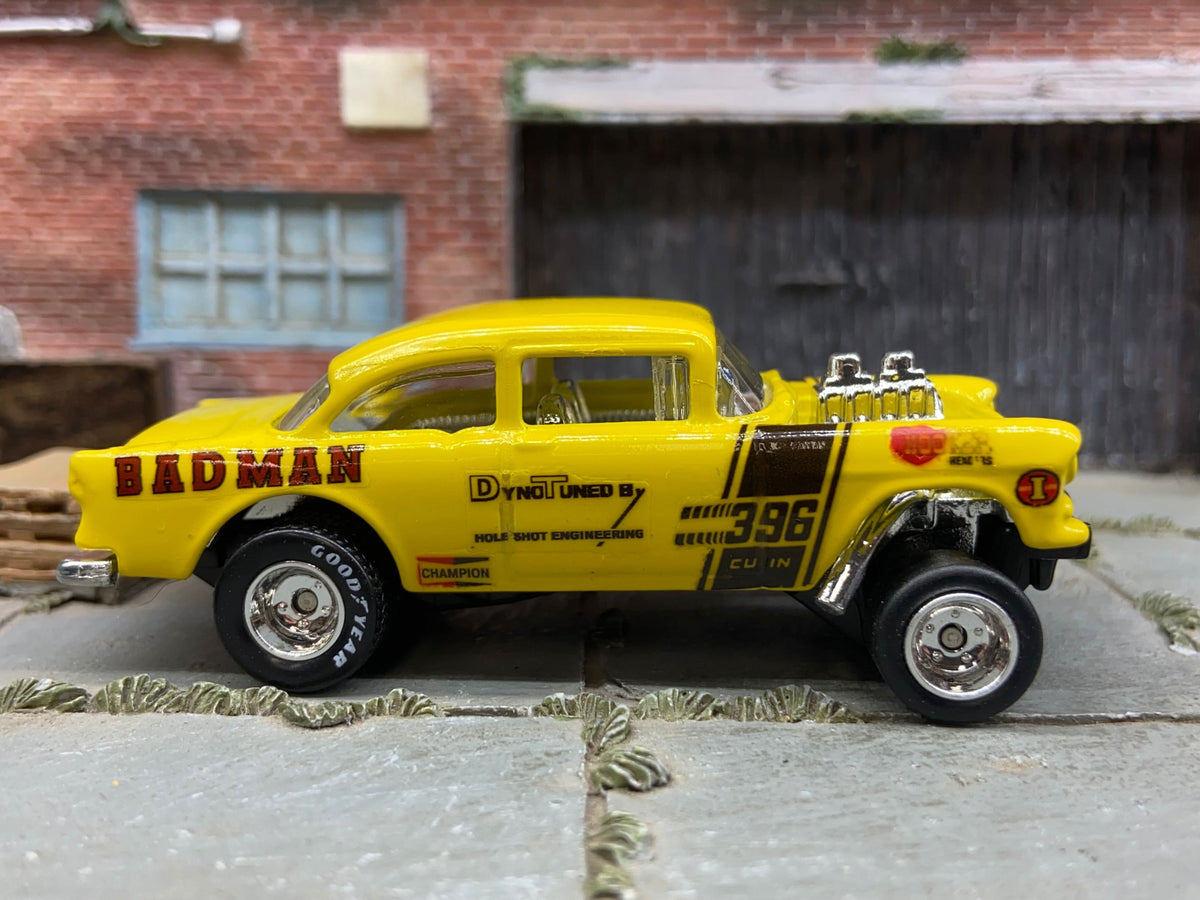
Choose what you want to own at the end of the purchase: a documented factory edition, a finished custom or a project you will paint and assemble. All three can have a gasser body and a dramatic wheel arrangement, but they give you different things to inspect and different work to budget for.
The yellow BADMAN ’55 Chevy in the featured photograph is a finished Muncle Mikes custom. Its lettering, exposed engine and larger rear tires show one completed look. The bare-metal ’55 Chevy and Nova wagon below show the other side of the decision: parts prepared for your own finish. Use these photographs to compare the result with the starting point.
Decide which kind of purchase you want
| Your aim | What to establish | What to compare before paying |
|---|---|---|
| A specific factory edition | The exact release, decoration, wheels and packaging. | Matching release details, disclosed changes and the condition of both car and package. |
| A finished custom | Which paint, graphics, wheels and assembly work the builder performed. | The actual finish, wheel alignment, exposed details and included accessories. |
| A prepared DIY kit | The named casting, supplied components and preparation already completed. | The work still needed, separate upgrades and the materials for your planned finish. |
A loose car describes its packaging status, not how much preparation it has received. If you are considering a complete car to take apart, the display car versus donor guide helps you choose which original parts you want to retain.
Read a finished gasser’s photographs in a useful order
Start with a level side view. On the yellow BADMAN example, the side lettering, front opening around the engine and different wheel sizes all contribute to the look. Decide whether that combination suits your display before comparing small finish details.
- Both sides, then front and rear. Look for an unwanted lean, a wheel sitting at an angle or a tire contacting the body. A raised nose alone does not establish damage; compare the intended build and ask whether it sits and rolls as described.
- Paint and graphics close up. Inspect the roof edges, window openings and lettering. Ask about an unclear chip, decal edge or rough patch instead of assuming that every mark is intentional weathering.
- The engine and other exposed parts. Check what is present, what has been modified and whether a bright reflection is hiding a detail. A striking side photograph cannot show every attachment.
- The underside and reassembly. Ask how a custom was closed and whether any parts are loose. A screw or adhesive may be part of a disclosed build; evaluate the assembly rather than treating the fastening method as a quality grade.
- The contents of the offer. Confirm whether photographs show the actual item or a representative example. Check any case, packaging or accessories separately; scenery in a photograph does not establish what is included.
Browse finished custom Hot Wheels to compare completed builds. That collection covers different bodies and styles; inspect the individual listing for the exact car and its current availability.
Check the factory edition before interpreting its wheels
The same casting name can cover different factory specifications. Mattel’s green Triassic-Five ’55 Chevy Bel Air Gasser, HGW21, lists Real Riders front wheels and rear drag slicks. Its pink RLC ’55 Chevy Bel Air Gasser, JCP37, lists Neo-Classics wheels. These are two named examples, not specifications for every gasser or offers for sale in this guide.
Match the particular release before judging an unfamiliar wheel setup. A repaint, similar lettering or an aftermarket wheel swap does not establish that a car is the factory edition you are seeking. For a custom purchase, assess the disclosed work on its own terms.
Compare two prepared gasser projects
The ’55 Chevy and ’64 Nova wagon kits below are stripped, ready-to-paint projects with click-together assembly. They are supplied for finishing and reassembly, and custom wheels are sold separately. The body shapes differ: the Chevy has a two-door profile, while the Nova gives you a long wagon roof and more side window openings to work around.
1955 Chevy Gasser DIY kit

Choose the Chevy if you want to plan the paint and graphics around its two-door body and exposed engine. Check the listed components before adding supplies; wheel style, interior color and window color may vary.
1964 Chevy II Nova Gasser Wagon DIY kit

Choose the wagon if the longer roof and side profile suit your design. Its parts photograph separates the body, windows, interior and base; compare those components with what your chosen listing supplies.
Both listings give a 10 mm / 12 mm factory wheel-size reference. That is a starting reference, not a promise that any replacement set will fit. Check tire width, axle length, hub clearance and the space inside the closed car. Similar dimensions do not establish that parts from these two castings are interchangeable.
Before choosing a complicated finish, read the prepared-kit building guide. It explains fitting the supplied parts first, keeping windows and wheels separate during painting, and checking the assembled car again afterward.
Compare the cost of the result you actually want
For a finished custom, compare the same level of work and condition: a wheel swap and a complete repaint are different purchases. For a factory edition, compare the same release and packaging format. A seller’s asking price does not show what another buyer actually paid.
For a kit, make a short list of what you still need: the chosen finish, tools, any graphics and any replacement wheels. Add those costs to the kit, shipping and applicable taxes. A lower starting price can still lead to a larger project budget. Check current listing and checkout totals rather than carrying an old price into the comparison.
Questions before buying a Hot Wheels gasser
Should my first gasser be a completed car or a kit?
Choose a completed car if your priority is displaying the photographed finish. Choose a kit if selecting the paint and doing the fitting and assembly are part of what you want to enjoy. Neither choice requires collecting every version of the casting.
Are the wheels shown in a kit photo guaranteed to be the ones I receive?
The two kit listings state that wheel style, interior color and window color may vary. They also identify custom wheels as separate purchases. Confirm a specific component before ordering if it is essential to your plan.
Will a custom gasser run on my track?
Its appearance and tire material do not establish track performance. Ask about actual rolling condition and any relevant test, then compare the car’s width, height and clearance with your track. A display photograph leaves those questions open.
Does every finished custom include a display case?
Use the individual offer’s contents. A case included with one car does not become an inclusion for other customs or for either DIY kit.
What if a photograph does not show the detail that matters to me?
Ask for the missing angle before deciding. A close view of a graphic, an underside photograph or a clear explanation of the supplied parts can be more useful than another general description of the car.
Choose a starting point in the DIY Hot Wheels kit collection, or compare a completed finish in the custom Hot Wheels collection. For more collecting, assembly and wheel guidance, return to the Hobby Learning Center.

