

Model Rocket Guides
How to Choose the Right Model Rocket Engine
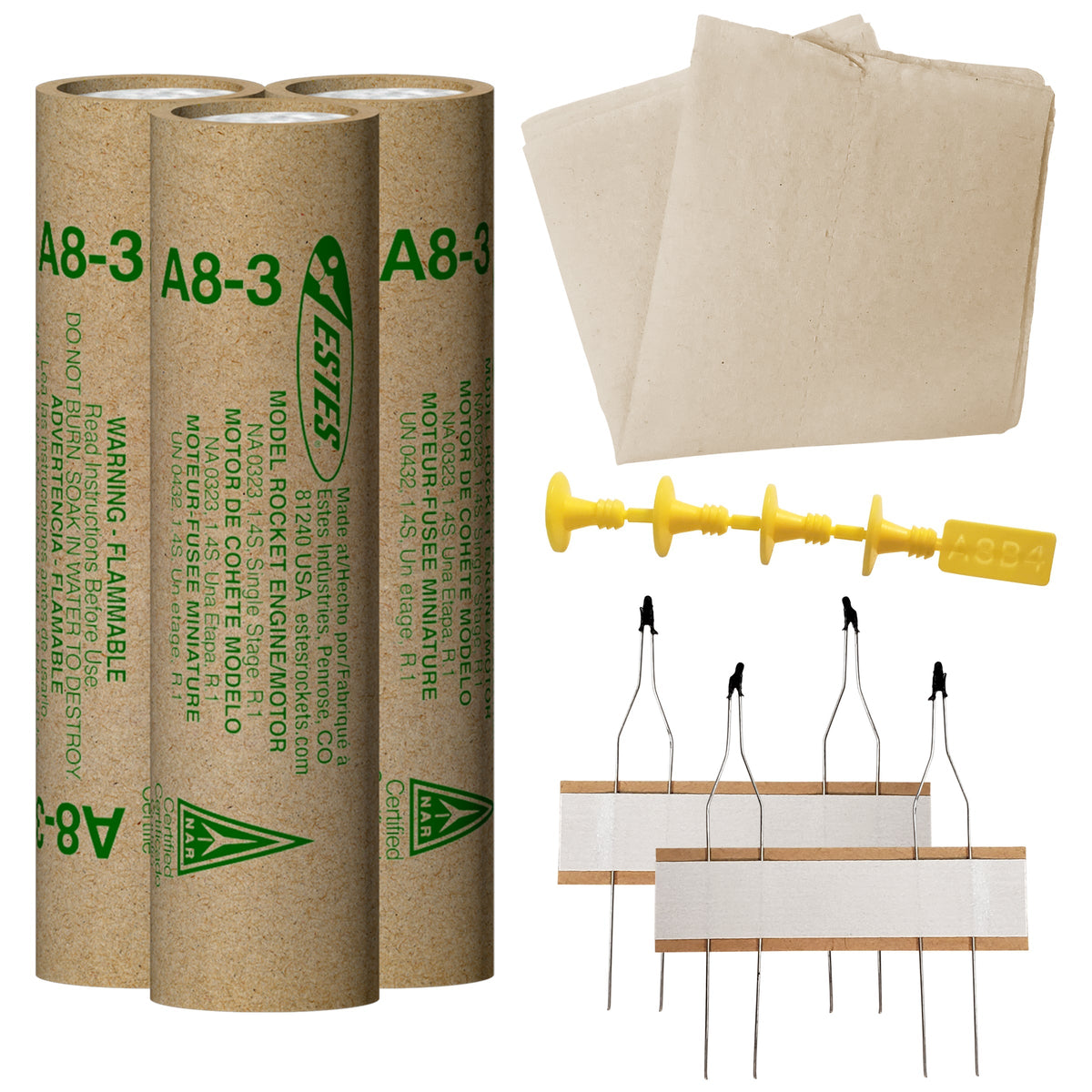
The right model rocket engine is the one approved for the exact rocket, finished configuration and flight you are preparing—not simply a motor with a familiar letter. Start with the rocket manufacturer’s current instructions, then match the complete motor designation, launch field and recovery plan.
Do not substitute by letter alone. Two motors in the same impulse class can have different average thrust or delay times. Those differences can change how a rocket leaves the launch rod and when its recovery system deploys.
Read the complete engine code
A code such as A8-3 contains three separate pieces of information:
- The letter identifies the total-impulse class.
- The first number identifies average thrust in newtons.
- The final number identifies the delay, in seconds, between the end of powered flight and the ejection charge.
Estes explains that motors ending in 0 are booster motors without a timed delay, while plugged motors have a different special-purpose code. Never use a booster or plugged motor as a substitute for a standard single-stage motor unless the rocket instructions specifically require it.
Use this five-step selection process
1. Open the exact rocket instructions
Find the manufacturer item number and its approved motor list. A product name alone is not enough when similar versions, reissues or bundles exist. Match the complete designation exactly, including the delay number.
2. Confirm the rocket’s actual configuration
Use the rocket as it will be flown. Added paint, payloads, repairs, alternate recovery systems or other changes can affect flight weight and drag. Do not assume a motor remains suitable after a material change.
3. Choose from the approved list for the available field
A larger impulse class generally requires a larger launch area. The National Association of Rocketry publishes minimum launch-site dimensions by installed total impulse. Use the current NAR Model Rocket Safety Code, the manufacturer instructions and local requirements when selecting the field and motor.
4. Match the delay, not only the power class
The recovery system should deploy near the appropriate point in the flight. A delay that is too short or too long can place additional load on the rocket or recovery system. Select only a delay shown on the exact approved list.
5. Check everything the package actually includes
Engine products can be sold as individual packs, flight packs or bulk packs. Check the listing for the exact quantities of motors, starters, plugs and recovery wadding. A motor pack does not automatically include a launch pad, electrical controller or controller batteries.
Engine pack, flight pack or bulk pack?
- Engine pack: useful when you already have the remaining consumables and launch equipment.
- Flight pack: groups the listed engines with selected launch consumables. Verify the exact contents before ordering.
- Bulk pack: intended for repeated or group launches. Calculate quantities from the number of rockets, planned flights and exact approved motor list.
Browse model rocket engines and flight packs, compare engine bulk packs, or start with a complete launch set.
What else is needed for launch?
Depending on the selected product and rocket, the complete system can include a launch pad, the correct launch rod or rail, an electrical controller, batteries, starters, plugs, flame-resistant recovery wadding, a suitable recovery system, build tools and a safe outdoor launch field. The individual product page should separate what is included from what is still required.
Engine-selection checklist
- Exact rocket and manufacturer item identified
- Current instructions opened
- Complete motor code appears on the approved list
- Finished rocket configuration considered
- Field and weather suitable for the selected flight
- Motor, starter, plug and wadding quantities counted
- Launch pad, controller, rod and batteries confirmed
- Shipping eligibility and delivery timing reviewed
Safety sources
Use only certified, commercially manufactured motors for their intended purpose, follow the manufacturer instructions and comply with applicable laws and site rules. Review the Estes explanation of engine codes and the current NAR Model Rocket Safety Code before launch.

