

Model Train Guides
Building Grand Valley with the Atlas 589 Track Pack
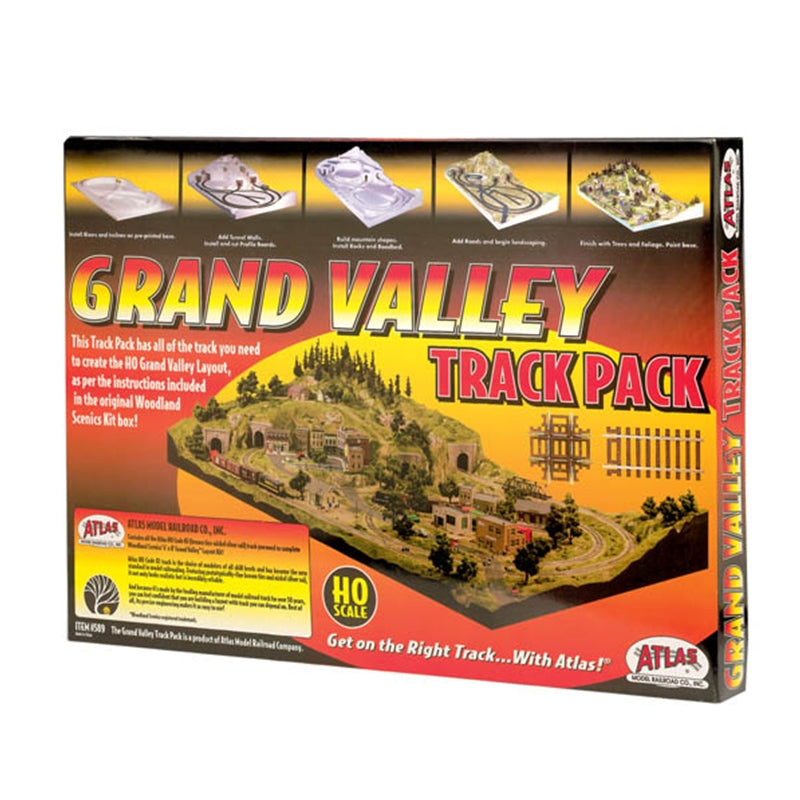
If you want to build Woodland Scenics’ Grand Valley, Atlas 589 supplies the track selected for its 4 × 8-foot HO layout. The route climbs through the landscape, crosses a bridge and passes through tunnels, so getting the track into the right position matters before the scenery goes on.
The attraction of this pack is having an established plan to follow. You can spend your time assembling a railway that runs well instead of working out which separate track sections will fit together.
What the two Grand Valley kits contain
The Atlas 589 track pack provides the track components: Code 83 nickel-silver rail with brown ties, rail joiners, turnouts, crossings and a 9-inch Warren truss bridge.
The separate Woodland Scenics ST1483 Grand Valley kit supplies the terrain and scenery materials, including risers, inclines, track-bed and tunnel portals. The buildings shown in Woodland’s finished layout photographs come from its separate City & Industry building set.
You will also need a locomotive, cars and a suitable controller. Allow for those when planning the whole project; buying the track pack alone will not give you a running, landscaped railway.
| Kit | What it supplies | Plan separately |
|---|---|---|
| Atlas 589 | Code 83 track components and the Warren truss bridge | Terrain, scenery, buildings, train and control equipment |
| Woodland Scenics ST1483 | The Grand Valley terrain and scenery materials | Track, buildings, train and control equipment |
Choose your train around the 18-inch curves
Grand Valley’s plan uses 18-inch-radius curves. That is the number to compare with the minimum radius specified for each locomotive and car you want to run. An HO model that requires a 22-inch radius needs a different track plan, even though its scale matches this one.
Check the cars as carefully as the locomotive. Long vehicles swing outward and inward on curves, so a train that gets around the track can still catch a tunnel portal or bridge. Before fixing those structures in place, move your longest intended vehicles through them and watch the clearance.
The Woodland kit also uses 4% inclines. Plan to test the actual train on the climb: begin with a short train and add cars gradually. A locomotive that climbs on its own may struggle once you add cars. Finding that limit while the track is accessible makes later scenery work much easier.
Use the drawing that matches your track
Woodland Scenics publishes a revised Grand Valley track plan because three short straight sections used in earlier drawings were discontinued. If an older diagram has you searching for 1-inch, 1¼-inch or 1½-inch pieces, compare the drawing with the instructions in your pack before ordering extras. If they disagree, ask us about your Grand Valley setup and include a photo of the drawing and the track pieces.
Lay out the pieces and compare them with the instructions supplied with your pack before attaching the risers. Where the instructions show an alternative combination of straight sections, use that arrangement. Pulling the ends together to close an unexplained gap can introduce a kink somewhere else.
Get the trains running before closing the tunnels
Get the train running smoothly around the layout before you move on to the scenery. Woodland’s Grand Valley assembly instructions build track testing into several stages. Follow that sequence, especially around the bridge and hidden sections.
- Assemble and inspect the track. Check that both rail ends enter each joiner properly and that the railheads meet without a step. Mark any joint that repeatedly causes a vehicle to jump or hesitate.
- Test on the planned elevations. Once the risers and inclines are arranged, check the route on them. A successful flat-table test cannot reveal every problem at the bottom or top of a grade.
- Try the routes you will actually use. Run through both turnout routes and across the crossings. Include the locomotive and cars intended for the finished layout.
- Check the hidden areas before covering them. Test tunnel and bridge clearances, arrange the wiring and keep the manual’s access openings usable. You need a way to reach a stalled train after the mountain is finished.
- Test again after fixing the track. Repeat the runs before adding ballast. Correcting a troublesome joint is much simpler while you can still reach and adjust it.
Can you use track you already own?
You can adapt Grand Valley, but existing HO track is not automatically a direct substitute. Woodland’s guidance says changing track types can require a new plan and repositioned risers and inclines. Different section lengths and turnout geometry can move the route away from its intended supports.
If you already own a substantial track collection, decide whether you want to redesign the layout around it. Atlas 589 is most straightforward when your aim is to follow Grand Valley’s established route. If your priority is running equipment that needs broader curves, choose that layout first and build the track purchase around it.
Start your Grand Valley project
Choose the kit for the part of the project you need. These two sets complement each other; neither is a complete train set.
Atlas 589 Grand Valley track pack

Use this pack when you want to follow the planned HO route with Atlas Code 83 track. The train, controller and scenery are separate purchases.
Woodland Scenics ST1483 scenery kit

Build the 4 × 8-foot Grand Valley landscape around the track plan. Track, trains and buildings are sold separately. Sold in the U.S. only.
Choosing a train for the layout? Browse our HO scale model trains, then check each model’s minimum radius. Find more planning help in Model Train Guides and Product Guides.

