

Model Train Guides
Model Railroad Easements: Smoother Curves and Better Transitions
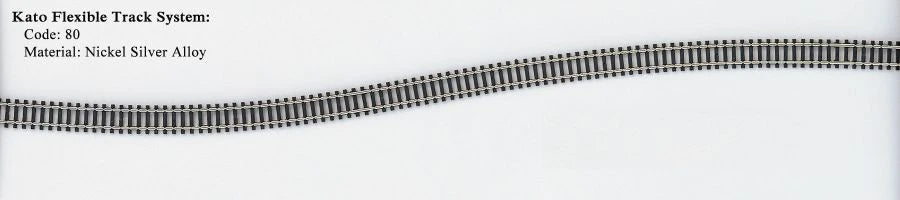
An easement is a transition curve whose radius changes gradually. Instead of moving instantly from straight track to the final circular radius, the track begins with a gentle bend and tightens progressively. The train appears to steer into the curve instead of snapping sideways.
The transition uses space. Plan it before cutting roadbed or fastening track: squeezing an easement into an already fixed boundary can tighten the rest of the curve or consume clearance you still need.
What an easement improves
Long passenger cars and freight cars show an abrupt curve entrance clearly. As the leading truck turns while the following vehicle remains on straight track, the car ends and body-mounted couplers move out of alignment. A gradual transition spreads that change over a longer distance and gives the train a more flowing appearance.
The easement does not make the tightest part of the curve disappear. Your locomotive and cars must still negotiate the final circular radius. It also cannot correct a kinked joint, poor rail contact or insufficient space beside the track.
Draw the transition before bending the rail
Mark the straight centerline and the circular part of the curve. A transition takes a length of track between them and shifts the circular curve relative to the straight. Use a scale-appropriate easement template or the NMRA's easement layout method to establish that geometry; do not simply push the first few inches of rail sideways.
Temporarily secure the flex track to the centerline without forcing a sharp bend at either end. Sight along the rails and check the change into the constant-radius section. Wherever a rail is cut, smooth its end and make sure the joiner actually grips both rail bases rather than leaving one rail sitting above it.
Move the longest equipment through the route before placing platforms, bridge sides or scenery. Car ends swing outward, while the middle of a long car reaches inward. On parallel tracks, check two vehicles passing each other through the curve as well as one vehicle alone.
| Track arrangement | What changes | Planning consequence |
|---|---|---|
| Straight into one sectional radius | Curvature changes at the first joint. | Simple fixed geometry; check the abrupt coupler angle with the intended equipment. |
| Broader sections followed by tighter sections | Curvature changes in steps. | Can soften the entrance, but remains an approximation with joints to align. |
| Flex-track easement into a circular curve | Curvature builds continuously toward the final radius. | Needs transition length, an offset from the tangent and careful rail alignment. |
Give opposing curves their own breathing room
An S-curve asks adjacent vehicles to swing in opposite directions. Easements help the transition, but they do not automatically provide enough room for body-mounted couplers. Where the route reverses curvature, plan a straight between the curves appropriate to the longest equipment. The NMRA's beginner planning guidance recommends a straight longer than the longest car with body-mounted couplers.
This matters at a yard throat as well as on the main line. If a turnout feeds directly into an opposing curve, test the exact turnout, locomotive and longest coupled cars together. Avoid assuming that successful travel through each piece on its own proves the combined route will work.
Test before ballast makes the route permanent
Start by rolling cars slowly through both directions. Then run the intended train forward and backward under power at a controlled speed. Watch truck rotation, coupler angles, rail joints and clearance beside the track. Correct the cause of a hitch before covering the track with ballast or scenery.
Questions about model railroad easements
Does an easement increase the minimum radius?
No. It changes how the train reaches the circular curve. Keep that curve at or above the radius your intended equipment requires, and reserve extra space for the transition.
Can sectional track make an easement?
Broader-to-tighter curved sections can approximate the effect in steps. Flex track allows a continuously changing curve, provided its joints and centerline are carefully aligned.
Is an easement the same as banking the track?
No. An easement changes curvature when viewed from above. Banking, or superelevation, changes the relative height of the two rails. Each needs its own planned transition.
Do short industrial tracks need the same treatment as a passenger main line?
The available space and equipment may justify different choices. Test the actual route with its assigned vehicles; a smooth appearance is useful, but reliable movement and clearances decide whether the plan works.
For a curved yard approach, decide what the yard needs to do before fitting the entrance tracks. Compare track and turnout options, or return to the Model Train Guides.

