

Hot Wheels How To
Hot Wheels Casting Identification: Find the Exact Release
You flip over a Hot Wheels car, find a name and an old copyright date, and think you've identified it. Then you look online and see three different cars with the same name. One is blue, one has different wheels, and another was released years later.
That's normal. Hot Wheels often reuses a familiar design in new colors, series and wheel combinations. The secret is to identify the casting first—then work out which release you have, and whether anything on your particular car has been changed.
Quick answer: Start with the body shape and underside, not the year stamp alone. Match the casting name, country mark, paint, graphics, wheel style, windows, interior and base against a documented release. If the car is carded, use its packaging as another clue. Leave anything you can't verify as unknown.
Casting, release, variation: what's the difference?
Collectors use these words a lot, and they aren't interchangeable. Think of them as layers of the same car.
| Term | What it tells you |
|---|---|
| Casting or tooling | The underlying miniature design: body shape and the tool used to produce it. Some named castings are retooled over time, so even the tooling history may need attention. |
| Release | A documented appearance of that design in a particular product line, series and year, with its factory configuration. |
| Factory variation | A supported difference within or among documented releases, such as wheel type, paint, graphics, window tint, interior or base. |
| Package version | The card, box, assortment, market or other packaging details accompanying a release. A loose car cannot prove which card it originally came on. |
| Your actual copy | The specific car you own, including scratches, bent axles, replacements, repainting and the story of where it came from. |
An important distinction: damage doesn't create a new factory variation. Neither does installing aftermarket wheels. A custom and a factory example may share the same basic casting, but they are not the same collectible record.
Start with a good look at the whole car
Before trying to read tiny letters on the base, study the silhouette. Is it a coupe, truck, van or fantasy casting? Look at the roofline, grille, window shape, fenders, wheel openings, engine, spoiler and exhaust. Those details help you find the right design even if the name is missing or hard to read.
Now check the underside for the brand or manufacturer name and any model wording. A base might say Hot Wheels or Mattel; older and retooled castings can use different wording. If the name isn't visible, search by the visible body features and compare several images rather than selecting the first similar-looking vehicle.
Some castings changed shape during a redesign or retool. When that happens, a familiar name doesn't guarantee every version uses identical physical tooling. Compare the particular body and base you have with the reference for that era.
Read the base markings without getting fooled by the date
Turn the car over in bright, indirect light and photograph the entire underside before zooming into individual marks. Write down the words and numbers as printed. They may include the casting name, a copyright date, country of manufacture and one or more production or tooling marks.
A copyright date is not the toy's release year
That little © date usually relates to copyright or design tooling. It does not tell you when the particular car was manufactured or which year it reached a store. A casting can return for years with older marks still underneath. If a card says 2002 and the base carries an older copyright, that isn't automatically a mismatch.
What about production date codes?
Many modern Hot Wheels vehicles have a stamped or printed production code. A common format uses a letter for the production year and digits for the week, but formats, availability and plant markings vary. Not every car has the same style of code, and older examples may have none.
A production code can help narrow when an individual item was made. It does not automatically establish the marketed release year, series or rarity. Cars may be manufactured before the year shown on their card, and more than one production run can belong to the same release.
To investigate the format on your car, use our Hot Wheels base-code and production-date guide. Don't force an unfamiliar number into a date chart without confirming what kind of mark it is.
Country, material and fasteners are supporting clues
Record the country as molded into the base. For original-era Redlines, the manufacturing location matters; later versions of the same casting may come from other countries. The metal or plastic base, base color, axle arrangement and rivets can help identify a version too—but none of those details alone proves originality.
Match the exact release by more than the body color
Once you're confident about the casting, compare its documented releases. Focus on a combination of details rather than one paint chip or wheel.
- Body color and finish: solid, metallic, translucent Spectraflame, unpainted ZAMAC and other factory finishes. Lighting and fading can make a familiar color look different.
- Graphics and tampos: racing numbers, stripes, logos, headlamps and tiny lettering. Note placement and colors, not just whether a decal exists.
- Wheels: spoke pattern, rim color, tire type and front/rear combinations. Standard plastic wheels and factory Real Riders are different specifications.
- Windows and interior: clear versus tinted glass, seat colors and other interior pieces. These can separate two otherwise similar releases.
- Base: country mark, material, color, any retooling difference and the location of visible inscriptions.
- Packaging: series name, toy number or SKU, collector number, assortment and any edition markings. Verify the car inside actually matches that package.
Manufacturers sometimes sell the same casting in more than one color within a year, and one named series may contain several castings. A printed number such as 2/4 usually refers to a model's position within that particular series; a larger collector number and a toy/product number serve different purposes. None should be read as the production date without checking what it labels.
The exact version is where research gets interesting. Two cars can look almost identical at a glance but have different wheels, graphics or interior colors. Those differences may indicate documented releases—or an aftermarket change. Compare a casting-specific reference and preserve photographs of the details supporting your conclusion.
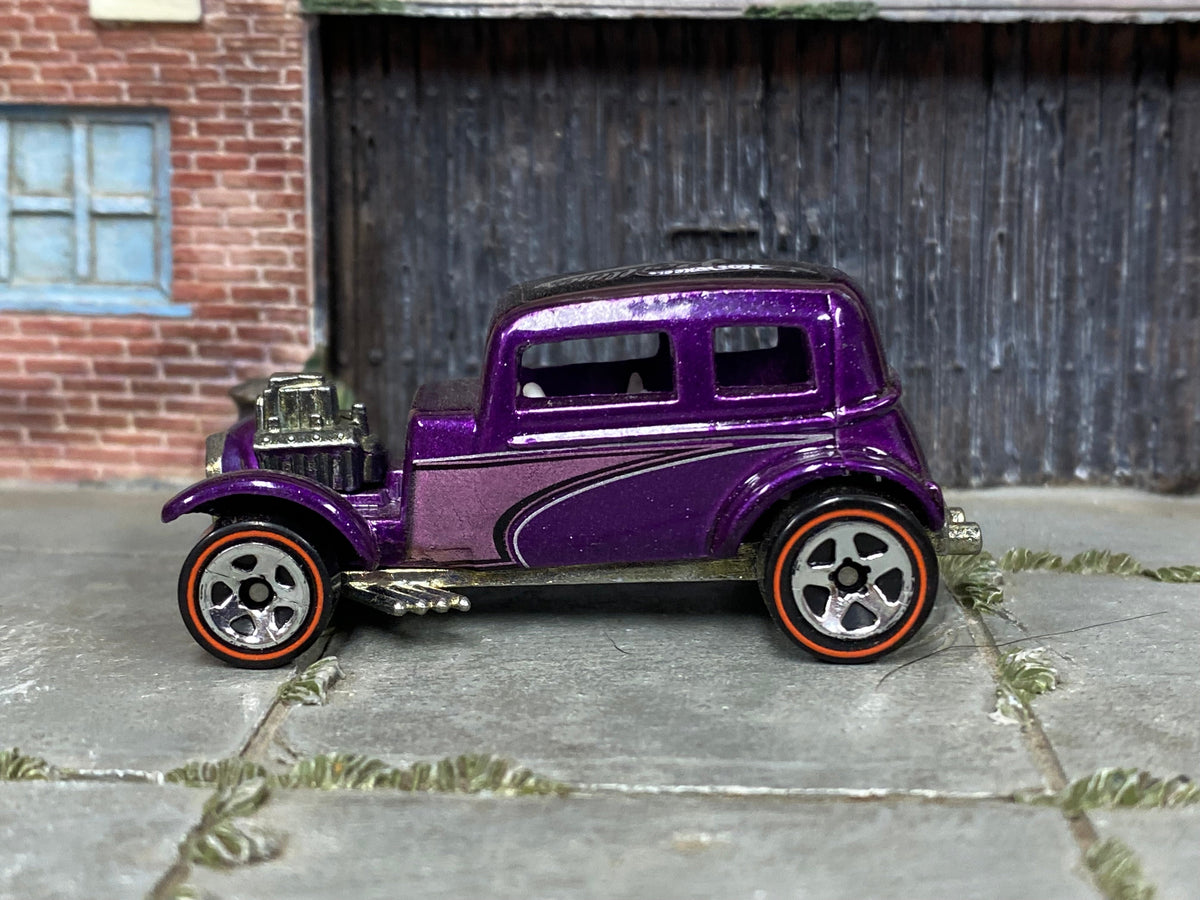
Real example: identifying a purple Classic ’32 Ford Vicky
The Classic ’32 Ford Vicky is a perfect example of why the model name and date can mislead you. The real car it represents is a 1932 Ford. The Hot Wheels design dates back much earlier than the particular purple example shown here, which belongs to a 2002 Red Lines release.

| Identification field | Documented example |
|---|---|
| Hot Wheels casting | Classic ’32 Ford Vicky |
| Full-size subject | 1932 Ford; this is the represented vehicle, not the toy's release year |
| Product release | 2002 Red Lines series, 2/4 |
| Collector and toy numbers | Collector #104; toy #54382 |
| Body and decoration | Metalflake purple with magenta, black and silver side stripes and Redlines graphics on the roof |
| Windows, interior, wheels | Clear glass, white interior and factory redline-style five-spoke wheels |
| Country and owned copy | Cataloged Malaysian manufacture; this store example is loose, so its individual wear and any past work need to be assessed from the item photos |
The original casting family goes back to an earlier era, and this later release recreates Redline styling. A red stripe on a 2002 car does not make it a 1968–1977 Redline. For an older find, use the original Redline identification guide before treating it as vintage.
This example cross-checks the MM product's documented release details with collector-series records. The photographs document the current listed copy; they do not authenticate another physical car you may own.
Why the card can help—and why it isn't the whole answer
If your Hot Wheels car is still in its original packaging, photograph the front and back before researching the series. Look for the release name, series numbering, collector number, toy number and any assortment information you can read. Then compare the actual car with that card's expected body, color, wheels and details.
Take the Boulevard #17 Kool Kombi as an example. The store listing identifies a carded Boulevard release with factory Real Riders wheels. The series number and packaging narrow its identity. They do not, by themselves, prove that a different loose Kool Kombi is the same release.

A package can be damaged, exchanged, opened or resealed. Don't claim an original sealed item without examining its condition. And if your car is loose, don't guess which regional or promotional package it originally came in.
Is it a factory variation, a custom or a repaired car?
Sometimes the wheels don't agree with the catalog photo, or the color looks unusually bright. That could be a factory variation, but it could also be a wheel swap, repaint, replacement base or repair. The clue itself isn't enough to decide.
For a clear comparison, the Dodge Challenger Drift Car below is sold by Muncle Mikes as a finished custom with a red, white and black “426” treatment and added chrome-mag-style wheels with rubber tires. The underlying Dodge Challenger casting is still identifiable. The installed wheels and hand-finished decoration do not become an undocumented factory release just because they look good.

Look for disturbed fasteners, mismatched wheel wear, unusual paint coverage or an axle that doesn't sit correctly. These signs justify more investigation; none is conclusive by itself. A restoration can contain genuine vintage parts and still differ from an untouched factory example.
For a car that appears altered, continue with our fake, repainted or custom Hot Wheels checklist. Avoid drilling or polishing an uncertain collectible until you understand what you have.
The seven photographs that make identification easier
Good photos are often more useful than a confident guess. Work with bright, neutral lighting, a plain background and a camera that can focus on tiny print. Take these views before cleaning or taking apart an unfamiliar car:
- Driver's side: see the complete silhouette, graphics and wheel faces.
- Passenger's side: compare decoration, stance and any damage you couldn't see from the other side.
- Top and interior: capture roof graphics, glass tint, seats and any engine details.
- Front and rear: show grille, lamps, exhaust, spoilers and molded openings.
- Entire underside: show the base, axle layout and country marks in one clear shot.
- Close-up of every code: record copyright text, casting wording and any stamped production codes without mixing them up.
- Packaging, if you have it: capture the full front and back, numbers, card edges and blister seal.
Keep the original images, especially if you're asking other collectors to help. A cropped, heavily filtered picture of a single wheel won't reliably identify a rare factory version.
What to do when you still can't find the exact car
Start by searching the casting name or visible vehicle features. Once you've found the right casting family, work down through the year and series lists rather than jumping to the first color match. Compare photos, toy numbers, wheel style, glass and interior color and packaging information.
MM's Collector Record Finder can help locate a related casting or release when a matching record exists. It isn't a guaranteed match for every car and doesn't automatically authenticate or appraise an individual item. Our collector guides library offers additional identification references.
If two entries are close but not conclusive, save both as candidates. Write down what's different and which photographs or references you still need. It's completely reasonable to know the casting while leaving the release unresolved.
Keep the physical copy separate from public release facts. One owner can have two cars from the same release, with different chips, bent axles or repair histories. For a collection, record each owned car individually instead of treating one catalog entry as proof of every copy's condition.
Quick answers to common Hot Wheels identification questions
Does the date on the bottom tell me what year my Hot Wheels car is?
Usually not. A molded copyright date identifies design or tooling rights, while a separate production code may help date manufacturing. The release or model year must be supported by the complete factory configuration and reliable records.
What's the difference between the casting year and the release year?
People sometimes use “casting year” casually for when a design first appeared. But a casting can be used again much later. When identifying a specific car, distinguish its first introduction, any retooling, its exact release and the manufacturing date code where available.
Can the same casting have different wheels and paint?
Yes. Mattel may release a familiar casting in different factory colors, graphics and wheel styles. Those differences can be documented releases or factory variations; aftermarket changes and damage are different questions.
Is a toy number the same as the collector number?
No. A toy or product number identifies an item or offering, while collector numbering is usually part of a particular series or lineup. Numbers such as 2/4 describe a series position. Read the card and reference carefully.
What if the underside doesn't show a clear model name?
Compare the body shape, grille, window outline, wheel arches and other molded details with photographs of likely castings. Then use the base and other features to narrow the release.
Does a red stripe on the wheels make it an original Redline?
No. Original-era Redlines and later Redline-styled releases can look similar. The 2002 purple Vicky above is an example of a later factory release; its stripe does not make it an original 1960s car.
Are Treasure Hunts and Super Treasure Hunts separate castings?
Not necessarily. Many Treasure Hunt releases use an existing casting in a special factory configuration, although a specific edition can have tooling differences. Verify the correct release and its year-specific markings instead of assuming every chase version is a new casting. See our Treasure Hunt identification guide.
Does a strange wheel or paint difference mean my car is rare?
Not by itself. First confirm whether it is a documented factory variation, a production change, wear or a custom. Then research actual comparable sold prices, not merely high asking prices.
A good identification is one you can explain
Start with the car in your hand. Read the whole base, compare the body and wheels, check the paint and interior, then use the card or catalog evidence to identify the exact release. When something doesn't match, save the uncertainty instead of forcing an answer.
Once you've identified the release, the next steps are easier: record your own copy, compare its condition and research its value. Our Hot Wheels inventory guide shows how to keep your collection organized, and the Hot Wheels value guide
Product photographs in this guide come from Muncle Mikes catalog listings. They illustrate specific documented examples; they do not authenticate a different car, establish a sale price or prove the history of an unseen copy.

