

Hot Wheels How To
Hot Wheels Redline Identification Guide (1968–1977)
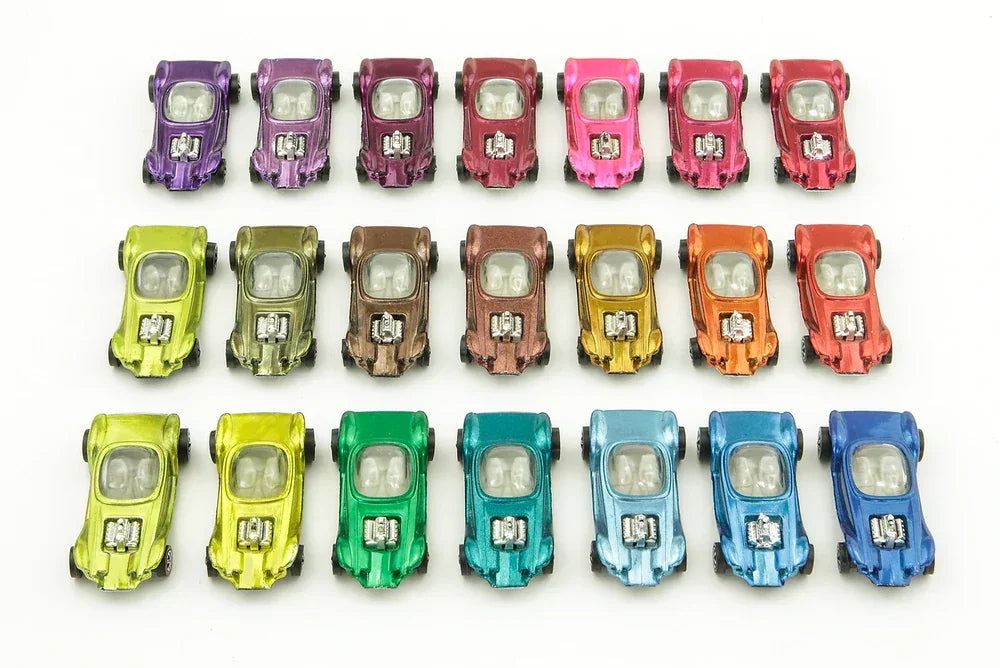
To identify original Redline Hot Wheels, match the casting, country mark, wheels, finish and parts to a documented 1968–1977 release. A red tire stripe or an old copyright date alone does not prove the car is original.
Start with clear photographs of both sides and the complete underside. The checks below help distinguish an original-era car from a later factory tribute, repaint or wheel-swapped custom before you research its value.
What are Redline Hot Wheels? Collectors generally call the original 1968–1977 Hot Wheels the Redline era. Most had red-striped wheels, but not every model did. Mattel later brought red stripes back on anniversary cars and other releases. A stripe by itself does not prove that the car in your hand was made in the original era.
The five things to check first
Before trying to name a rare variation or looking up prices, work through these in order. You can do most of it with good light and a close look at the car.
- Identify the casting. Look at the body shape and any name on the underside. A familiar name such as Custom Camaro or Twin Mill isn't enough to establish when this particular version was made.
- Read the country mark. Original-era Hot Wheels production was in the U.S. and Hong Kong. If the car is marked China, Malaysia, or another later manufacturing country, it is not an original 1968–1977 production example. A U.S. or Hong Kong mark is an important clue, not final proof of untouched originality.
- Check all four wheels. Look for the thin red band, then compare wheel shape, size, construction, and axle fit with a documented release. One replacement wheel can change what you're looking at.
- Study the paint and parts. Look at the finish, window color, interior, engine, and opening pieces. They should make sense together for the exact casting and version.
- Check for changes. Repainted bodies, replaced wheels, drilled posts, and swapped bases all affect what you can honestly call original.
If something doesn't match, it doesn't automatically mean the car is fake. It means you need a better casting-specific comparison before deciding what it is.
What counts as an original Redline?
Hot Wheels arrived in 1968 with sixteen launch castings, now known as the Original 16 or Sweet 16. The early cars helped make bright paint, wild custom styling, and fast-rolling wheels part of the Hot Wheels identity.
The collector term Redline describes the early production era, generally 1968 through 1977. Most cars from that period wore a thin red ring around the tire. The change to blackwall-style wheels happened during 1977, and later releases sometimes brought back the red stripe for nostalgia.
There are exceptions to the wheel rule: certain period dragsters, motorcycles, and other specialty vehicles did not use the familiar red-striped wheel arrangement. That's why a car shouldn't be dated by the stripe alone—or ruled out solely because the stripe is missing.
For the names of the sixteen launch models, see the 1968 Sweet 16 casting checklist. This guide stays focused on identifying the individual car you have.
Turn it over: what the base can tell you
Start with a clear photograph of the whole underside, not just the date stamp. Write down the casting name, the country, and every visible marking. Then compare the shape and fasteners with an example of that same casting.
The copyright date is not the manufacture date
A base marked ©1967 can belong to a Hot Wheels car first sold in 1968. And a later reproduction can carry an old copyright date because that date belongs to the design or tooling. Reading “1968” underneath a car does not mean that particular car left the factory in 1968.
U.S. and Hong Kong marks are useful—but not magic
Early Redline-era production came from U.S. and Hong Kong factories. For an original-era claim, one of those origins is the expected starting point. But a correct-looking base can still have been attached to a restored car, or paired with replacement wheels or other parts. Match the full assembly before calling it untouched.
Don't rely on a metal base or heavy weight alone, either. Construction varied across the period, and later cars can be substantial too.
Look closely at the redline wheels
The classic look is a narrow red stripe encircling the black tire sidewall. On a played-with car, that stripe may be faded, uneven, or partly missing. A faded stripe does not necessarily make the car a reproduction; neither does a clean stripe make it an original.
Period Hot Wheels used several wheel sizes and constructions, including bearing-style and capped styles. The right wheel for one early casting is not automatically right for another. Look at the wheel face, the reverse side, the axle, and whether the front and rear sizes match the documented version.
- Compare all four. An odd wheel, different hub, or mismatched wear might indicate a repair or a documented variation. Check before deciding.
- Look at the axle ends and stance. An axle that sits off-center, a tire touching the body, or a freshly altered axle end deserves a closer look.
- Don't use the stripe as the only test. Later factory cars and aftermarket rubber-tire sets can deliberately imitate the old Redline appearance.
Unless you're examining a practice custom, leave the wheels in place while identifying the car. Taking apart an unidentified vintage piece can destroy evidence you'd rather have kept.
Paint, windows, interior: the details that settle the question
Many famous early Redlines wore Spectraflame, a bright translucent finish over prepared metal. Later original-era releases also came in opaque painted finishes. So a shiny candy color can help identify certain early versions, but an enamel finish doesn't automatically rule out a genuine late-era car.
Inspect paint around edges, posts, windows, and raised details. Look for overspray, paint inside seams, fresh touch-ups, and a shade that doesn't agree with well-documented examples. Time, light, and storage can change the appearance of old finishes; don't call a color rare from a single photograph.
Then check the details that are easy to overlook: windshield tint, interior color, engine shape, roof finish, exhaust placement, opening hood, and base casting. These differences can be the key to an exact version.
A real example: the 1968 Beatnik Bandit
The Beatnik Bandit, one of the Original 16, came in U.S. and Hong Kong versions with meaningful differences. Its dome, grille, engine, and interior details help separate them; U.S. examples generally have a clear dome, while Hong Kong examples are known for blue-tinted domes. But you shouldn't transfer the Beatnik Bandit's details to a Custom Mustang or Deora.
Our Beatnik Bandit U.S. versus Hong Kong guide goes through that particular casting in more detail. The Beatnik Bandit photograph at the top of this page is a reference example, not authentication of a separate seller's car.
Original Redline, later factory release, or custom?
This is where many good-looking cars get misidentified. Mattel revisited Redline-style wheels in anniversary and collector releases, including the 1993 anniversary period and subsequent vintage-themed lines. A newer car can look a lot like an original at first glance.
These two Muncle Mikes examples make the difference easy to see. Neither is being presented as a 1968–1977 original.


Later factory tributes and custom builds aren't bad collectibles. They simply need the right description. If you're buying an original, compare the exact release, base and wheel construction, not just the familiar body or a red ring.
Is it original, restored, or simply well loved?
Once the model's identity starts to make sense, look at the individual physical car. An original-era body can have replacement wheels. A genuine base can be attached to a repainted shell. A beautiful restoration may be enjoyable on display, but it isn't the same as an untouched example.
Check the posts and fasteners
Look for tool marks, disturbed rivets, mismatched aging, or traces of repainting around the posts. None of these is proof by itself; each is a reason to ask what work, if any, was done.
Write down the condition, not just a grade
Record paint chips, scratches, toning, missing or cracked glass, bent axles, worn chrome, and damaged details. A heavily played-with original is still an original-era car, but its condition is different from a mint example.
Judge packaging separately
If a seller describes the car as unopened, examine the blister, cardboard, adhesive area, package printing, and whether the enclosed car actually belongs with that card. A period-looking card doesn't authenticate a swapped or resealed car.
Six photographs to request before buying
If the seller only shows one side of the car, there's no reliable way to check all of the details above. These are the views worth asking for:
- Left and right sidesCheck the body profile, wheel faces, stripe wear, paint, and decoration.
- Complete undersideRead the base text, country, axles, wheels, and untouched-or-altered fasteners.
- Front and rearCompare grille, lights, exhaust openings, and any casting differences.
- Roof and interiorSee the glass tint, seats, engine details, and fragile pieces.
- Wheel close-upsGet the wheel faces and inside edges, with enough detail to compare their construction.
- Packaging, if includedPhotograph the card front and back, blister edges, and the car inside.
Ask for clear, uncropped pictures in ordinary light. A missing photo doesn't prove something is wrong, but it does mean the identity is still unconfirmed. When a seller makes a rare-color or prototype claim, a second opinion from a collector who knows that specific casting is worthwhile.
Keep a simple record of what you found
Once you've made your comparisons, save the casting name, possible release, exact base wording, country mark, wheel style, paint, interior and window colors, condition, and any known repairs. Keep the photographs with the notes. That way, you won't have to reconstruct the story when it's time to compare another one.
For an unfamiliar car, use the Hot Wheels casting identification guide to narrow down the model before researching a specific Redline variation.
And if you want to know what an identified car might sell for, use the Redline values and completed-sales guide. A high asking price for a similar-looking car isn't evidence of what yours is worth.
Quick answers about original Redline Hot Wheels
Does the red stripe mean I found an original Redline?
No. A thin red stripe is an important clue, but later factory releases, reproductions, and customized cars use it too. Match the base, wheels, casting and parts to a documented original-era version.
Are all original Redlines from 1968 to 1977?
That's the collector-era definition. Most cars of that period used red-striped wheels, with some special-model exceptions. The switch toward blackwall wheels occurred during the final part of the era.
My base says 1967. Can the car still be a 1968 Hot Wheels?
Yes. The molded date commonly relates to copyright or tooling, not the date that particular car was manufactured. Some first-year Hot Wheels carry 1967 dates.
Does “Made in Hong Kong” guarantee originality?
No. It's an expected origin for original-era production, but you still have to check that the wheels, body, paint, interior, and base belong together. A restored or reassembled car can retain an original base.
Can an original-era car have no visible red line?
Yes. Some period specialty vehicles used different wheel arrangements, and ordinary play can wear the stripe away. Identify the casting and release rather than relying only on what's left of the paint.
Should I clean an old Redline before identifying it?
Not beyond the gentlest handling needed to see it safely. Photograph the car as found first. Harsh cleaning, solvents, or polishing can disturb original paint and other evidence.
Is a rare color automatically worth more?
No. Color claims must match the exact casting and documented variation, and market value depends on condition, originality, packaging, demand, and genuinely comparable sales.
One last look before you call it original
Find the casting. Read the whole base. Check the wheels and paint. Then compare the actual car—not just its nickname or year stamp—with a documented original. If the clues don't agree, keep looking before paying an original-Redline price.
If you're building a collection, browse loose Hot Wheels at Muncle Mikes and check each listing's actual release, photos, and condition. A car doesn't have to be from 1968 to deserve a spot on your shelf. It just deserves to be identified for what it is.

