

Hot Wheels
Make Room for the Hot Wheels You Want to Keep
Make room for the Hot Wheels you most want to see. When a collection outgrows its display, choose which cars belong on the shelf now, which deserve a later turn and which no longer interest you. That decision is more useful than buying another case simply because the last one is full.
Start with one shelf or storage box. You can make that group easier to enjoy without sorting every car you own in a single weekend. Keep a few personal favorites in view while you work; a car with a memory attached does not need to complete a series to earn its place.
Give each group a clear role
| The group | A useful choice | What that changes |
|---|---|---|
| Favorites you want to see often | Keep them in the current display. | Give them clear space and an angle that shows the details you enjoy. |
| Cars you still like but cannot show together | Make a rotation group. | Keep them easy to retrieve so they can take a turn without unpacking everything. |
| A completed theme you want to retain | Store it as an identifiable group. | You can revisit the whole theme without continuing to buy for it. |
| Donors and unfinished customs | Give them a separate project area. | Loose parts and work in progress stay apart from finished collectibles. |
| Duplicates or cars you no longer want | Set them aside for a considered decision. | You can compare, gift, trade or sell them without losing track of your favorites. |
A worn childhood car may stay in the display, while an untouched purchase may no longer fit your interests. Likewise, two cars with the same casting name may have different wheels or decoration that you deliberately chose to collect.
Try a small rotation before adding more space
Choose a group that fits comfortably in the display you already have. It could be the cars you remember from childhood, a finished project or a few models whose details you have not looked at recently. Leave enough room to remove one without catching the cars beside it.
Put the next group somewhere you can reach easily. Note where you put the group so you can find it again. Change the selection when you want a fresh view; you can move a few cars each time.
Notice what you miss when a car is put away. If you keep bringing it back, make it a regular part of the display. If a whole theme stays boxed because you have lost interest, consider whether keeping it still serves your collection. You can decide slowly rather than turning an afternoon of sorting into an immediate sale.
Choose a case for the group you decided to keep
A case with several spaces keeps a chosen group together. Individual cases let you move or replace one display at a time. Compare those formats against your actual cars and access needs before buying more capacity.
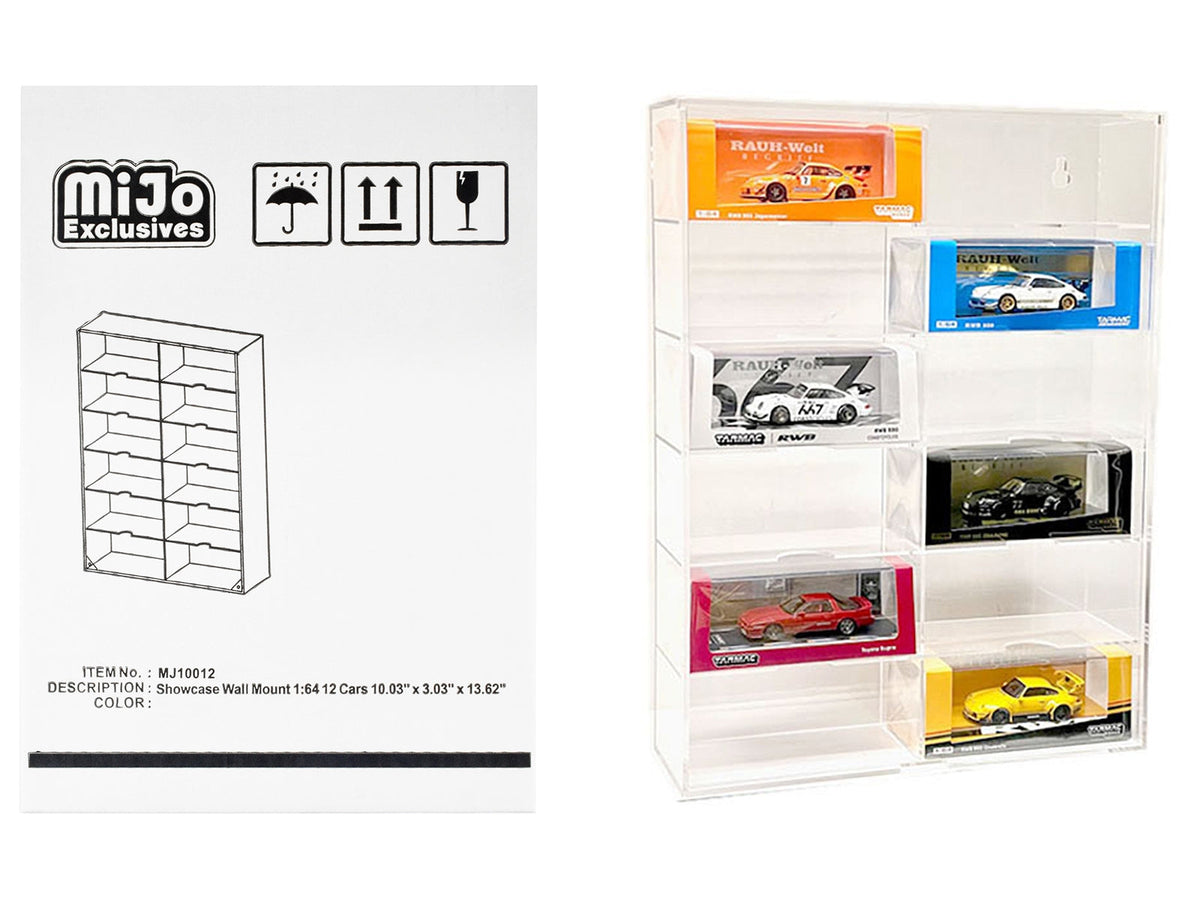
MiJo MJ10012: twelve spaces in one wall display
This clear-back case is supplied pre-assembled, with six shelves and two columns. Its listed outside size is approximately 10.03 inches long, 3.03 deep and 13.62 high. The listed car-holder size is 4.75 inches long, 2.625 deep and 2.125 high. Use the outside size to plan its location, then confirm usable clearance for the actual models or packages you want to place inside.

The twelve spaces are capacity, not a target for twelve new purchases. Measure the tallest and widest items in your chosen group, including their packaging where you intend to keep it. Confirm the mounting method and any required hardware before installing a wall display.
An individual case for a smaller selection

The individual case pictured here is currently unavailable. It remains a useful example of the smaller format: one clear, stackable case with beveled edges, listed at approximately 3¾ inches long, 1¾ wide and 1⅝ high outside. Those are exterior measurements, not a promise of usable interior space.
If you choose a similar case, compare its internal clearance and opening with the complete vehicle. A nominal 1:64 label cannot settle whether a tall truck, projecting engine or wide wheel setup fits. A grouped wall case and an individual showcase solve different display needs; neither should be treated as a travel container without appropriate product guidance.
Keep packaged cars and loose cars separate in the plan
A car on its card takes up space for the whole package, not just the vehicle. Decide whether you want to see the card artwork or the loose model before choosing storage. Do not remove packaging simply to make it fit a display you have already bought if keeping that presentation matters to you.
The Hot Wheels packaging guide explains the difference between the car, card, blister and a removable outer protector. Measure the complete package when choosing protection; a protector for a carded car is a different accessory from a case for a loose model.
If your retained group is carded, compare carded cars and separately sold protectors. That category contains both vehicle offers and protective accessories. Read the contents of the particular offer so you do not mistake a protector for an included car or a wall-display insert.
Let the next purchase answer a specific need
Before adding a car, compare it with the version you already own. Look at the finish, wheels and decoration instead of relying on slightly different seller titles. Decide whether the difference is one you actually want to see, rather than a variation you feel obliged to buy.
Choose its place before ordering: a space in the current display, a named rotation group or a defined project. If the new car would require another case or supplies to finish a build, include that in the purchase decision. Finishing a theme is a valid stopping point.
Keep useful photographs and purchase or modification details for the pieces you want to document. For routine rotations, a simple note of where a group is stored is often the part you need most. Update that note when you move, gift or sell the cars; the record should help you find and enjoy them.
Questions about a growing Hot Wheels collection
Do I need to sell cars that are not on display?
No. A rotation lets you keep cars you still enjoy without showing every one at once. Set aside only the pieces you want to reconsider, and give yourself time before deciding what leaves.
Should I fill every space in a new case?
No. Spare spaces make later changes easier. Choose a case for the group you want to keep and the access it needs; empty compartments do not create a need for more cars.
Will every Hot Wheels fit a case marked 1:64?
No. Check the actual model and the usable case space, including height, width, projecting details and any package. Outside dimensions alone do not establish that fit.
Does a duplicate always need to go?
No. A second example may serve a different purpose, such as one for display and one for a planned custom. Keep it for that clear reason; compare the actual versions before calling two purchases identical.
Must I finish a complete inventory before starting?
No. Begin with one manageable group. Identify enough to avoid confusing versions and to find the cars again, then decide whether fuller records would help the rest of your collection.
Return to the Hobby Learning Center for more collecting and project guides.

