

Storage
Best Display Cases for 1:64 Diecast Cars
Display-case selection guide
The right Hot Wheels display case fits the actual car or package, shows the details you enjoy and lets you remove the item without scraping it. Start with what you want to display: one loose custom, a casting series or original carded presentation.
This guide compares formats and measurement questions. It does not award untested cases a universal “best” rating or assume that clear plastic automatically blocks ultraviolet light.
Choose a display format
| Display goal | Format to consider | Main compromise |
|---|---|---|
| One favorite loose car | A fitted single-car case | Repeated cases take more shelf space than a shared cabinet. |
| A group of loose castings | A divided cabinet | Standard compartments may exclude oversized models. |
| Original retail artwork | A supported carded display | The package needs more room than the loose vehicle. |
| Frequently changing arrangements | An accessible shelf with suitable individual protection | An open shelf requires a different dust and handling plan. |
Choose a format for the complete item, including a protector, plinth or trailer you intend to keep with it. A case designed for a loose car should not be described as fitting a carded release.
Measure the model before ordering the case
Record the longest, widest and tallest points without pressing delicate parts. Include a rear wing, raised exhaust, mirrors and the tire width. Leave room to place and remove the car; barely clearing the closed lid is not a comfortable fit.
Compare those measurements with stated internal clearance, not only the outside dimensions. A decorative base, thick wall or sloping cover can reduce the usable space. Ask the seller to clarify an ambiguous dimension before buying several cases.
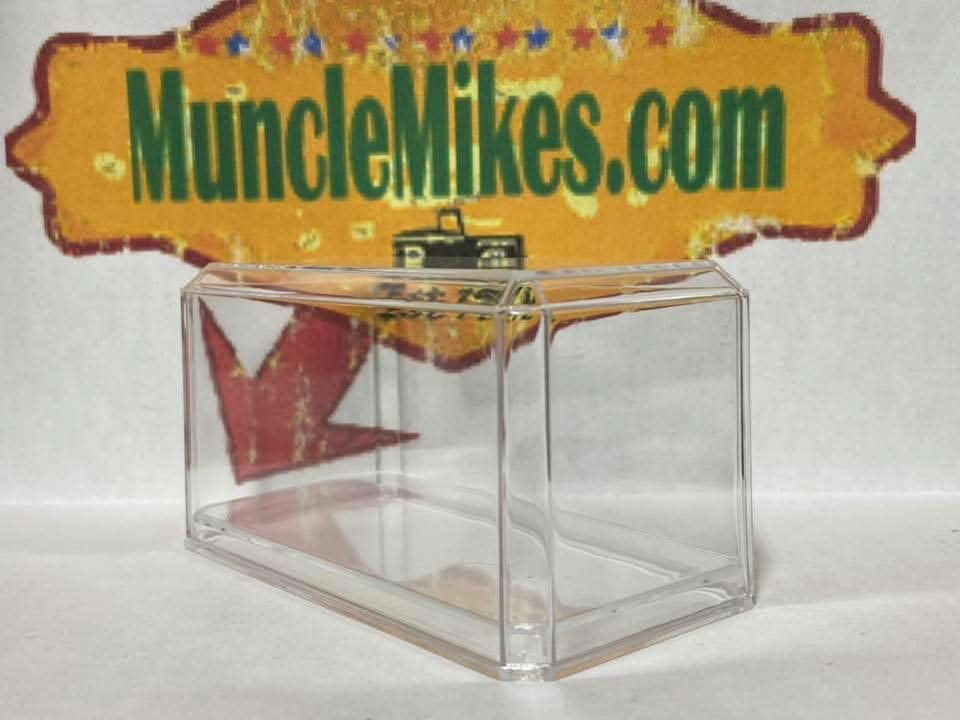
A single-car option from Muncle Mikes
The clear display case shown above has a stackable design and beveled edges. Its product description gives dimensions of 1¾ × 3¾ × 1⅝ inches and states that the car is not included.
Those measurements are not identified as internal in the listing. Check clearance for your particular casting, especially a long truck or a custom with different wheels. The offer does not document UV filtration, an airtight seal or controlled humidity.
Protection claims need a specification
Ask what the maker actually promises. A closed front can reduce direct handling and exposure, but “dust-resistant,” “sealed” and “UV-protective” are not interchangeable descriptions. Look for a documented feature rather than supplying it in your own collection record.
Prefer a listing that distinguishes usable interior clearance from outside dimensions. A measurement supplied for one case does not establish the clearance of a similar-looking product.
Check the viewing position and access
Place an empty sample in the intended location and check reflections from the normal viewing angle. Make sure opening a lid or door does not strike another case. Leave enough space to support the model while removing it.
For a cabinet, assign positions before filling every compartment. Keep labels outside contact with the car, and avoid adhesives on an original retail package. Decide whether the side profile, top view or packaging artwork should be the main display.
Keep display and bulk storage separate
A display holds the selection you want to see. Storage holds the rest in a way you can retrieve and document. Use the large-collection storage guide for capacity planning and the inventory workflow for location tracking.
For a wall installation, read the wall-display planning guide. A tabletop case should not be converted into a wall fixture without a suitable manufacturer-approved mounting design.
Choose the case around the car
Browse finished customs or packaged collectibles with the display format in mind. Measure first, check the exact contents and keep your favorite model accessible without making it part of a crowded stack.
Current display-case choices to compare
For a larger desktop collection, the MiJo Acrylitower 24-car spinner is built around multiple 1:64 cars. For one featured model, the MiJo single 1:64 collector display case uses a much smaller footprint. A two-tier acrylic riser is another option when dust protection is less important than making a row easier to see.
Capacity alone should not decide the purchase. Think about whether you want sealed dust protection, open access, wall/desktop placement and room for trucks or taller vehicles. Continue to the 1:64 case-capacity guide before sizing a larger display.
Compare display cases by the item they are protecting

Single loose-car case
1:64 crystal clear case
For an individual loose car when you want dust protection and easy viewing.

Card protectors
Sterling mainline protector 24-pack
For carded mainline-sized packages rather than loose-car display.


Larger scale
GreenLight 1:24 display case
A reminder that a case sized for 1:24 is not interchangeable with one intended for 1:64.

