

1992 Hot Wheels
1992 Hot Wheels Recycling Truck #143: Wheels, Condition and Buying Choices
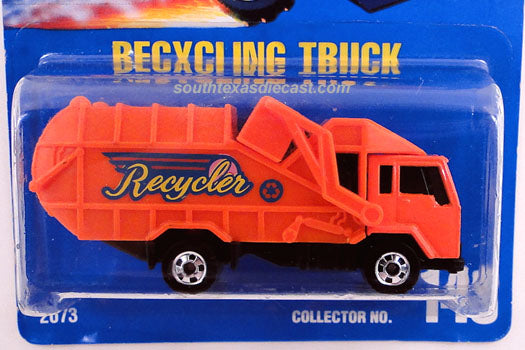
The 1992 Hot Wheels Recycling Truck #143 rewards a closer look at the wheels, side decoration and package. An orange truck with Recycler lettering is a useful starting point, but the same collector number appears on later versions. Match the complete configuration before choosing a particular release.
This guide separates that vintage Hot Wheels purchase from two other ways to collect refuse trucks: a finished New Ray Freightliner model and an AMT Ford assembly kit. They represent different vehicles and collecting activities.
Separate the product number from the collector number
Mattel’s 1968–2003 Vehicle List places item 2073, Recycling Truck, under 1992 Workhorses. The historical product number identifies the named item in that register. The 143 printed on the card is a collector number; it is not the year or a count of trucks produced.
The South Texas Diecast release catalog distinguishes these useful comparisons:
| Cataloged release | Body and decoration | Wheels |
|---|---|---|
| 1992, item 2073, #143 | Orange with multicolor Recycler graphics. | Blackwall, abbreviated BW. |
| 1995–1996, item 2073, #143 | Orange with the same named side decoration. | Seven-spoke, abbreviated 7SP. |
| 1997, item 2073, #143 | Bright green with sanitation markings. | Several cataloged wheel versions. |
The header photograph is the reference image linked from the catalog’s 1992 entry. It shows the orange truck on its blue #143 card. Photo: South Texas Diecast Collectors. Compare the wheel design on the actual truck you are offered; neither orange paint nor the card number settles the identification alone.
Inspect the body, arms and rear assembly
Start with an unobstructed view of each side. The lettering, ribbed refuse body and exposed lifting arms give you specific areas to compare. Ask for a rear view and an underside photograph before deciding that a truck is complete.
- Body and lettering: Look for rubbing across the Recycler graphic, marks along the cab and raised edges, and differences between the two sides. Glare through a blister can hide a scratch.
- Arms and attachment areas: Inspect thin sections, joints and the rear assembly for cracks, bends, missing pieces or adhesive. Ask which parts have been repaired or replaced.
- Wheels and base: Compare all four wheel faces, axle alignment and visible underside markings. Ask whether the truck rolls freely and whether any wheels or axles have been changed.
A molding seam is not proof that a part should move. Do not force an arm or rear section to demonstrate a function that has not been established for that exact model. A seller’s clear photographs and explanation are more useful than a strained mechanism.
Choose loose or carded condition deliberately
A loose example makes the underside and rear easier to examine. A carded example adds the printed identifiers, artwork and packaging condition to the decision. Request the full front and back, the hanger and corners, and the blister’s attachment area. The Hot Wheels packaging guide explains how to assess the card, blister and any separate outer protector.
Compare completed sales only after matching the release, wheel configuration, condition and packaging format. A damaged loose truck, a clean carded example and a mixed lot are different offers. Include delivery and keep disclosed repairs in the comparison; the old prices in a historical checklist are not a current appraisal.
Browse the loose Hot Wheels collection for other individual vehicles. The selection can include sold-out listings and does not guarantee an orange Recycling Truck #143; open each offer to check its actual identity and availability.
Choose a finished display model or a building project
If the working-truck subject matters more than the vintage Hot Wheels release, these two examples offer different paths. Compare the vehicle, scale, required work and display space before choosing one. Neither is a replacement part or an exact equivalent of #143.
New Ray Freightliner 114SD — finished model in 1:32

The current listing identifies NR11033 as a finished New Ray Freightliner 114SD garbage truck in 1:32 scale. Its three-axle layout and taller refuse body make a different display subject from the small orange Hot Wheels truck.
Use the actual listing to check the supplied packaging, current price and availability. Confirm dimensions and any opening or moving functions you need before choosing a shelf or case.
AMT Ford C-900 GarWood Load-Packer — kit in 1:25

The AMT1247 listing is a 1:25 Ford C-900 kit with a GarWood Load-Packer body. Round 2 identifies it as skill level 3 and says paint and glue are required. The photographed packaging also states that paint and cement are not included.
Read the kit instructions and confirm the exact box contents before planning materials. Allow room for the completed truck as well as a work area for construction; the finished model pictured on a box does not mean it arrives assembled or painted.
Questions before buying a Recycling Truck
Does #143 prove that a truck is from 1992?
No. Compare its wheels, decoration and available release information together. Keep a later version separate even when it uses the same collector number.
Does the reference photo prove another seller’s truck is original?
No. It provides a comparison. The offered truck still needs its own photographs and disclosure of replaced parts, repainting or package repairs.
Can I judge display fit from scale alone?
No. These trucks represent different vehicles. Measure the available shelf space and ask for the actual model’s length, width and height, including mirrors or other projections. A packaged display also needs room for the box or card.
Is the AMT option ready to display when it arrives?
It is an assembly kit. Choose it for the building project and plan the required materials; choose a finished model when that is the format you want.
Return to the 1992 Hot Wheels vehicle and program reference to place item 2073 among the year’s other documented vehicles.

