

News
Hot Wheels Super 6-Lane Raceway V1983: Buying & Setup Guide
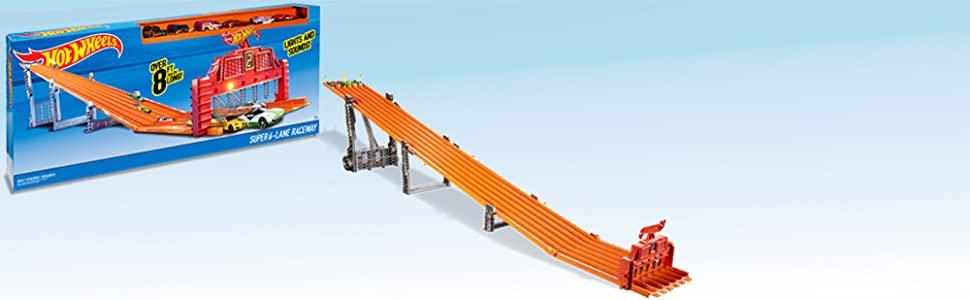
Direct answer: Before buying a Hot Wheels Super 6-Lane Raceway, verify the product number, measure more than the advertised track length, confirm the start and finish electronics work, inspect every folding joint and connector, and test the exact cars you plan to race. This guide covers Mattel product V1983, released in 2011. It is not a current Muncle Mikes stock offer for the Raceway.
Mattel’s customer-support record for V1983 identifies more than eight feet of track, six included Hot Wheels vehicles, a fair-start release, lights and sounds, a winning-lane announcement, folding storage, three AA/LR6 alkaline batteries, age guidance of 5 years and up, and a warning that some Hot Wheels vehicles are unsuitable. A differently numbered Super 6-Lane set may not have the same parts or instructions.
Watch the original Muncle Mikes Raceway video
The original MM video remains part of this article. Use it to understand the scale and racing format, then use the checks below for the exact secondhand set in front of you. The video is not a completeness guarantee or a timed comparison of every car.
Verified V1983 specifications
| Detail | Mattel V1983 record | What to verify on a used set |
|---|---|---|
| Product identity | Hot Wheels Super 6-Lane Raceway, product V1983, released in 2011. | Match V1983 on the box, instructions, or product markings before applying this checklist. |
| Track and start | More than eight feet of six-lane racing action with a fair-start release lever. | All lanes, joints, supports, and the release must be present, aligned, and able to move together. |
| Original cars | Six Hot Wheels vehicles; colors and decorations may vary. | Identify the cars actually included in the sale rather than assuming the original six remain. |
| Finish feedback | Lights and sounds announce the winner and illuminate the winning lane. | Request a demonstration of every lane and the finish display. |
| Storage | The track folds flat for storage and setup. | Inspect hinges, latches, cables, lane joints, and plastic near every folding point. |
| Power | Three AA/LR6 alkaline batteries. | Check the battery cover, terminals, corrosion, and whether the electronics were tested with fresh batteries. |
| Age and compatibility | Age 5 years and up; some Hot Wheels vehicles are unsuitable. | Follow the exact instructions and test the dimensions and rolling condition of each intended car. |
The product number matters because Mattel has used similar Raceway names for more than one release. Do not combine an instruction sheet, replacement part, or advertised specification from another product number with V1983 unless the manufacturer documentation confirms compatibility.
Measure the full racing area, not just eight feet
The track itself is only part of the space requirement. You also need room to operate the starting gate, reach both sides, retrieve cars beyond the finish, and walk around the set without stepping over lanes.
- Mark the proposed track path. Use removable tape or a measured string on the floor.
- Add start access. Leave room for racers to load six lanes without leaning on the structure.
- Add finish clearance. Keep the display visible and provide a safe area for cars leaving the finish.
- Check traffic through the room. Doors, furniture, pets, cords, and walking paths should not cross the track.
- Plan storage before buying. Confirm where the folded set, loose pieces, and race cars will live.
Ask a secondhand seller for the assembled footprint and folded dimensions of the exact set. A photographed tape measure is more useful than a guess based on the box.
Identify and inventory a used V1983 set
Begin with one photograph showing every included piece. Then compare the box, instructions, product number, lane sections, start assembly, finish display, supports, connectors, battery cover, and cars. Mark each item as present, missing, damaged, substituted, or untested.
Do not call a set complete merely because it can be assembled. A substituted support may hold the track for a photograph while preventing correct folding or lane alignment. Likewise, six random cars do not automatically become the six cars originally packaged with that example.
Use the same evidence discipline described in the Hot Wheels Service Center identification and completeness guide: identity, completeness, condition, and originality should be recorded separately.
Inspect folding joints, lanes, and connectors
Long track sections depend on consistent alignment. Examine each lane from the side and above. Look for raised joints, bowed sections, cracked tabs, stress whitening, warped plastic, missing supports, and repairs that change the lane surface.
Fold and unfold the set only according to the matched instructions. Stop if a joint binds or a cable, latch, or plastic hinge moves in a way that was not intended. Do not force brittle tabs simply to make the set appear complete.
Place the assembled set on a level, stable surface. A twisted frame or uneven floor can make one lane behave differently even when the cars are similar.
Test the starting gate fairly
The shared release is central to the six-lane format. Load the same type of test car into each lane and operate the release several times. Watch whether all six gates clear the cars together and whether any car catches on a divider or misaligned lane.
If one lane releases late, do not immediately blame the car. Inspect the gate, lane surface, joint, and loading position. Change one variable at a time and repeat the test.
Test the finish electronics and battery compartment
Request or perform a demonstration with fresh, correctly installed batteries:
- run a car through each lane independently;
- confirm the correct lane number lights;
- listen for the winner announcement and crowd sound;
- repeat several finishes to check for intermittent behavior; and
- inspect the battery compartment after testing.
Look for corrosion, missing contacts, a damaged cover, loose wires, heat damage, or improvised repairs. An untested finish display should be described and priced as untested—not assumed working because the plastic looks clean. Follow the manufacturer’s battery and safety instructions; do not improvise electrical repairs.
Choose cars that actually clear the track
Mattel’s V1983 record warns that some Hot Wheels vehicles are unsuitable. Check each car for:
- overall body width and parts that project beyond the wheels;
- very low noses, splitters, exhausts, or base details;
- unusually tall features that can contact the start or finish;
- wheels that rub the body or do not spin freely;
- bent axles, uneven tires, or excessive side play; and
- custom parts that change width, ride height, or rolling resistance.
Test one car gently before loading a complete field. For race candidates, browse loose Hot Wheels listed with individual photographs. The listing shows the exact collectible offered, but it is not a promise that the car has been track-tested.
Keep unopened collectibles separate from race cars unless opening them is your deliberate choice. The carded Hot Wheels collection is for comparing packaged examples and current availability, not a recommendation to open a particular release for racing.
Run a repeatable home comparison
- Use the same assembled track and surface. Do not change setup between recorded runs.
- Inspect every test car first. Confirm that wheels spin and nothing contacts the lane.
- Rotate lane assignments. A car should not stay in one lane for every run.
- Repeat enough times to see consistency. One win does not establish a fastest car.
- Record problems separately. Note false starts, collisions, stalls, finish errors, and visible contact rather than counting them as ordinary losses.
- Stop when the equipment behaves unexpectedly. Diagnose the lane, gate, car, or finish before continuing.
This process produces results for your own cars and your own V1983 set. It is not universal performance data and should not be presented as a ranking of every casting.
Compare the real delivered cost
A low asking price can become expensive after shipping a long, fragile set and sourcing missing parts. Compare:
- verified product number and included components;
- demonstrated electronics versus untested condition;
- cracks, repairs, warped track, and missing battery cover;
- original box and instructions, when those matter to you;
- the cars actually included;
- shipping method and protection for the folded track; and
- the cost and availability of confirmed-compatible replacements.
Compare completed sales only when the product number, condition, completeness, and delivered cost are genuinely similar. An active asking price is not proof of market value.
Store the Raceway without creating new damage
Remove batteries before long-term storage. Clean loose debris with a method suitable for the plastic and electronics, allow the set to dry, and fold it only as directed. Do not stack heavy items on the lanes, finish display, supports, or start mechanism.
Keep the instructions, battery cover, loose supports, and identified original cars together in labeled storage. Photograph the complete set before packing so missing pieces are easier to notice later.
Super 6-Lane Raceway questions
Is this guide for every Hot Wheels six-lane track?
No. It is centered on product V1983. Match the exact number before using the specifications or parts checklist.
Did V1983 originally include six cars?
Mattel’s support record says it included six Hot Wheels vehicles and notes that colors and decorations could vary. A used sale may include different cars or none at all.
Will every Hot Wheels car fit?
No. Mattel specifically warns that some vehicles are unsuitable. Test dimensions, clearances, and rolling condition on the exact set.
Does folding storage mean it fits a small room?
Not automatically. The set still needs more than eight feet of track plus access at the start, finish, and sides. Measure the open and stored positions.
Can I trust an untested finish display?
Treat it as untested. Ask for a fresh-battery demonstration of every lane or include the risk of electronic failure in the decision.
Is the Raceway in this article for sale?
No current Raceway offer is implied. This is an identification, buying, setup, and testing guide. Current car availability is shown separately in the linked collections.
Verify the set, measure the room, then build the lineup
V1983 can create a clear six-car race only when the track is complete, level, correctly assembled, and paired with cars that fit. Verify the product number, test the gate and finish, inspect every joint, and measure the entire play area before buying.
For questions about a currently listed car, contact Muncle Mikes. This guide was written by Mike Graves. Muncle Mikes is an independent reseller and collector resource and is not affiliated with or endorsed by Mattel.

