

Hot Wheels Gassers
Hot Wheels Gasser Stance Explained: Why the Nose Sits High
Muncle Mikes gasser guide · Updated September 21, 2026
Hot Wheels gassers sit nose-high to capture the look of classic drag racers. On the full-size cars, a raised chassis helped increase rearward load transfer under acceleration. On the diecast, the body, base, axle positions and tires create the stance—it is a styling feature, not a promise of faster track times.
The best starting point is the shape you like: a sharp ’55 Chevy coupe, a long-roof Nova wagon, a restrained wheel swap or a painted showpiece. Here is how to judge the proportions, understand what a wheel change actually does, and choose a finished car or your next build.
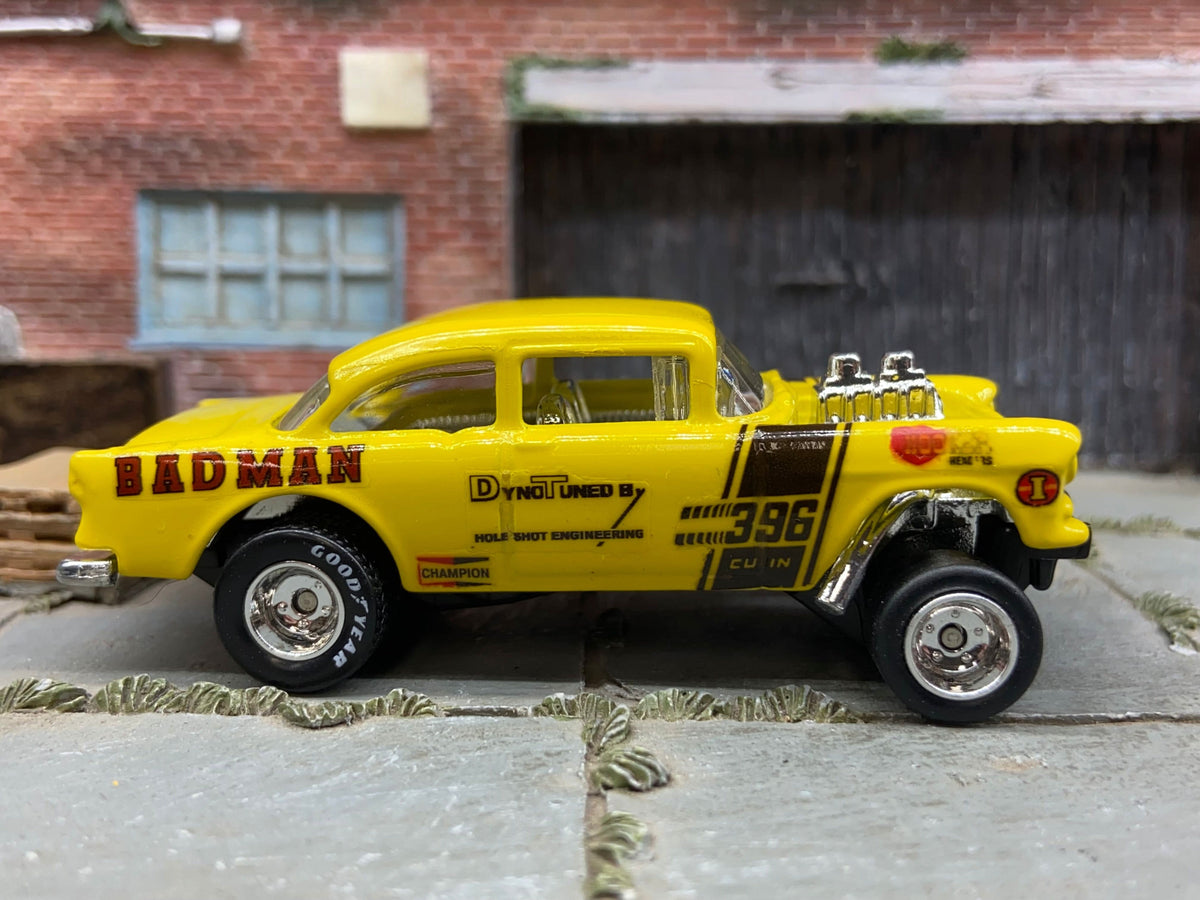
Cover build: yellow BADMAN custom ’55 Chevy gasser with Goodyear drag slicks. Open the listing for its full photo set, build details and current availability.
Why did real gassers have a high front end?
The name came from drag racing’s Gas Coupe and Sedan classes. Period builders used elevated suspension and engine placement to raise the center of gravity, encouraging more load onto the driven rear tires during a launch. Straight front axles and a tall profile became closely associated with the look.
That approach addressed the tire and chassis limitations of its time. It does not mean that raising a car farther always improves performance. Racing rules and designs changed, and not every historic gasser had the same nose angle or a rear end sitting close to the ground.
Historical background: Speedway Motors’ gasser history and stance explanation.
How Hot Wheels turns that drag-racing look into a casting
On a typical unpowered Hot Wheels car, stance is largely fixed by its construction. The axle centers sit in particular places relative to the base, the body mounts above that base, and the tire radius sets the axle’s height above a flat surface. Those relationships matter more than calling a wheel set “drag style.”
Ride height describes how far the car sits above the surface. Rake describes its front-to-rear tilt. A car can be high at both ends with little rake, or nose-high without the rear being unusually low. Side-to-side lean is a different issue again.
| Feature | Full-size drag car | Hot Wheels model |
|---|---|---|
| Nose-high profile | Part of a chassis and suspension setup. | Created by the casting, base, axle mounting and tires. |
| Rear tire grip | Helps transmit engine power to the track. | An unpowered toy has no engine driving its rear wheels. |
| Wheel choice | Selected for the vehicle’s operating requirements. | Must suit the wheel openings, axle fit, desired appearance and intended use. |
| Performance claim | Requires evidence from the actual car and setup. | Requires testing the actual toy on the intended track—not judging it by stance. |
Use the exact casting name when shopping. The ’55 Chevy Bel Air Gasser is a specific subject, not another name for every ’55 Chevy or the Big-Air Bel-Air. Likewise, check that a Nova listing is the wagon gasser you intended to buy. Mattel’s 2016 RLC ’55 Chevy Bel Air Gasser feature is one manufacturer reference for that named casting; its specifications belong to that release.
Compare finished custom Hot Wheels gassers
These Muncle Mikes listings show two different ways to build a gasser display: a blue Nova wagon with lettered tires, or a two-tone ’55 Chevy with gold wheels. Open each product’s photos to compare the complete build rather than deciding from one angle.

Blue Nova wagon gasser
Choose a long-roof body with Hot Wheels blue livery, blue five-star wheels and Hoosier rubber tires. Compare the wheel placement and finish in the listing’s additional photos.
View Nova build and current price
Pearl-white and copper ’55 Chevy
Choose a two-tone coupe with gold five-spoke race wheels and rubber tires. Compare its proportions with the Nova rather than assuming the same wheel set fits both castings.
View ’55 Chevy build and current priceThese are separate finished-custom listings, not a bundle or a factory chase set. Prices, included items and availability are shown on each product page. For other finishes, browse the full custom gasser collection.
How wheel size changes a Hot Wheels gasser’s stance
Tire width and tire diameter do different jobs
A narrow front tire can create a front-runner look without necessarily being smaller in outside diameter. Width affects the space needed beside the wheel; diameter affects clearance above it and the axle’s distance from the ground. Check both dimensions instead of choosing by the wheel’s spoke pattern alone.
Larger rear tires do not automatically lift the nose. With the same axle mounting, increasing rear tire diameter raises the rear axle relative to the ground. That can reduce an existing nose-up angle. Raising the front visually may instead require a different front tire diameter, axle location or body-to-base relationship.
A simple wheel-size example
Replacing a round tire with a 10 mm outside diameter with one measuring 12 mm increases its radius by 1 mm. On a flat surface, its axle center therefore sits about 1 mm higher—not 2 mm—before accounting for tire deformation or other changes.
This is an illustrative geometry example, not a measurement or fit recommendation for any product shown here.
Check fit before choosing a wheel set
Measure the tire’s outside diameter and width, the available wheel-well space, and the axle arrangement. Hub offset—the position of the wheel on its axle—can change clearance even when two tires have similar dimensions. Excessive width may contact the body or base; insufficient axle clearance may stop the wheels turning freely.
For a display build, choose the look and then verify the fit. For a rolling build, also check that all four wheels turn freely, sit squarely and clear the body under normal handling. Shop drag slick wheels and tires, or compare the broader Hot Wheels and Matchbox wheel selection. Neither collection implies universal fit.
What to look for when buying a nose-high custom gasser
Look for an intentional front-to-rear stance, not a car leaning to one side. Perspective can exaggerate the angle, so ask for a level side view and straight-on front and rear views. A dramatic pose is not a substitute for useful product photographs.
| View or detail | What to compare |
|---|---|
| Both side views | Compare the body angle, tire clearance and wheel position on each side. Look beyond the front wheel gap alone. |
| Front and rear views | Check for unexplained side-to-side lean, uneven wheel seating or a visibly bent axle. |
| Underside and assembly | Look for the stated modifications, secure body-to-base fit, loose components and anything that could interfere with the wheels. |
| Paint and graphics | Compare chips, finish quality, graphics and any disclosed wear. A good stance does not establish the condition of the whole car. |
| Rolling and intended use | Read any rolling notes. Ask about wheel rub and track suitability when those matter; do not infer them from rubber tires. |
| Included items | Confirm the exact car, accessories, packaging or display case. A finished custom, project car and DIY kit are different purchases. |
A wheel-swapped or repainted model should be sold as a custom. Its stance does not turn it into a factory RLC release or Super Treasure Hunt. For a fuller purchasing checklist, read the Hot Wheels gasser buyer’s guide.
Buy a finished gasser or build your own?
Choose a finished custom for a ready-made display
Start with finished custom Hot Wheels gassers when the paint, wheels and stance are already part of what you want. Compare the actual pictured build and its description. For other body styles, browse all finished custom Hot Wheels.
Choose a donor or DIY kit for a hands-on project
Starting with a casting already designed as a gasser can reduce the amount of stance conversion you need to plan. Compare loose Hot Wheels project cars with Build Your Own Hot Wheels DIY kits. Look for the exact casting and read the included-parts list; do not assume a kit contains wheels, tires or axles.
Choose wheels after checking the car
Plan the intended stance, measure the available space, and test-fit before final assembly. Avoid permanent axle or base changes until the wheel clearance is understood. Use the custom gasser build guide for the wider project and the gasser wheels and tires guide to compare styles. Follow tool and material safety instructions for any cutting, drilling or painting.
Hot Wheels gasser stance FAQ
Is the high front end a mistake?
Not necessarily. A nose-high profile can be intentional on a gasser casting or custom. Distinguish that front-to-rear angle from a loose base, bent axle or unexplained side-to-side lean.
Does a higher nose make a Hot Wheels gasser faster?
No speed advantage follows from appearance alone. An unpowered toy is not applying engine torque through rear slicks like a full-size drag car. Test the actual model on the intended track before making a performance claim.
Do gassers need a low rear end?
No single rear ride height defines every model. Judge the complete proportions against the casting or reference car you are trying to represent, and keep the wheels clear of the body.
What size wheels fit a ’55 Chevy Bel Air Gasser?
There is no single answer for every release or modified base. Check outside diameter, width, axle fit, hub position and wheel-well clearance. A wheel set’s label or spoke count is not enough to establish compatibility.
Will bigger rear drag slicks give me more nose-up rake?
Not by themselves. With unchanged mounting, a larger rear tire radius raises the rear axle from the surface and can make the car sit more level. Plan the front and rear together.
Are rubber-tire customs intended for racing?
Use the individual listing’s intended-use and rolling information. Rubber tires may be chosen for appearance, but their presence is not evidence of tested track performance. A display-focused custom should not be assumed to work on every track.
Which is easier for a first gasser purchase: a finished car or a kit?
A finished custom avoids the assembly work and lets you choose a completed appearance. A kit suits someone who wants the project itself and is prepared to select any separately required parts.
Find the gasser that fits your shelf
Choose the casting first, compare the stance and finish, then check the full listing. Start with the custom gasser collection for finished cars or DIY Hot Wheels kits for your next project.

