

Hot Wheels Gassers
Hot Wheels Gasser History: Drag Racing, Castings & Customs
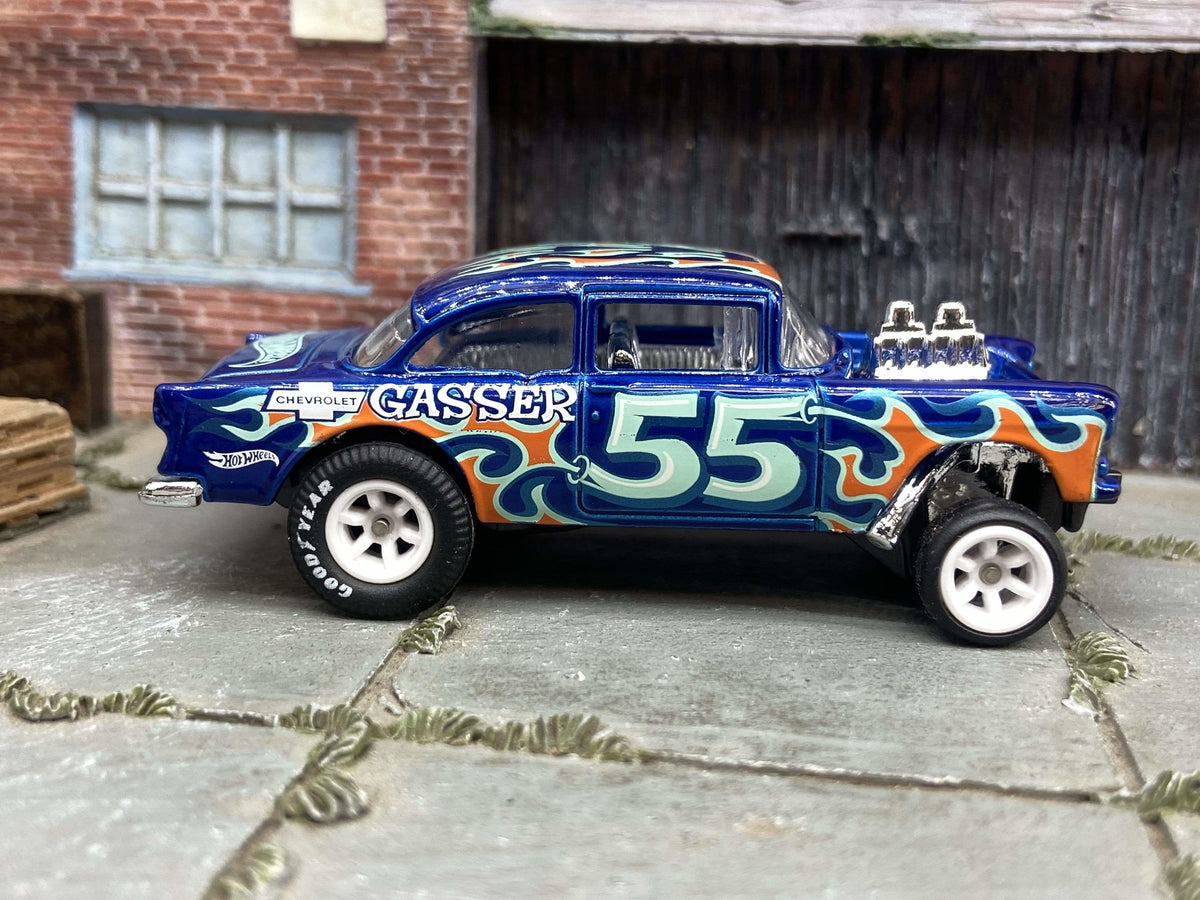
From the drag strip to your display
The history behind that nose-high Hot Wheels stance
Explore the racing roots of the ’55 Chevy Bel Air Gasser, Nova Wagon and other key castings—then choose a finished custom or your next DIY project.
Follow the timeline and learn how factory editions differ from hand-customized builds. The Bel Air is part of the story, not the beginning of the real racing class or the only casting worth collecting.
Article photographs show Muncle Mikes customs, not untouched factory releases or full-size historic race cars.
What was a real gasser?
“Gasser” grew out of the Gas Coupe & Sedan classes in 1950s and 1960s drag racing. These racers retained recognizable production-car shapes while their engines, weight and chassis setups changed. The Gas classes were organized around rules, including weight relative to engine displacement—not simply whether a car looked nose-high. [1]
The 1960s: recognizable bodies, serious racing
NHRA’s history of Stone, Woods & Cook describes its supercharged, gasoline-burning ’41 Willys and the mid-1960s rivalry with “Big John” Mazmanian and “Ohio George” Montgomery. These were fiercely competitive street-shaped racers, not merely show cars with oversized engines. That mix of familiar silhouettes and dramatic racing helps explain the appeal of the miniature style today. [2]
Why did gassers sit high at the front?
Period builders used raised chassis and engine positions to encourage rearward load transfer during acceleration, working around the tire and suspension limitations of their time. The silhouette became a signature of the era, but not every historically correct Gas-class car used the same stance. [1]
Style is not a rulebook. A straight axle, raised nose or big rear tires alone does not establish a car’s historical racing class. Factory Experimental cars and later street builds can share those visual features. [1]
For a diecast display, look at the complete proportions: front ride height, rear tire profile, exposed engine and body shape. A dramatic miniature stance is a styling choice—not proof it will roll faster on toy track.
Hot Wheels gasser history: key milestones
This timeline separates a car’s full-size model year from its Hot Wheels debut and from later special editions. It is a selection of milestones, not an every-variation checklist.
| Year | Milestone | Why it matters |
|---|---|---|
| 2001 | Morris Wagon | An early gasser-themed Hot Wheels example documented in the collector history. [3] |
| 2008 | Pass’n Gasser | Larry Wood’s hot-rod design joins the New Models lineup. [4] |
| 2011 | ’65 Mercury Comet Cyclone | The gasser-style Comet arrives in Hot Wheels Garage: Ford. [3] |
| 2012 | ’66 Chevy Super Nova | The HWC Series 11 Real Riders release adds a distinct Nova coupe to the story. [5] |
| 2013 | ’55 Chevy Bel Air Gasser | Brendon Vetuskey’s Bel Air casting enters the lineup. [3] |
| 2014 | Blue ’55 Gasser Super Treasure Hunt | Item BFF38 is a specific factory chase release, not the pink Candy Striper. [6] |
| 2015 | Original Candy Striper sale | Mattel dates its pink-and-white ’55 Gasser release to 2015. [7] |
| 2019 | ’64 Nova Wagon Gasser | The long-roof gasser debuts in HW Race Day. [8] |
| 2021 | HWC Triassic-Five ’55 Gasser | A detailed edition based on Vetuskey’s full-size build launches October 26. [9] [10] |
A 1955, 1964 or 1965 date in a casting’s name describes the vehicle represented. It is not that toy’s release year. Record the release, packaging and markings separately when identifying a purchase.
Five Hot Wheels gasser castings to compare
’55 Chevy Bel Air Gasser: the classic sedan shape
The 2013 Brendon Vetuskey design is the starting point for many modern Chevy gasser collections. [3] Its removed-hood look and prominent engine make wheel choices easy to see. On a custom, compare front and rear wheels independently; a repaint, replacement tires or altered base fasteners should be described as modifications, not passed off as a factory variation.
Our custom Hot Wheels Gasser collection includes ’55 Chevy builds alongside Nova customs. Check the individual casting and finish rather than assuming everything in the collection is the same car.
’64 Nova Wagon Gasser: a separate long-roof casting
This Brendon Vetuskey casting debuted in 2019’s HW Race Day series. The photographed first cyan release carries “JERRY-RIGGED” graphics; the wagon body, large exposed engine and exhaust behind the front wheels give it a different profile from the Bel Air. [8]
Do not substitute the standard ’64 Chevy Nova wagon or the ’66 Super Nova coupe when matching a listing. For a finished example, see our blue Nova Wagon Gasser with custom wheels and rubber tires.
’65 Mercury Comet Cyclone: the Mercury alternative
The gasser-style Comet predates the ’55 Bel Air casting, arriving in the 2011 Hot Wheels Garage: Ford series. [3] Choose it when you want a different body shape in a mostly Chevrolet display. Use the full casting name when shopping; a generic “Mercury Cyclone” result can describe another model or scale.
Check current ’65 Mercury Comet Cyclone listings.
’66 Chevy Super Nova: not the Nova wagon
Larry Wood designed the ’66 Chevy Super Nova, whose first HWC Series 11 Real Riders release appeared in 2012. [5] Treat its two-door body and its release history separately from the ’64 Nova Wagon Gasser. For collector editions, match the exact decoration, wheels and packaging before comparing prices.
Search ’66 Chevy Super Nova listings.
Pass’n Gasser: Larry Wood’s earlier hot-rod approach
Pass’n Gasser entered the 2008 New Models series, several years before the Bel Air. Its history includes both mainline and premium versions. [4] It is a useful reminder that “Hot Wheels gasser” describes a family of designs, not just one Chevrolet tool.
Check Pass’n Gasser listings. Casting searches can return related items; confirm the actual name, scale and version on the product page.
Super Treasure Hunt, Candy Striper and Triassic-Five are different releases
Learning the casting is only the first step. These three ’55 Gasser examples illustrate why paint, wheels, graphics and release identity must be checked together.
2014 Super Treasure Hunt
Item BFF38 is collector number 241/250: Spectraflame blue, Isky Racing Cams decoration, “TH” markings and Real Rider Mag wheels with Goodyear tires. It has a black plastic base. Rubber tires do not automatically imply a metal base. [6]
Original Candy Striper
Mattel identifies the pink-and-white pinstriped ’55 Chevy Gasser as a 2015 HWC release. It is not the blue 2014 Super Treasure Hunt. A custom using a similar pink paint scheme is also not the original factory edition. [7]
Triassic-Five
Mattel’s HGW21 edition reproduces Brendon Vetuskey’s full-size gasser in bright green with a white roof. It uses different front and rear Real Riders designs. Mattel also identifies a related 2022 mainline, which should not be confused with the more detailed HWC offer. [9]
Factory identity cannot be added with a wheel swap. A standard car fitted with rubber tires remains a custom. Buy an original collector edition for its documented factory specification, or a custom for the work and appearance you actually want.
For factory products, browse Hot Wheels factory releases and sets. For a finished hand-customized display car, start below.
From the Muncle Mikes shop
Shop finished custom Hot Wheels gassers
Compare three wheel-and-color combinations from our catalog. These are Muncle Mikes customs—not untouched Super Treasure Hunts, Candy Stripers or factory HWC editions. Open the listing for the current price, availability, complete photographs and included items.

Muncle Mikes custom
’55 Chevy Gasser · Blue
White six-spoke wheels and Goodyear-marked rubber tires give this blue Chevy a contrasting wheel-swap look. Compare all listing photos before choosing your display piece.
Shop the blue ’55 Gasser
Muncle Mikes custom
’64 Nova Wagon Gasser · Blue
Choose the long-roof shape with Hot Wheels blue livery, blue five-star wheels and Hoosier-marked rubber tires. This is a customized wagon, not a factory chase-car claim.
Shop the Nova Wagon Gasser
Muncle Mikes custom
’55 Chevy Gasser · Pearl & Copper
Pearl white and copper body colors pair with gold five-spoke wheels and rubber tires. Pick this combination for its finish and wheel style rather than a rarity label.
Shop the pearl-and-copper ’55Product photographs belong to the linked listings. A pictured display surface or a case is not automatically included. These links stay with the product as availability changes; the Gasser collection is the place to compare other builds.
Build your own gasser: choose the donor before the wheels
A gasser project works best when its proportions are planned together. Start with the casting you want, decide whether you are preserving the donor’s paint or changing its finish, and select wheels that clear the body and base. Do not alter a potentially scarce factory edition before identifying it.
Choose your project
Browse Build Your Own Hot Wheels DIY kits. Read the exact included-parts list. Do not assume a kit contains wheels, tires, axles, paint or tools unless the listing says so.
Measure the running gear
Before ordering replacement wheels and rubber tires, compare axle length, tire diameter, wheel width and body clearance. A “1:64” label is not a universal fitment guarantee.
Check the finished result
Look from the front, rear and both sides. Check that the car sits as intended and that the wheels do not rub. Keep original parts and photos where documenting the donor matters to you.
For a build walkthrough, read how to build a custom Hot Wheels gasser. Cutting and drilling require appropriate tools, eye protection and adult supervision for younger builders.
Not looking for a project? Explore more finished custom Hot Wheels with rubber tires instead.
What to check before buying a Hot Wheels gasser
Factory release or custom build?
Ask what was changed: wheels, axles, paint, decals, engine detailing or base fasteners. For a factory release, compare the exact version with a reference. For a custom, assess the actual workmanship. Neither the word “premium” nor an aftermarket screw proves a particular level of build quality.
Condition and display details
Look for paint chips, bent axles, tire rub, uneven stance, glue marks and damaged engine details. Request underside photos where the base matters. For packaged examples, inspect the card and blister; for loose customs, check whether a case or any extra parts are included.
Price and purpose
Compare dated completed sales for the same factory edition and condition, not an ordinary mainline against a special release. Evaluate a custom separately for its finish, parts and workmanship. An asking price is not a completed sale, and no gasser style comes with a guaranteed resale return.
Choose a display car for its appearance. Choose a track car only after checking its rolling behavior and clearance. Realistic rubber tires and an aggressive stance are not promises of faster runs. Ask about a specific Muncle Mikes build when those details affect your decision.
Keep exploring the Gasser guides
Take the next step with Gasser stance explained, casting identification, Gasser wheels and tires, and the Gasser buyer’s guide.
Hot Wheels gasser history questions
What does “gasser” mean?
It comes from the Gas Coupe & Sedan classes in drag racing. In diecast collecting, the term also describes miniatures inspired by that period’s race-car style. A raised front end alone is not a historical class definition. [1]
When did the ’55 Chevy Bel Air Gasser become a Hot Wheels casting?
In 2013. Brendon Vetuskey designed the casting; “1955” identifies the Chevrolet represented, not the Hot Wheels release year. Other gasser-themed castings appeared earlier. [3]
Is the ’64 Nova Wagon Gasser the same as the ’66 Chevy Super Nova?
No. The 2019 wagon and the 2012 Super Nova coupe are separate castings with different shapes and release histories. Use the complete casting name when comparing a purchase. [8] [5]
Is the Candy Striper the 2014 blue Super Treasure Hunt?
No. The blue Super Treasure Hunt is BFF38. Mattel dates the original pink-and-white Candy Striper sale to 2015. The similar underlying casting does not make them the same collectible. [6] [7]
Do all Hot Wheels gassers have rubber tires and metal bases?
No. Specifications depend on the release and any later modifications. The documented 2014 ’55 Gasser Super Treasure Hunt combines Real Riders with a plastic base, illustrating why those details must be checked separately. [6]
Was Triassic-Five based on a real car?
Yes. Mattel says HGW21 is based on designer Brendon Vetuskey’s full-size build. Check the exact HWC or mainline version when shopping rather than using the nickname alone. [9]
Are the cars pictured here factory collector editions?
No. The photographs show the linked Muncle Mikes custom products. They are presented as modified display builds, not as untouched factory chase cars or historic racing photographs.
Should I buy a finished gasser or a DIY kit?
Choose a finished custom gasser when you want a completed build. Choose a DIY Hot Wheels project when you want to do the work, then check which components and tools you need separately.
History and release references
Historical context comes from NHRA and Speedway Motors. Casting milestones use photographed collector studies, and named HWC editions use Mattel’s own release records. These sources establish identification and history; they do not establish current resale values.
- Speedway Motors: Gas-class origins, period stance and class distinctions.
- NHRA: Stone, Woods & Cook and the 1960s supercharged-gasser rivalry.
- Orange Track Diecast: early casting milestones and the 2011 Mercury Comet.
- Orange Track Diecast: Larry Wood’s Pass’n Gasser and its 2008 debut.
- Orange Track Diecast: photographed ’66 Chevy Super Nova releases.
- HWtreasure: the blue 2014 ’55 Chevy Bel Air Gasser Super Treasure Hunt.
- Mattel: retrospective identifying the original Candy Striper sale as 2015.
- Orange Track Diecast: the 2019 ’64 Nova Wagon Gasser debut.
- Mattel: Triassic-Five specifications and its full-size inspiration.
- Mattel: October 26, 2021 Triassic-Five launch.
Product details were checked against our Shopify catalog. Muncle Mikes is an independent diecast reseller and customizer, not affiliated with or endorsed by Mattel. This guide covers selected milestones rather than every factory variation.
Bring the drag-strip look to your collection
Choose the body shape, wheel setup and finish you will enjoy seeing on your shelf. Start with a completed custom or build your own version of the gasser look.

